Filmlexikon.
Support
Technovision
Camera · Terms

Technovision

Murnau AI illustration
flow para roll take

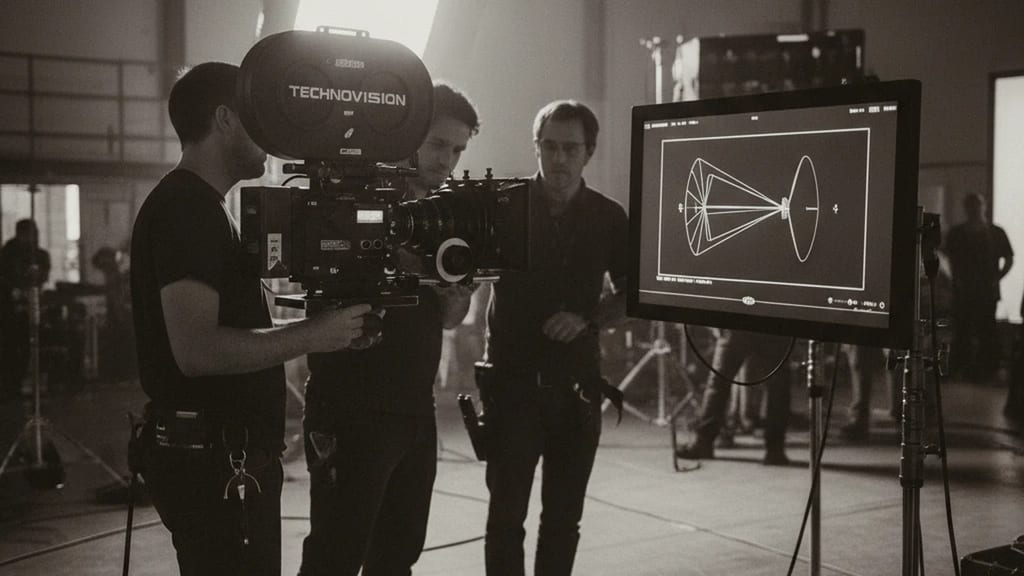
Italian anamorphic lens series (1965–1985) with distinctive blue lens flares and warm skin tone rendering; now available as Cooke Anamorphic/i.

Technical Details

Technovision lenses use cylindrical glass elements for horizontal compression and are available in focal lengths from 35mm to 200mm. The minimum focus distance for most focal lengths is 1.5 meters, and the T-stop ranges between T2.8 and T4. The system operates with a horizontal resolution reduction of approximately 50% during recording. The lenses weigh between 2.8 kg (35mm) and 4.2 kg (200mm) and feature a PL mount system. The close focus distance is, on average, 20 times the focal length.

History & Development

In 1965, the Italian company Technovision S.p.A. developed the system in response to the high licensing costs for Bausch & Lomb's CinemaScope lenses. Sergio Leone first used the lenses in 1966 in "For a Few Dollars More." In the 1970s, Joe Dunton licensed the lenses for his rental company and established them in the British market. In 2014, Cooke Optics took over production as the "Anamorphic/i" series, after the original production ceased in 1985.

Optical Characteristics

The lenses produce blue horizontal flares from light sources and lend skin tones a warm, slightly yellowish hue. In close-ups, the shallow depth of field creates a pronounced 3D effect. The oval-distorted bokeh enhances the horizontal image composition. Films such as "Once Upon a Time in the West" (1968), "Quadrophenia" (1979), and "The Dark Crystal" (1982) showcase these characteristic features.

Comparison to Other Systems

Panavision lenses offer higher T-stops (T2.8-11) but less distinctive optical characteristics. Zeiss Master Anamorphics deliver technically more precise results without the organic image quality of Technovision lenses. Cooke Anamorphic/i combines modern coatings with the classic look. Atlas Orion lenses are today the most cost-effective alternative.

From the crafts

Perspectives

Cinematographer

Die ovalen Bokeh-Kreise und horizontalen Flares der Technovision-Objektive geben mir sofort den klassischen 70er-Jahre-Look, den digitale Nachbearbeitung nie authentisch hinbekommt. Bei Schwenks muss ich wegen des höheren Gewichts stabilere Stativköpfe einsetzen, aber die warme Farbwiedergabe und der 3D-Pop bei Nahaufnahmen rechtfertigen den Mehraufwand.

Director

Technovision-Objektive transportieren automatisch Nostalgie und cinematische Größe – perfekt für Period-Pieces oder wenn ich bewusst eine analoge, "größere als das Leben" Ästhetik anstrebe. Die horizontalen Flares bei Gegenlicht verstärken emotionale Höhepunkte, während die ovalen Unschärfebereiche Charaktere vom Hintergrund isolieren und Intimität schaffen.

Producer

Ein Technovision-Set kostet 3.500€ pro Woche gegenüber 2.800€ für Standard-Anamorphics, rechtfertigt sich aber durch den unverwechselbaren Look ohne teure Post-Production-Filter. Die begrenzte Verfügbarkeit erfordert frühe Buchung, und ich muss stärkere Stative einkalkulieren, aber spare dafür bei der Farbkorrektur, da die Objektive bereits den gewünschten Vintage-Look liefern.

More in the lexikon

Related terms

Test your knowledge

Quiz

1. Zu welchem Department gehört „Technovision"?

2. Wie viele verschiedene Fachperspektiven bietet dieser Eintrag?

Report an error
From the Filmfarm ecosystem

Understand visual language, budget productions, connect crew.

The Lexikon is part of the Filmfarm ecosystem — alongside budgeting (FilmBalance), an industry magazine (FilmCircus) and crew networking (FilmCall, CrewMesh). One shared vocabulary for the whole production.

FilmFarm FilmRadarComing soonFilmPulseComing soonFilmNumbersComing soonFilmCapitalComing soonFilmLabComing soonFilmBalanceComing soonFilmCircusComing soon