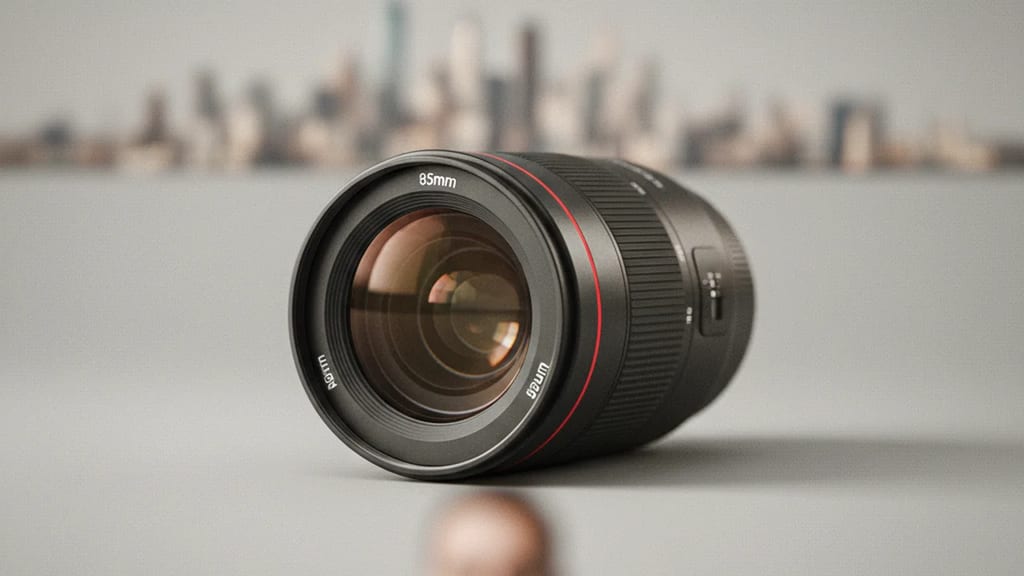
Focal length from 85mm with a narrow field of view and shallow depth of field — from the camera distance it requires, the planes appear closer together. Essential for portraiture and subject isolation.
Telephoto / Long Lens
With focal lengths of 85mm and above, the camera stands far back for the same framing — and from that distance, foreground and background visually move closer together. This is the core principle of the telephoto lens. On set, you notice it immediately: a 135mm or 200mm lens acts like a telescope: from far away, the scene moves closer together. Objects that are spatially far apart appear close together. This compression isn't a flaw, but your creative tool — use it consciously.
For portraits, the telephoto lens is your standard tool. An 85mm or 135mm lens flatters facial features because the camera stands one to two meters away and noses don't appear exaggeratedly large — wide-angle portraits, by contrast, look unflattering. You position yourself further away from the subject, yet still achieve a full-frame shot of the face. The psychological effect: a natural distance between camera and person, less discomfort. The shallow depth of field — this is also characteristic of the telephoto lens — allows for effortless background separation. At f/2.8 and 135mm on a 35mm sensor, your focus range is often less than 30cm. Ideal for a soft bokeh that draws focus to the face.
In practice, you need tripod stability. Longer focal lengths amplify camera movements — handheld shooting becomes critical from 85mm onwards, and serious work with telephoto lenses is almost always done on a tripod or gimbal. The lighting situation also becomes more demanding: wide apertures on telephoto lenses are rarely faster than f/2 or f/2.8, and these lenses are heavy and expensive. For dramatic close-ups, for narrative intimacy without physical proximity, for compressing space — the telephoto lens is your means. It appears intentional, almost voyeuristic. Shot from a distance, it compresses movement in action sequences, making everything feel crowded and intense. A car driving towards you appears more threatening at 200mm than at 35mm: from that far away, the gap barely seems to shrink even as it races closer.
Pay attention to focus accuracy: the depth of field is thin. Manageable with modern autofocus technology, but peak precision is required for manual focusing. Zoom telephotos offer practical flexibility, while prime telephotos are optically sharper and faster — choose based on production logic. The telephoto lens is not the eye; it's a machine that manipulates space.
Related terms
Quiz
1. Zu welchem Department gehört „Télé"?