Filmlexikon.
Support
Technocrane
Grip · Equipment

Technocrane

Murnau AI illustration
crane shot scorpio crane jimmy jib flow para roll

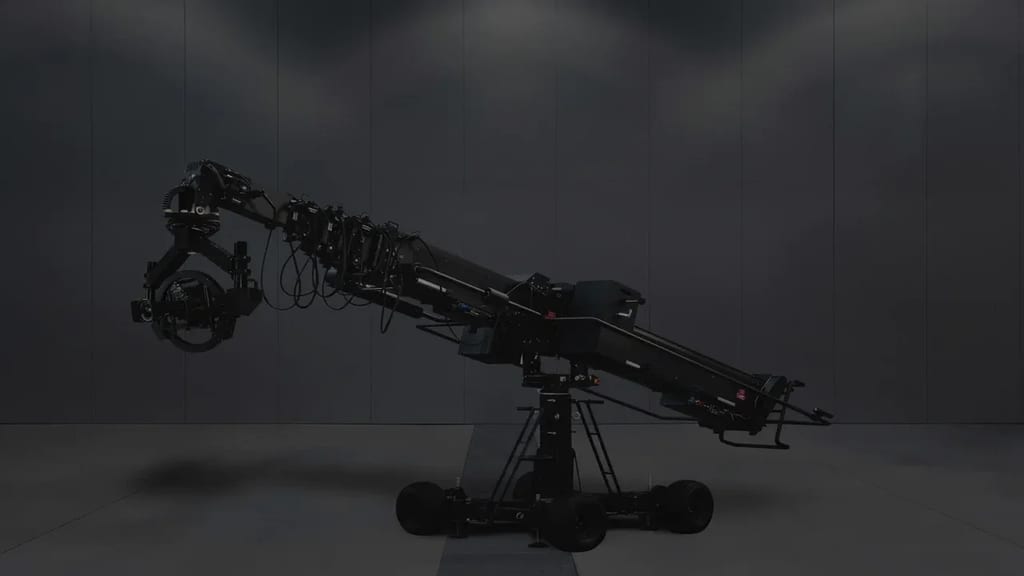
Telescopic crane by Filmotecnica with carbon fiber arm and Preston HotHead system for programmable, precision camera movements with 360° pan capability.

Technical Details

The Technocrane is based on a carbon fiber telescopic arm with stepless hydraulic extension. The standard arm weighs 180 kg, the counterweight system varies between 200-800 kg depending on the configuration. The Preston HotHead system allows for 360° pans with ±90° tilt with a precision of 0.1 degrees. Operation is via joystick controllers with programmable moves and a repeatability function. Setup time is 45-90 minutes depending on the model, and power is supplied by a 24V DC system.

History & Development

The Technocrane was developed in 1988 by Stanton Barrett and Filmotecnica in response to the limitations of conventional dolly cranes. Its first use was on "Terminator 2" (1991), where the precise repeatability of movements was crucial for VFX shots. In 1995, Filmotecnica integrated the Preston HotHead system, followed by the introduction of encoders for motion control applications in 2003. Since 2010, brushless motors and digital control systems have complemented the mechanical base.

Practical Use in Film

The Technocrane enables complex camera movements such as the iconic 360° orbit in "The Matrix" (1999) or the chase sequences in "Children of Men" (2006). Typical workflow: setup in the morning, blocking with the director, programming of key moves, followed by arbitrary repetition for multiple takes. The advantage lies in the combination of long reach and millimeter-precise repeatability – essential for VFX plates and complex choreographies. Disadvantages: high weight requires adequate floor load capacity and transport logistics.

Comparison & Alternatives

In contrast to conventional dolly cranes, the Technocrane offers telescopic extension and programmable moves. Jib arms achieve similar reach but without the precision of motion control capabilities. Modern alternatives include Bolt-Cinebot systems for extreme precision or drones for maximum freedom of movement. The Technocrane remains the standard for medium to large productions when repeatable moves with high load capacity are required, while gimbal systems dominate handheld applications.
From the crafts

Perspectives

Cinematographer

Ich schätze die millimetergenaue Wiederholbarkeit der programmierten Moves - essentiell für VFX-Plates oder wenn ich identische Kamerabewegungen für verschiedene Coverage-Einstellungen brauche. Das integrierte Gyro-System kompensiert Vibrationen, die bei 15-Meter-Extension normalerweise die Bildstabilität ruinieren würden. Der Hot-Head ermöglicht mir während der Fahrt präzise Korrekturen am Bildausschnitt, ohne dass ein zweiter Operator am Krankopf agieren muss.

Director

Die Technocrane eröffnet mir Erzählperspektiven, die mit statischen Setups unmöglich sind - ich kann die Kamera nahtlos von Bodenhöhe bis in 15 Meter Höhe führen und dabei komplexe Choreographien mit Schauspielern synchronisieren. Besonders wertvoll bei Enthüllungsmomenten, wo die Kamera eine neue räumliche Dimension erschließt oder bei Verfolgungsszenen, wo ich die Perspektive dynamisch zwischen Verfolgern und Verfolgten wechseln kann. Die programmierbare Wiederholbarkeit gibt mir die Sicherheit, verschiedene Intensitätsvariationen derselben Bewegung zu probieren.

Producer

Eine Technocrane kostet 1.500-2.500 Euro Tagesmiete plus Operator, dafür spare ich oft teure Aufbauten für Hochwinkel-Shots oder Drohnengenehmigungen bei komplexen urbanen Locations. Der 90-Minuten-Setup amortisiert sich ab drei programmierten Moves, da jeder Take identisch reproduzierbar ist - keine kostspieligen Wiederholungen wegen inkonsistenter Kamerabewegungen. Transportlogistik erfordert entsprechende LKW-Kapazität und Kranwagen für schwer zugängliche Locations.

More in the lexikon

Related terms

Test your knowledge

Quiz

1. Was beschreibt „Technocrane" am besten?

2. Zu welchem Department gehört „Technocrane"?

3. Wie viele verschiedene Fachperspektiven bietet dieser Eintrag?

Report an error
From the Filmfarm ecosystem

Understand visual language, budget productions, connect crew.

The Lexikon is part of the Filmfarm ecosystem — alongside budgeting (FilmBalance), an industry magazine (FilmCircus) and crew networking (FilmCall, CrewMesh). One shared vocabulary for the whole production.

FilmFarm FilmRadarComing soonFilmPulseComing soonFilmNumbersComing soonFilmCapitalComing soonFilmLabComing soonFilmBalanceComing soonFilmCircusComing soon