Filmlexikon.
Support
Superimposition
Editing · Terms

Superimposition

Murnau AI illustration
superimpose super overlap ueberblendung trim intercutting

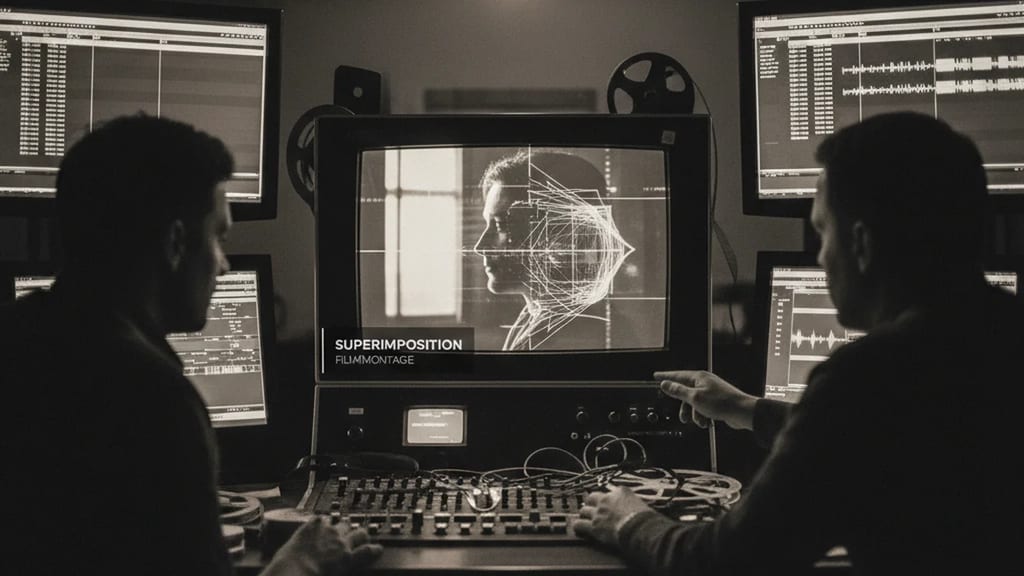
Overlaying two images with transparency—achieved optically during exposure or digitally via compositing with reduced opacity values.

Technical Details

In analog 35mm film technology, superimposition is achieved by deactivating the automatic film transport after the first exposure. The Canon F-1 camera enabled this via a multiple exposure switch, while modern digital cameras simulate the effect by overlaying RAW files with blending modes such as "Screen" or "Multiply." The exposure time remains constant, while ISO values are halved or the aperture is closed down by f/1.4. In post-production, alpha channels with 50% transparency are overlaid, with the luminance values of the pixels being mathematically added.

History & Development

The first documented superimposition was created in 1860 by photographer Hippolyte Bayard. In cinema, Georges Méliès established the technique in 1898 in "L'Homme de têtes" for ghost effects. In 1920, Fritz Lang developed narrative superimposition in "Der müde Tod" for dream sequences. With the introduction of Technicolor cameras in 1932, multiple exposure became more complex, as each color layer had to be exposed separately. Digital post-processing from the 1990s onwards largely replaced in-camera techniques with software compositing.

Practical Use in Film

Orson Welles used superimpositions in "Citizen Kane" (1941) for the mirror scene in Xanadu to visualize Kane's fragmented psyche. Ingmar Bergman employed the technique in "Persona" (1966) to merge the faces of Liv Ullmann and Bibi Andersson. Modern productions such as "Blade Runner 2049" (2017) use digital multiple exposure for memory sequences, overlaying 4K footage in DaVinci Resolve with Fusion modes. The workflow requires precise camera positioning, as subsequent corrections reduce image quality.

Comparison & Alternatives

Superimposition differs from dissolve (crossfade) by simultaneous rather than time-delayed image presentation. Composite shots use separate takes, while true superimposition utilizes identical film sections. Modern CGI ghost effects replace classic superimposition with greenscreen compositing, offering more precise control over opacity and masking. Split-screen displays multiple images side-by-side; superimposition completely overlays them.
From the crafts

Perspectives

Cinematographer

Ich plane Doppelbelichtungen bereits beim ersten Setup, da die Kameraposition millimetergenau reproduzierbar sein muss – verwende ich Stativmarkierungen und notiere Brennweite plus Fokusabstand. Die kritische Herausforderung liegt in der Belichtungsmessung: beide Motive müssen so belichtet werden, dass die addierte Helligkeit nicht clippt, weshalb ich mit Falschfarbendarstellung am Monitor arbeite.

Director

Doppelbelichtung nutze ich gezielt für psychologische Momente – Erinnerungen, die sich überlagern, oder innere Konflikte, die visuell manifest werden. In "Lost Highway"-artigen Narrativen verschmelze ich Charaktere durch Gesichtsdoppelbelichtungen, um Identitätsverlust zu externalisieren. Timing ist entscheidend: der Effekt muss motiviert wirken, nicht wie technische Spielerei.

Producer

Doppelbelichtungen verlängern Drehtage um 20-30%, da jede Einstellung mindestens zweimal gefahren werden muss – bei analogem Material bedeuten Fehlversuche direkten Rohstockverlust. Digital spare ich Filmkosten, brauche aber zusätzliche Post-Production-Stunden für sauberes Compositing. Kalkuliere zwei extra VFX-Artistentage pro zehn Doppelbelichtungseinstellungen und teste kritische Shots vorab im Previs.

More in the lexikon

Related terms

Test your knowledge

Quiz

1. Was beschreibt „Doppelbelichtung" am besten?

2. Zu welchem Department gehört „Doppelbelichtung"?

3. Wie viele verschiedene Fachperspektiven bietet dieser Eintrag?

Report an error
From the Filmfarm ecosystem

Understand visual language, budget productions, connect crew.

The Lexikon is part of the Filmfarm ecosystem — alongside budgeting (FilmBalance), an industry magazine (FilmCircus) and crew networking (FilmCall, CrewMesh). One shared vocabulary for the whole production.

FilmFarm FilmRadarComing soonFilmPulseComing soonFilmNumbersComing soonFilmCapitalComing soonFilmLabComing soonFilmBalanceComing soonFilmCircusComing soon