Filmlexikon.
Support
Stunt Prop
Art Department · Terms

Stunt Prop

Murnau AI illustration
rubber prop stunt pad stunt

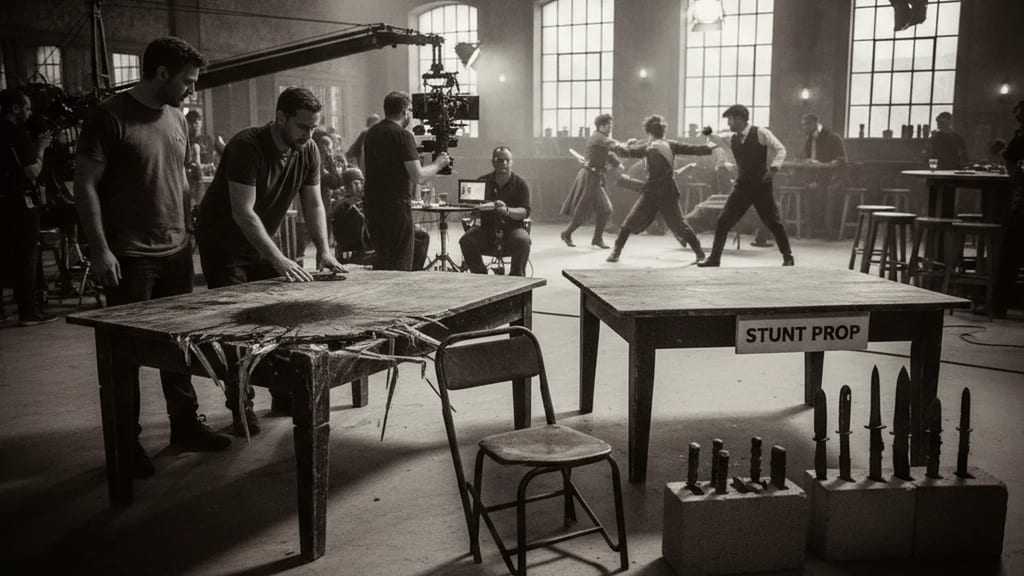
Safety-engineered film props designed to break reliably during stunts: sugar glass, breakaway furniture with predetermined fracture points, or soft props made from polyurethane foam.

Technical Details

Breakaway furniture uses predetermined breaking points with defined breaking forces of 15-30 Newtons. Sugar glass (isomalt-based) melts at 145°C and shatters into blunt fragments with edge angles under 30°. Stunt bottles made of wax have a breaking strength of a maximum of 2 Joules of impact energy. Soft props made of polyurethane foam achieve Shore hardnesses between 20A-40A. Collapsible structures utilize magnetic connections or spring mechanisms with release forces of 50-200 Newtons.

History & Development

In 1903, Edwin S. Porter first used prepared wooden crates in "The Great Train Robbery." In 1927, Bud Westmore developed the first sugar glass for Universal Studios. In the 1960s, Hal Needham introduced pneumatic breakaway systems. In 1995, Digital Domain revolutionized hybrid practical props with "Waterworld," combining real destruction with CGI enhancements. Since 2010, modern 3D printing methods have enabled custom-made predetermined breaking points with millimeter-precise fragmentation.

Practical Use in Film

"Raiders of the Lost Ark" (1981) utilized 47 different breakaway versions of the golden idol. For "The Matrix" (1999), the props department crafted 200 identical sugar glass windows with uniform breaking characteristics. In "John Wick" (2014), the stunt crew used balsa wood furniture with integrated air cushions for safe breakthroughs. Each prop is produced in sets of 6-12 identical copies, as retakes require multiple passes. Stunt coordinators test each prop beforehand with crash test dummies at defined impact speeds.

Comparison & Alternatives

Stunt props differ from hero props through their single use and reduced detail accuracy. CGI destruction has increasingly replaced practical breakaways for large-scale destruction since 2000, but costs $15,000-$50,000 per scene versus $200-$2,000 for practical props. Pneumatic rigs enable reusable destruction effects but require air connections and 2-3 technicians. Hybrid approaches combine real breakaway props in the foreground with digital destruction in the background for maximum credibility at controlled costs.
From the crafts

Perspectives

Cinematographer

Ich plane Stunt-Requisiten immer mit erhöhter Framerate – mindestens 48fps für saubere Slow-Motion der Fragmentierung. Das Zuckerglas reflektiert anders als echtes Glas, deshalb teste ich vorab die Lichtbrechung und justiere meine Keylight-Position um 10-15 Grad nach links. Bei Breakaway-Möbeln verwende ich längere Brennweiten ab 85mm, um Splitter außerhalb des Sicherheitsbereichs zu filmen.

Director

Ich setze Stunt-Requisiten gezielt für emotionale Beats ein – das zerbrechende Familienporträt verstärkt die Trennung, der kollabierte Stuhl zeigt Charakterschwäche physisch. In der Probenphase lasse ich Schauspieler erst mit Standard-Props arbeiten, dann mit den finalen Breakaways, damit sie die unterschiedliche Haptik internalisieren. Ich filme jeden Stunt-Prop-Moment aus drei Winkeln, da Wiederholungen die Spontaneität der Zerstörung verlieren.

Producer

Ich kalkuliere grundsätzlich das Dreifache der geplanten Stunt-Props ein – für Proben, Takes und Sicherheit. Ein Breakaway-Tisch kostet 800€, aber ein verletzter Darsteller bedeutet Drehtage-Verzug für 15.000€ täglich. Ich koordiniere die Herstellung 4 Wochen vor Drehbeginn, da Spezial-Materialien wie temperaturstabiles Zuckerglas 10-14 Tage Lieferzeit haben. Meine Versicherung reduziert die Prämie um 12%, wenn zertifizierte Stunt-Props verwendet werden.

More in the lexikon

Related terms

Test your knowledge

Quiz

1. Zu welchem Department gehört „Stunt-Requisite"?

2. Wie viele verschiedene Fachperspektiven bietet dieser Eintrag?

Report an error
From the Filmfarm ecosystem

Understand visual language, budget productions, connect crew.

The Lexikon is part of the Filmfarm ecosystem — alongside budgeting (FilmBalance), an industry magazine (FilmCircus) and crew networking (FilmCall, CrewMesh). One shared vocabulary for the whole production.

FilmFarm FilmRadarComing soonFilmPulseComing soonFilmNumbersComing soonFilmCapitalComing soonFilmLabComing soonFilmBalanceComing soonFilmCircusComing soon