Filmlexikon.
Support
Symmetry
Art Department · Terms

Symmetry

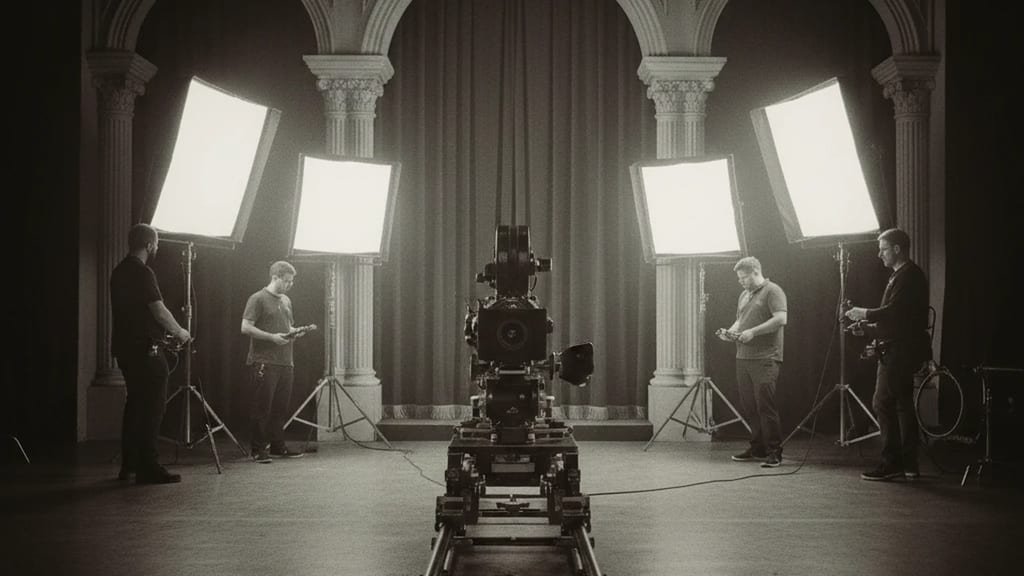
Murnau AI illustration
asymmetry balance color scheme

Frame composition with precise mirror symmetry along vertical or horizontal centerline. Requires exact camera positioning and extends shoot time by 15–30%.

Technical Details

Horizontal symmetry uses the vertical centerline of the sensor at 50% of the image width as the axis of reflection. In standard cinema formats (2.39:1), this is at 1024 pixels from the left at 2K resolution (2048×858 pixels). Vertical symmetry uses the horizontal centerline at 50% of the image height. Perfect symmetry requires millimeter-precise camera positioning, where even a 2-3mm deviation can destroy the effect. Modern cameras use grid overlays with 3×3 or 9×9 grids for precise alignment. Lens distortions, especially with wide-angle lenses under 24mm, can falsify symmetry at the image edges and require digital corrections in post-production.

History & Development

Symmetrical image composition originates from Renaissance painting and was already used in Georges Méliès' studio films from 1896. Fritz Lang perfected architectural symmetry in "Metropolis" (1927), Orson Welles used it for psychological effect in "Citizen Kane" (1941). Stanley Kubrick established symmetry as a trademark from the 1960s onwards, especially in "2001: A Space Odyssey" (1968) with a centripetal arrangement of the space station shots. Digital image processing since the 1990s has enabled post-production symmetry corrections that were impossible analogously.

Practical Application in Film

Wes Anderson uses an average of 40-60 perfectly symmetrical shots in every film, combined with static camera work and centered object placement. Kubrick's "The Shining" (1980) uses symmetry for a menacing atmosphere – the famous hotel corridor shot shows an exact reflection during a 237-meter Steadicam movement. Denis Villeneuve employs radial symmetry for the alien ships in "Arrival" (2016), enhanced by 360° camera movements. Setting up symmetrical shots increases shooting time by 15-30% because every image element must be positioned with millimeter precision.

Comparison & Alternatives

Asymmetrical composition according to the rule of thirds creates dynamic tension rather than static calm. The Golden Spiral offers a more organic image division than strict axial symmetry. Pseudo-symmetry uses similar but not identical elements on both sides of the axis for a more natural effect. Modern film language often favors deliberately broken symmetry – slight shifts of 5-10% create subtle unease without complete loss of symmetry.

From the crafts

Perspectives

Cinematographer

Ich arbeite mit Laser-Wasserwaagen und digitalen Grid-Systemen, um millimetergenaue Symmetrie zu erreichen - schon 3mm Abweichung ruiniert den Effekt komplett. Bei Weitwinkelobjektiven unter 24mm muss ich Barrel-Distortion einkalkulieren, die perfekte Linien an Bildrändern krümmt. Symmetrische Shots benötigen dreifache Setup-Zeit, da jedes einzelne Requisit exakt gespiegelt werden muss.

Director

Ich setze Symmetrie gezielt für psychologische Wirkung ein - perfekte Balance erzeugt Unnatürlichkeit und kann Unbehagen auslösen, wie in Kubricks Horror-Sequenzen. Zentrale Figurenplatzierung verstärkt deren narrative Bedeutung und isoliert sie visuell von der Umgebung. Bei Dialogen breche ich bewusst die Symmetrie, um Machtverhältnisse oder emotionale Distanz zu visualisieren.

Producer

Symmetrische Einstellungen verlängern meine Drehtage um 20-30%, da das Lighting-Setup doppelt so komplex wird - jede Lichtquelle muss gespiegelt werden. Set-Decoration kostet das 1,5-fache, weil alle Requisiten symmetrisch angeordnet werden müssen. In der Post spare ich jedoch Geld, da weniger kreative Color-Correction nötig ist - symmetrische Bilder wirken bereits "fertig komponiert".

More in the lexikon

Related terms

Test your knowledge

Quiz

1. Zu welchem Department gehört „Symmetrie"?

2. Wie viele verschiedene Fachperspektiven bietet dieser Eintrag?

Report an error
From the Filmfarm ecosystem

Understand visual language, budget productions, connect crew.

The Lexikon is part of the Filmfarm ecosystem — alongside budgeting (FilmBalance), an industry magazine (FilmCircus) and crew networking (FilmCall, CrewMesh). One shared vocabulary for the whole production.

FilmFarm FilmRadarComing soonFilmPulseComing soonFilmNumbersComing soonFilmCapitalComing soonFilmLabComing soonFilmBalanceComing soonFilmCircusComing soon