Filmlexikon.
Support
ND Filter
Camera · Equipment

ND Filter

Murnau AI illustration
15lb sandbag 20 c stand 216 diffusion 250 diffusion 251 diffusion 25lb sandbag 35lb sandbag 40 c stand

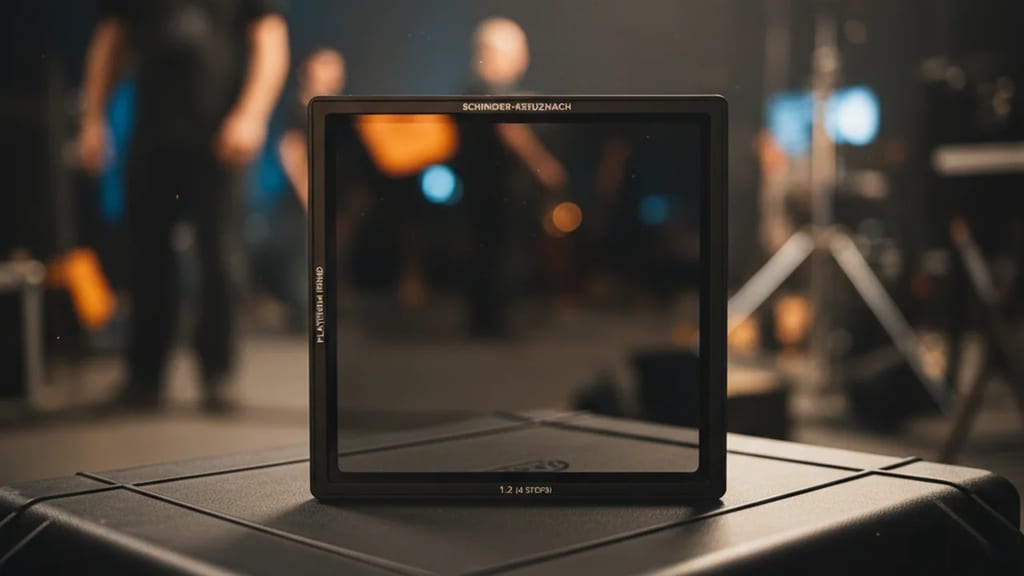
Neutral density filter uniformly reduces all wavelengths of light, allowing wider apertures or longer exposures in bright conditions.

Technical Details

ND filters are made of optical glass with vapor-deposited metal particles or dyed materials. Fixed filters offer reduction values from ND 0.3 to ND 3.0 (10 stops). Matte box systems use 4x4" or 4x5.65" filters, while round filters for DSLR lenses measure 77mm to 95mm in diameter. IRND (Infrared Neutral Density) filters additionally block infrared light, preventing color shifts on digital sensors. Variable filters produce X-pattern artifacts at extreme settings due to crossed polarization planes.

History & Development

Photographic ND filters have existed since the 1930s for long exposures. Tiffen developed the first professional cine ND filters in 1952 for Hollywood productions. The breakthrough for digital cinematography came in 2008 with the first IRND filters from Schneider Optics, which eliminated color shifts on RED and Canon cameras. Variable ND filters became established from 2010 onwards for DSLR film productions, with Singh-Ray and later Polar Pro shaping the market.

Practical Use in Film

Roger Deakins used heavy ND filters for daylight scenes in "Blade Runner 2049" (2017) to shoot at an open aperture of f/1.4 and create extreme bokeh. In "Mad Max: Fury Road" (2015), ND 1.2 filters allowed cinematographer John Seale to use a 180° shutter in bright daylight for natural motion blur. Variable ND filters speed up run-and-gun shoots as filter changes are not necessary. Strong ND filters (6+ stops) combined with long shutter speeds create motion streaks for moving cars or flowing water.

Comparison & Alternatives

Polarizing filters reduce light by 1-2 stops but selectively affect reflections and contrast. Electronic ND filters like Atomos' ND system use LCD technology but do not achieve the optical quality of glass filters. Digital exposure correction in post-production is not an alternative, as it amplifies image noise and loses highlight details. Graduated ND filters have a gradient and are suitable for landscape shots with bright skies. While inexpensive variable filters under €200 cause color casts, professional filters starting at €800 offer neutral color reproduction.

From the crafts

Perspectives

Cinematographer

Ich setze feste ND-Filter für kritische Szenen ein, da sie keine Farbverschiebungen verursachen und schärfer abbilden als variable Filter. Bei Handheld-Drehs verwende ich trotzdem Variable NDs, weil der Zeitgewinn beim Filterwechsel die leichten optischen Nachteile aufwiegt. Für extreme Unschärfe-Effekte kombiniere ich ND 1.8 mit f/1.4 und kann so auch bei Mittagssonne cineastische Tiefenschärfe erreichen.

Director

ND-Filter ermöglichen mir traumähnliche Sequenzen durch extreme Unschärfe bei Tageslicht, ohne dass die Kamera übersteuert. Für emotionale Wendepunkte lasse ich oft mit offener Blende und schwerem ND drehen - das isoliert die Charaktere visuell vom Hintergrund. Bei Actionszenen nutze ich die Filter, um auch bei hellem Licht den 180°-Shutter zu halten und natürliche Bewegungsunschärfe zu erzielen.

Producer

Ein Satz hochwertiger ND-Filter kostet 3000-5000€, spart aber täglich 30-45 Minuten Drehzeit gegenüber ständigen Beleuchtungsanpassungen. Variable Filter reduzieren die Anzahl benötigter Kameraassistenten, da weniger Filterwechsel nötig sind. Bei internationalen Koproduktionen standardisiere ich auf 4x5.65" Filter, da diese weltweit verfügbar sind und Mietkosten für lokale Ausrüstung senken.

More in the lexikon

Related terms

Test your knowledge

Quiz

1. Was beschreibt „ND-Filter" am besten?

2. Zu welchem Department gehört „ND-Filter"?

3. Wie viele verschiedene Fachperspektiven bietet dieser Eintrag?

Report an error
From the Filmfarm ecosystem

Understand visual language, budget productions, connect crew.

The Lexikon is part of the Filmfarm ecosystem — alongside budgeting (FilmBalance), an industry magazine (FilmCircus) and crew networking (FilmCall, CrewMesh). One shared vocabulary for the whole production.

FilmFarm FilmRadarComing soonFilmPulseComing soonFilmNumbersComing soonFilmCapitalComing soonFilmLabComing soonFilmBalanceComing soonFilmCircusComing soon