Filmlexikon.
Support
Split Screen
Editing · Terms

Split Screen

Murnau AI illustration
split screen 2 multi screen split edit intercutting pan and scan 2 substitution splice

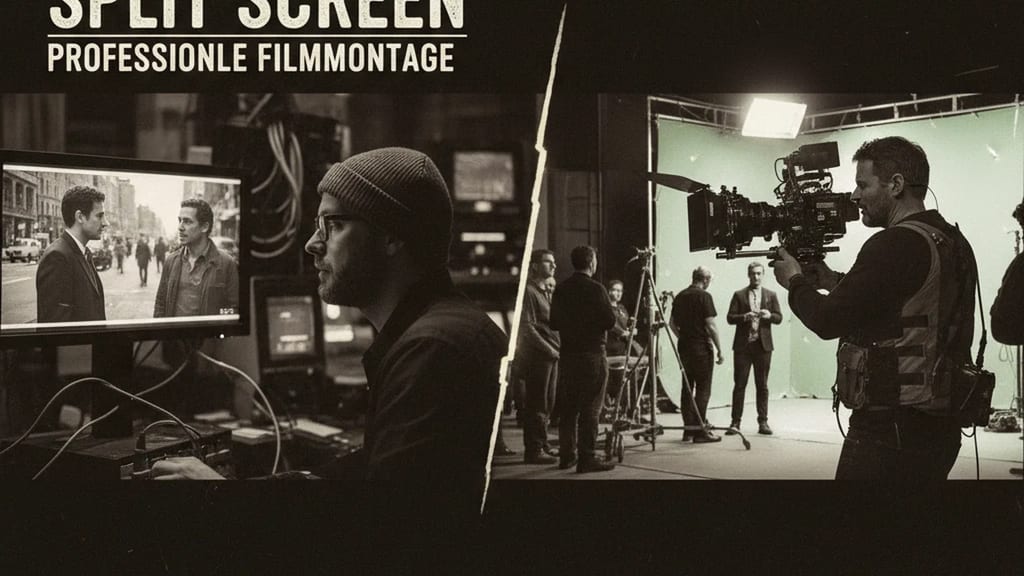
Simultaneous display of multiple actions by dividing the screen into separate fields—created through multiple exposure or digital pixel boundaries.

Technical Details

Split screens are created through multiple exposures of 35mm film with precise masks or, since the 1970s, through optical printers. With a vertical split, the left half of the image is exposed first with the right side masked, and then vice versa. Modern digital systems work with exact pixel boundaries – with 4K material (4096×2160), a vertical split results in two fields of 2048×2160 pixels each. Common variations include: double split (vertical/horizontal), quad grid, asymmetrical splits (70:30), or triptych arrangements with three fields.

History & Development

Abel Gance first systematically used split screens in 1927 in "Napoleon" with his triptych process on three 35mm screens. Brian De Palma perfected the technique in the 1970s with "Carrie" (1976) and "Dressed to Kill" (1980), where he showed up to four simultaneous storylines. The TV series "24" (2001-2010) established the multi-split as a trademark with up to six simultaneous windows. Quentin Tarantino revived the classic double split for phone conversations in 2003-2004 with "Kill Bill."

Practical Application in Film

Phone conversations show both participants simultaneously without cut-aways – as in "Pillow Talk" (1959) or "Kill Bill Vol. 1." Parallel actions intensify tension: in "Carrie," prom preparations overlap with the revenge plan. "24" used splits for real-time storytelling over 24 hours. The workflow requires a precise planning phase, as both image parts must be composed equally. Disadvantage: the reduced image size per storyline can dilute details.

Comparison & Alternatives

Picture-in-Picture overlays a smaller image onto the main image, while Split Screen creates fields of equal value. Cut-away editing shows the same content sequentially rather than simultaneously. Multi-cam setups provide the raw material for splits but are not identical to the final image composition. Modern VR productions use 360° splits for spatial storytelling. Widescreen formats favor horizontal division (2.35:1), while 16:9 material is usually divided vertically.
From the crafts

Perspectives

Cinematographer

Ich muss beide Bildfelder gleichzeitig perfekt belichten und komponieren – das halbiert meine Gestaltungsfläche pro Handlung. Bei praktischen Splits am Set verwende ich Masken vor der Linse und plane exakte Markierungen für die Trennlinie, damit in der Post keine Überlappungen entstehen. Die Herausforderung liegt darin, dass beide Kamerawinkel dramaturgisch gleichwertig funktionieren müssen, ohne sich gegenseitig zu konkurrieren.

Director

Split Screen komprimiert Zeit und verstärkt Spannung, indem ich dem Publikum mehr Informationen gebe als den Figuren selbst – klassische dramatische Ironie. Ich setze ihn ein, wenn parallele Aktionen sich aufeinander zu bewegen oder kontrastieren sollen, wie bei Telefongesprächen oder Verfolgungsjagden. Wichtig ist der präzise Timing-Point, wann die Teilung beginnt und endet – zu früh wirkt es künstlich, zu spät verpasst man den dramatischen Mehrwert.

Producer

Split Screens verdoppeln den Aufwand für Set-Dekoration, Kostüm und Schauspielführung, da beide Bildteile gleichzeitig funktionieren müssen. In der Post benötige ich zusätzliche Render-Zeit für Compositing und präzise Farbkorrektur beider Hälften. Der Vorteil: ich spare Drehtage, da ich zwei Szenen simultan abdrehe statt sie einzeln zu inszenieren – das reduziert Location-Kosten und Crew-Überstunden bei komplexen Parallelhandlungen.

More in the lexikon

Related terms

Test your knowledge

Quiz

1. Was beschreibt „Geteilter Bildschirm" am besten?

2. Zu welchem Department gehört „Geteilter Bildschirm"?

3. Wie viele verschiedene Fachperspektiven bietet dieser Eintrag?

Report an error
From the Filmfarm ecosystem

Understand visual language, budget productions, connect crew.

The Lexikon is part of the Filmfarm ecosystem — alongside budgeting (FilmBalance), an industry magazine (FilmCircus) and crew networking (FilmCall, CrewMesh). One shared vocabulary for the whole production.

FilmFarm FilmRadarComing soonFilmPulseComing soonFilmNumbersComing soonFilmCapitalComing soonFilmLabComing soonFilmBalanceComing soonFilmCircusComing soon