Filmlexikon.
Support
Split Edit
Editing · Terms

Split Edit

Murnau AI illustration
slip edit split screen slide edit

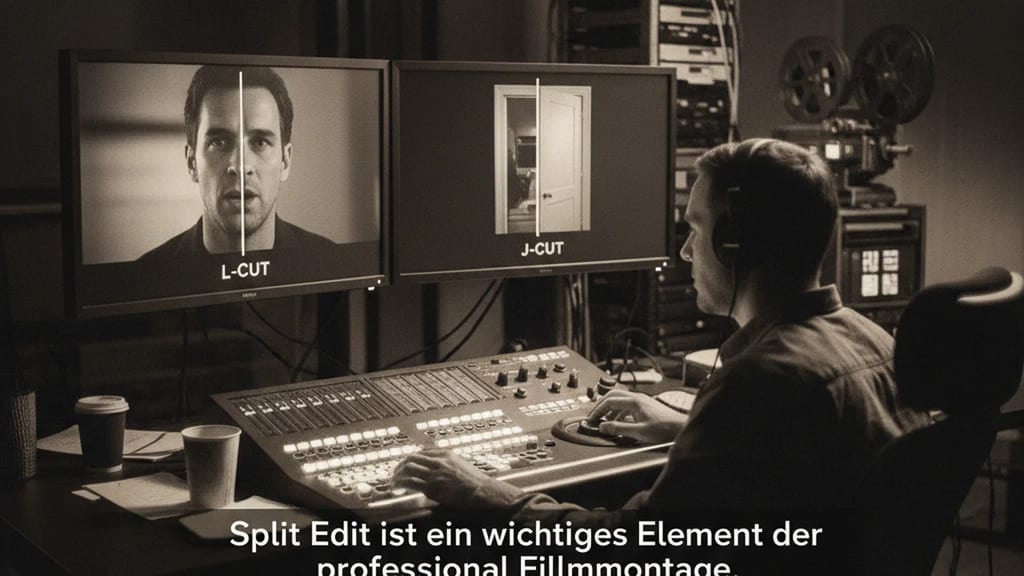
Editing technique where audio and video cuts are staggered: L-cuts extend sound over a visual transition, J-cuts introduce audio before the picture change.

Technical Details

In L-cuts, the audio track typically extends 12 to 72 frames (at 24fps, this corresponds to 0.5 to 3 seconds) beyond the picture cut. J-cuts usually begin 6 to 48 frames before the actual picture change. In digital editing systems like Avid Media Composer or Adobe Premiere, split edits are realized by trimming the audio and video tracks on separate timelines. The transition is then either hard (Direct Cut) or with short crossfades of 2-8 frames in length to avoid pops and clicks.

History & Development

Split editing developed from 1927 onwards with the advent of sound film, as editors realized that synchronous picture-sound cuts often appeared unnatural. Hal C. Kern did pioneering work on "Gone with the Wind" (1939), where dialogues were systematically laid over reaction shots. With the introduction of multitrack recording in the 1950s, the technique became standard. The terms L-cut and J-cut only emerged in the 1980s with digital editing systems that visually represented these cutting forms.

Practical Use in Film

L-cuts dominate dialogue scenes: In "The Social Network" (2010), Mark Zuckerberg's monologues run continuously over reaction shots of his conversation partners. J-cuts create anticipation through prematurely starting audio, such as footsteps before entering a room. "No Country for Old Men" (2007) uses J-cuts for atmospheric sounds that begin 1-2 seconds before the picture. Split editing accelerates the narrative pace by an average of 15-20% compared to synchronous cuts and reduces the perceived cutting frequency.

Comparison & Alternatives

While synchronous cuts (Straight Cuts) deliberately create pauses, split edits create fluid transitions. Cross-cutting alternates between parallel storylines, while split edits remain within a single scene. Audio bridges connect scenes thematically through continuous music or sounds; split edits primarily work with original sound. In action scenes, editors prefer synchronous cuts for precise impact; in dialogue passages, L-cuts dominate with a ratio of approximately 3:1 compared to direct cuts.
From the crafts

Perspectives

Cinematographer

Ich plane bereits am Set Einstellungen für versetzte Schnitte, indem ich Reaktionen und Zwischenschnitte zusätzlich aufzeichne. Besonders bei Dialogen filme ich systematisch separate Takes der Zuhörer, da diese später als Bildebene für L-Cuts dienen. Die Kontinuität von Licht und Bewegung muss stimmen, da diese Einstellungen oft minutenlang über fremde Tonspuren gelegt werden.

Director

Versetzte Schnitte sind mein primäres Werkzeug, um natürliche Gesprächsrhythmen zu schaffen und Zuschauer emotional zu führen. Ich setze L-Cuts ein, um Charakterreaktionen zu verstärken – der Zuschauer hört die Beleidigung, sieht aber das verletzte Gesicht. J-Cuts nutze ich für Suspense: Das Geräusch der sich öffnenden Tür kommt zwei Sekunden vor dem Bild und baut Spannung auf.

Producer

Versetzte Schnitte verlängern die Postproduktion um etwa 20%, da jede Szene doppelt so viele Schnittentscheidungen erfordert. Dafür reduzieren sie den Drehtag-Aufwand, da weniger perfekt synchronisierte Takes nötig sind – ein Dialog kann aus verschiedenen Takes zusammengesetzt werden. Der Tonmix wird komplexer und kostet zusätzliche 10-15% Budget, spart aber oft teure Nachdrehs für Anschlussfehler.

More in the lexikon

Related terms

Test your knowledge

Quiz

1. Zu welchem Department gehört „Versetzter Schnitt"?

2. Wie viele verschiedene Fachperspektiven bietet dieser Eintrag?

Report an error
From the Filmfarm ecosystem

Understand visual language, budget productions, connect crew.

The Lexikon is part of the Filmfarm ecosystem — alongside budgeting (FilmBalance), an industry magazine (FilmCircus) and crew networking (FilmCall, CrewMesh). One shared vocabulary for the whole production.

FilmFarm FilmRadarComing soonFilmPulseComing soonFilmNumbersComing soonFilmCapitalComing soonFilmLabComing soonFilmBalanceComing soonFilmCircusComing soon