Technical Details
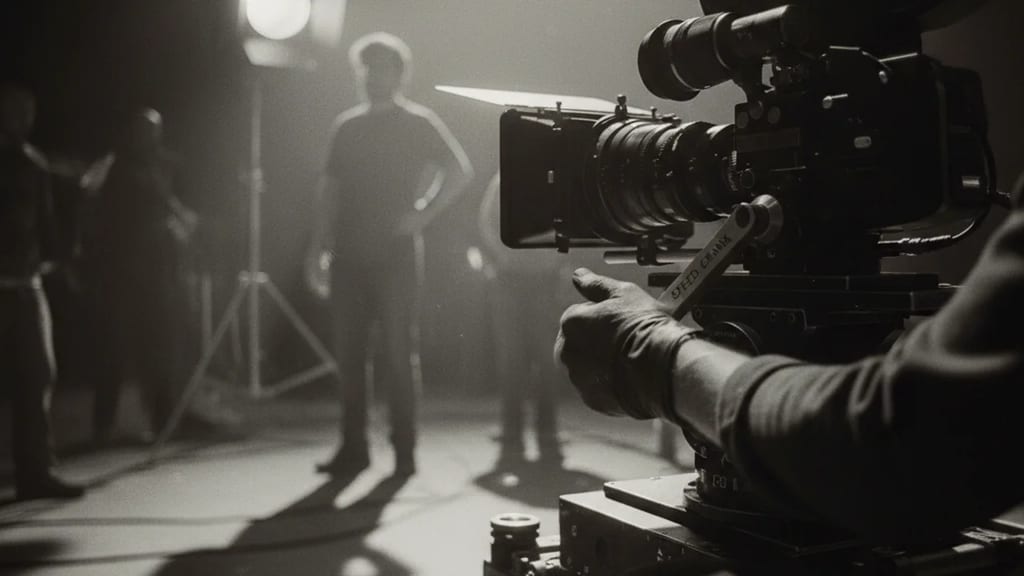
Speed cranks operate with a gear train that multiplies the manual cranking speed by 2 to 4 times. At the standard film speed of 16 frames per second (Silent Era), a 1:2 speed crank allows for 32 frames per second at a constant cranking speed. The mechanism consists of a main gear (24-48 teeth) and a smaller drive gear (8-16 teeth). High-quality versions from Bell & Howell or Mitchell featured interchangeable gear sets for different gear ratios. The weight of the crank mechanism increased by 200-400 grams compared to standard equipment.
History & Development
The first commercial speed crank was developed in 1923 by the Bell & Howell Company for their 2709 studio camera. Pathé followed in 1924 with its own variant for the Professional series. By 1930, the speed crank had established itself as standard equipment for professional 35mm cameras. With the introduction of synchronous motor cameras from 1928 onwards, the manual speed crank lost its significance for slow-motion shots. From the 1950s onwards, it disappeared entirely from professional film production, as electric motors regulated variable speeds more precisely.
Practical Use in Film
Director Abel Gance extensively used speed cranks for "Napoléon" (1927) to shoot battle scenes in slow motion. The crank, operating at 48 frames per second, created a triple slow-motion effect at standard projection speed of 16 fps. F.W. Murnau employed it in "Sunrise" (1927) for the famous swamp scenes. Practical advantages: no power supply needed, absolute running smoothness, immediate speed adjustment. Disadvantages: limited maximum speed, uneven exposure with fluctuating cranking speed, physically demanding for longer takes.
Comparison & Alternatives
The speed crank differs from a standard crank by its integrated gear train and from motor cameras by its manual operation. Variable speed motors replaced it from the late 1920s onwards, enabling speeds up to 128 fps instead of the crank-limited 32-48 fps. Modern high-speed cameras achieve 1,000+ fps with constant exposure. For authentic reproductions of historical shooting techniques, cinematographers today use reconstructed speed cranks on restored cameras such as the Mitchell BNC or Arriflex 35.