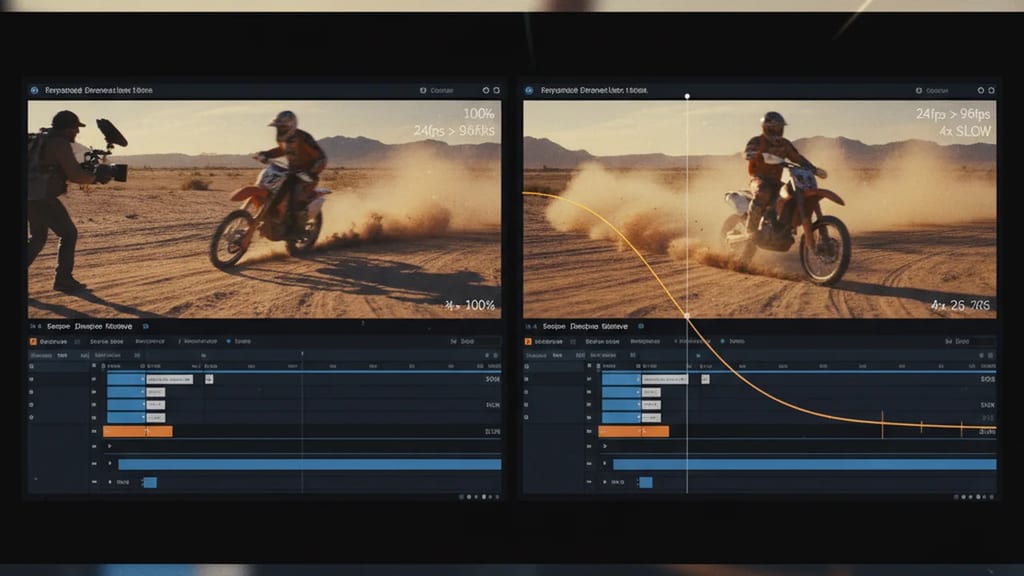
Technical Details
Modern digital cameras like the RED V-Raptor or ARRI Alexa 35 allow for variable frame rates from 1-120 fps at full resolution. For extreme speed ramps, Phantom TMX cameras are used with up to 1.75 million fps. Post-production is handled via optical flow algorithms in software such as Twixtor or the native time remapping tools in DaVinci Resolve and Adobe After Effects. The software interpolates missing intermediate frames through motion analysis of adjacent frames. Critical parameters include ramp duration (typically 0.5-2 seconds), ease-in/out curves, and the frame rate ratios between speed stages.
History & Development
The pioneer of the speed ramp was cinematographer Bill Pope on "The Matrix" (1999), who combined mechanical vari-speed systems with digital post-production. Director Zack Snyder perfected the technique in "300" (2006) through the systematic use of Phantom high-speed cameras and precise digital speed ramps. The breakthrough for budget productions came in 2008 with the Canon 5D Mark II, which offered variable frame rates in DSLR cameras for the first time. Today, AI-based frame interpolation like RIFE or DAIN also enables subsequent speed ramps from 24fps footage.
Practical Application in Film
Classic application is found in action sequences: normal speed for the run-up, slow motion for the jump/strike, back to normal speed for the landing/impact. "Mad Max: Fury Road" (2015) used speed ramps to emphasize crash moments, "John Wick" (2014) for precise weapon handling depiction. The workflow requires precise planning of camera movements, as slow-motion segments require 5-20x longer recording times. Lighting changes during longer takes and the increased data requirements for high-speed recordings are problematic.
Comparison & Alternatives
Speed ramps differ from hard cuts between different speeds through the continuous transition ramp. Variable speed effects are created in post-production, while mechanical vari-speed is realized directly during shooting. Frame blending creates artificial motion blur, while optical flow interpolates actual intermediate frames. For extreme speed differences or complex movements, bullet time arrays with multiple synchronized cameras are used. Modern AI-enhanced speed ramping also enables subsequent creation from standard 24fps footage with acceptable quality.