Filmlexikon.
Support
Special Makeup Effects
Art Department · Terms

Special Makeup Effects

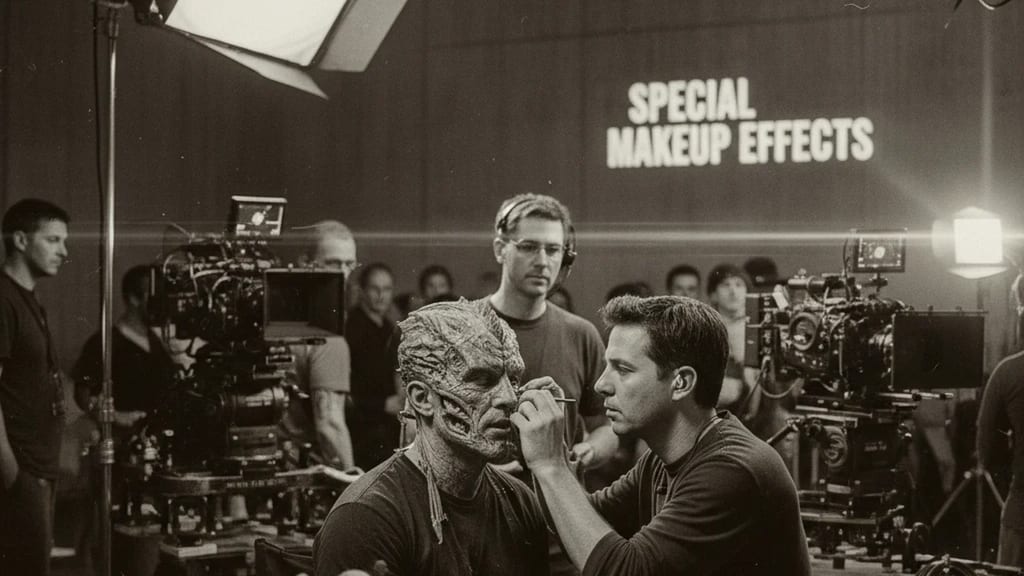
Murnau AI illustration
flow makeup roll

Three-dimensional facial and body prosthetics made from foam latex, silicone, or gelatin, created via negative casting to transform actors into creatures or other characters.

Technical Details

Modern special makeup effects are created by taking a negative mold of the actor's face using alginate (setting time 3-4 minutes), followed by the creation of a plaster positive. Foam latex masks are vulcanized at 93°C for 45-90 minutes, while silicone masks (Shore hardness A10-A25) cure at room temperature within 24 hours. Gel masks made from Knox gelatin offer the highest realism but disintegrate at temperatures above 32°C. Application times vary between 2-8 hours depending on complexity, with multi-piece full-face masks potentially comprising up to 15 separate prosthetic pieces.

History & Development

In 1931, Jack Pierce revolutionized film history with Boris Karloff's Frankenstein mask through the first use of greasepaint on textured foam appliances. In 1973, Dick Smith established foam latex as an industry standard with "The Exorcist" and developed the technique of invisible edges (feather edges). Rick Baker received the first Oscar for Makeup Effects in 1981 ("An American Werewolf in London") and introduced multi-stage transformation masks. Stan Winston perfected animatronic mask integration in the 1980s, while modern digital workflows since 2010 utilize 3D scanning and CNC milling for precision lifecasts.

Practical Application in Film

Gary Oldman's Dracula transformation (1992) required 4.5 hours of makeup application daily with 12 separate silicone pieces. "The Curious Case of Benjamin Button" (2008) combined traditional aging prosthetics with motion capture for seamless transitions between practical and digital effects. Zombie productions like "The Walking Dead" standardized modular prosthetic systems with pre-fabricated cheekbone, forehead, and chin sections for over 200 background performers daily. Full-body creature suits can reach weights up to 25kg and require integrated cooling systems as well as viewport technology.

Comparison & Alternatives

Special makeup effects differ from standard beauty makeup through dimensionality and permanent skin integration, whereas digital makeup represents purely post-production solutions. CGI face replacement costs €80,000-€150,000 per minute of finished material; practical masks amortize after 15+ shooting days. Hybrid approaches use prosthetics for the base structure and CGI for final details or impossible transformations. Motion capture suits are increasingly replacing full-body creature costumes but cannot replicate the tactile interaction between actors.

From the crafts

Perspectives

Cinematographer

Ich plane bei Spezialmasken-Drehs grundsätzlich 40% mehr Lichtleistung ein, da Silikon- und Latexoberflächen deutlich mehr Streulicht schlucken als natürliche Haut. Die Maskenränder erfordern präzise Lichtführung mit Barndoors und Cutters, um harte Schattenwürfe zu vermeiden, die die Illusion zerstören würden. Besonders kritisch wird es bei Nahaufnahmen unter 50mm Brennweite – hier offenbart selbst beste Maskenarbeit ihre künstliche Struktur.

Director

Ich setze Spezialmasken gezielt als visuelles Storytelling-Element ein, nicht nur zur reinen Transformation – Oldmans sich wandelnde Dracula-Gesichter erzählen seine emotionale Entwicklung mit. Die 4-6 Stunden tägliche Maskenzeit nutze ich für intensive Charaktergespräche mit dem Schauspieler, da er während der Applikation gefangen und voll konzentriert ist. Ich plane grundsätzlich kürzere Drehtage, da die psychische Belastung unter schweren Masken die Schauspielleistung nach 8 Stunden drastisch reduziert.

Producer

Spezialmasken-Produktionen kalkuliere ich mit 15.000-45.000€ pro Hauptcharakter-Design plus 800-2.500€ tägliche Applikationskosten durch spezialisierte Makeup-Teams. Die 6-12 Wochen Vorlaufzeit für Maskenherstellung blockiert oft die Casting-Flexibilität, da Gesichtsabdrücke bereits vor Drehbeginn erfolgen müssen. Ich budgetiere grundsätzlich 20% Reserve für Masken-Dubletten, da Beschädigungen durch Schweiß, Stunts oder Continuity-Fehler produktionsstoppend wirken können.

More in the lexikon

Related terms

Test your knowledge

Quiz

1. Zu welchem Department gehört „Spezialmasken"?

2. Wie viele verschiedene Fachperspektiven bietet dieser Eintrag?

Report an error
From the Filmfarm ecosystem

Understand visual language, budget productions, connect crew.

The Lexikon is part of the Filmfarm ecosystem — alongside budgeting (FilmBalance), an industry magazine (FilmCircus) and crew networking (FilmCall, CrewMesh). One shared vocabulary for the whole production.

FilmFarm FilmRadarComing soonFilmPulseComing soonFilmNumbersComing soonFilmCapitalComing soonFilmLabComing soonFilmBalanceComing soonFilmCircusComing soon