Filmlexikon.
Support
Split Complementary
Art Department · Terms

Split Complementary

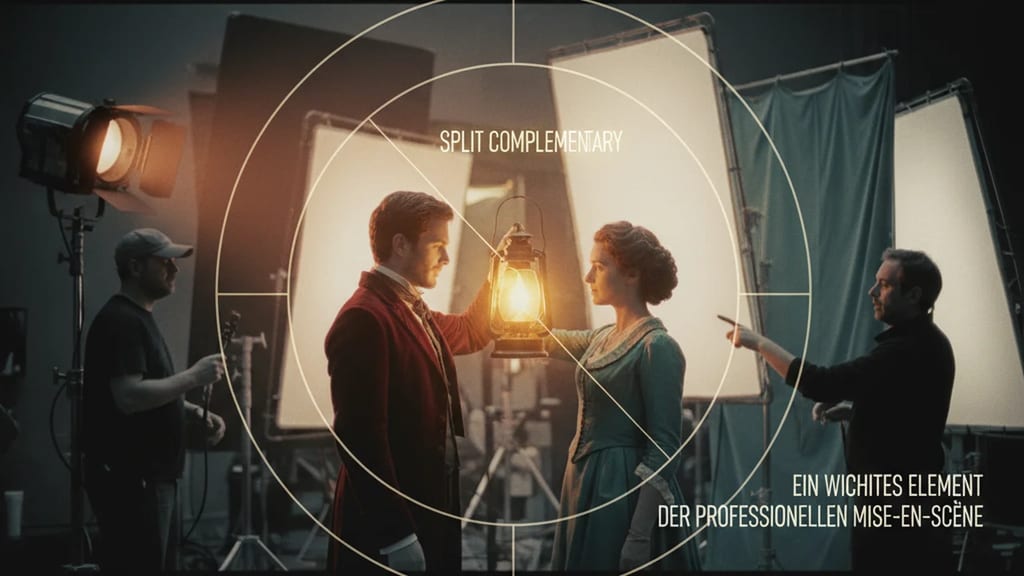
Murnau AI illustration
complementary colors complementary color symmetry asymmetry

Color scheme pairing one primary hue with the two neighbors of its complement. Delivers visual contrast without confrontation—you use the softened adjacent tones instead of the pure opposite.

Technical Details

The scheme is based on Johannes Itten's 12-part color wheel. With a base color of blue (240°), instead of orange (60°), the colors yellow-orange (30°) and red-orange (90°) are used. The color temperature difference is typically 2000-3000 Kelvin between the warm and cool components. In digital color correction, HSV values are used, with saturation usually between 60-80% to avoid clipping. Modern color grading software like DaVinci Resolve offers vectorscope displays that visualize the 120-degree triangle of split complementary colors.

History & Development

The technique originates from 19th-century painting and was first systematically applied by Neo-Impressionists such as Henri-Edmond Cross. Technicolor introduced the three-strip process in 1932, which made split complementary colors technically fully implementable. Cinematographer Jack Cardiff was influential in "Black Narcissus" (1947), using red-orange and yellow-orange against deep cyan. Digital color correction since the 1990s has enabled precise control over these color relationships.

Practical Application in Film

Christopher Doyle systematically used red-orange and yellow-orange against blue-green in "In the Mood for Love" (2000) to create emotional distance between the protagonists. Roger Deakins employed split complementary colors in "Blade Runner 2049" (2017): orange-dominated interiors contrasted with cyan-magenta exteriors. The color palette reduces eye strain compared to harsh complementary contrasts and allows for longer viewing times. Set designers work with color samples in the LAB color space, as this ensures the most visually uniform color distribution.

Comparison & Alternatives

Compared to monochromatic palettes, split complementary colors offer higher visual contrast with less aggressiveness than pure complementary contrasts. Triadic color schemes use three evenly distributed colors (120-degree intervals) but create a more restless image effect. Analogous color harmonies with 30-degree intervals appear more harmonious but offer less dramatic tension. Split-Complementary is particularly suitable for character studies and drama genres, while action films often resort to direct complementary contrasts.

From the crafts

Perspectives

Cinematographer

Ich verwende gespaltene Komplementärfarben hauptsächlich bei Available Light-Situationen, wo ich warme Prakticals gegen kühles Tageslicht setze - das ergibt natürlichere Hauttöne als der harte Orange-Cyan-Kontrast. Bei LED-Panels kann ich präzise die Farbtemperaturen zwischen 2700K und 4300K mischen, um diese subtilen Farbübergänge zu schaffen. Das Vektorskop zeigt mir sofort, ob ich im gewünschten 120-Grad-Dreieck bleibe.

Director

Diese Farbpalette nutze ich für komplexe Charakterbeziehungen, wo direkte Komplementärfarben zu plakativ wären - der subtile Kontrast spiegelt emotionale Ambivalenz wider. In Liebesgeschichten setze ich bewusst gespaltene Komplementärfarben ein, um die Spannung zwischen Nähe und Distanz visuell zu unterstützen. Die harmonischere Wirkung hält das Publikum entspannter, während trotzdem visueller Konflikt entsteht.

Producer

Gespaltene Komplementärfarben reduzieren meine Postproduktionskosten, da weniger drastische Farbkorrekturen nötig sind und die Grading-Sessions um etwa 15% kürzer werden. Bei Kostümen und Set-Design kann ich mit drei statt zwei Hauptfarben arbeiten, was mehr Flexibilität bei Locationwechseln bietet. Die subtileren Kontraste verzeihen auch günstigere LED-Beleuchtung, da harte Farbstiche weniger auffallen.

More in the lexikon

Related terms

Test your knowledge

Quiz

1. Zu welchem Department gehört „Gespaltene Komplementärfarben"?

2. Wie viele verschiedene Fachperspektiven bietet dieser Eintrag?

Report an error
From the Filmfarm ecosystem

Understand visual language, budget productions, connect crew.

The Lexikon is part of the Filmfarm ecosystem — alongside budgeting (FilmBalance), an industry magazine (FilmCircus) and crew networking (FilmCall, CrewMesh). One shared vocabulary for the whole production.

FilmFarm FilmRadarComing soonFilmPulseComing soonFilmNumbersComing soonFilmCapitalComing soonFilmLabComing soonFilmBalanceComing soonFilmCircusComing soon