Filmlexikon.
Support
Solarflood
Lighting · Terms

Solarflood

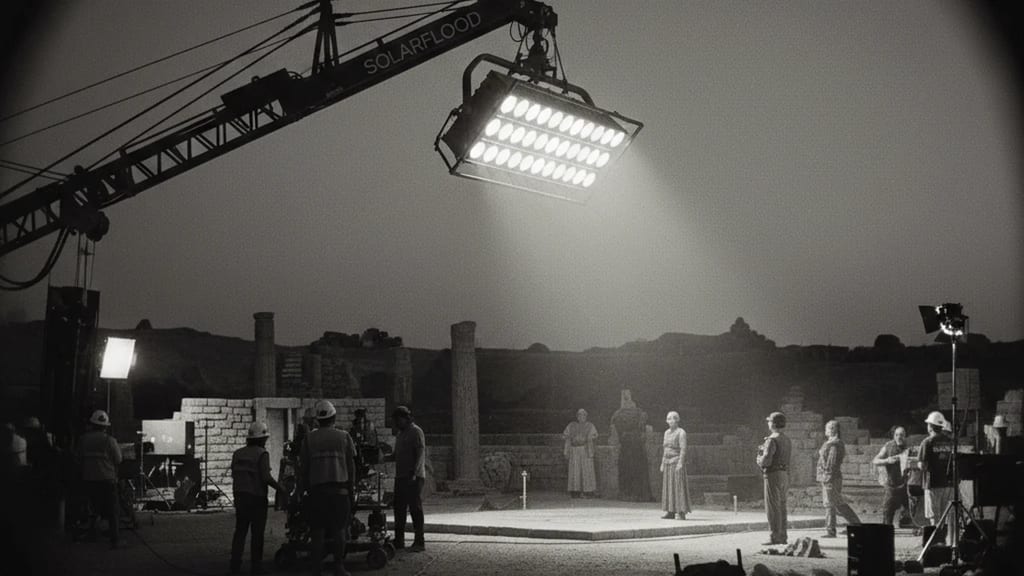
Murnau AI illustration
color temperature flow roll take

Soft area light with asymmetric parabolic reflector for even base illumination of large sets without hard shadows.

Technical Details

Standard solarfloods use asymmetric parabolic reflectors with a beam characteristic of 60° to 120° horizontally and 40° to 80° vertically. The luminaires achieve illuminance levels of 800 to 4000 Lux at a distance of 3 meters. Typical models such as the Arri Softlight or LTM Pepper weigh between 8 and 25 kilograms and measure approximately 80 x 60 x 40 cm. The lamps are arranged in segmented reflector chambers, ensuring uniform illumination even if individual bulbs fail.

History & Development

The solarflood was developed in the 1940s by Mole-Richardson for Hollywood studios to evenly light large sets. In 1952, Arri introduced the first European solarflood. In the 1980s, more compact versions with improved light distribution emerged. Since 2010, LED-based solarfloods have increasingly been developed, consuming 70% less energy for the same light output and generating no heat.

Practical Use in Film

Solarfloods serve as base light for large studio areas or as soft fill light for group shots. In "Blade Runner" (1982), Jordan Cronenweth used solarfloods for the uniform illumination of the cityscapes. In television productions, they are standard for talk show sets. The advantage lies in the even light distribution without hard shadows; the disadvantage is the low light intensity and high power consumption of halogen models.

Comparison & Alternatives

Unlike Fresnel spotlights, solarfloods do not produce a focusable beam but constant area illumination. Space lights hang from the ceiling and illuminate in all directions, while solarfloods create directed area light. Modern LED panels such as the Arri SkyPanel or Litepanels Gemini are increasingly replacing classic solarfloods as they are dimmable, offer various color temperatures, and generate significantly less heat. Kino Flo fluorescent tube arrays offer similarly soft light with lower power consumption.
From the crafts

Perspectives

Cinematographer

Ich nutze Solarfloods hauptsächlich als Base Light, um große Bereiche gleichmäßig aufzuhellen, ohne dass harte Schatten entstehen. Die asymmetrische Lichtverteilung ist perfekt, um Hintergründe sanft auszuleuchten, während ich mit Fresnels die Akzente setze. Bei LED-Varianten schätze ich besonders die Möglichkeit, die Farbtemperatur während des Drehs anzupassen.

Director

Für mich sind Solarfloods das perfekte Werkzeug, um eine natürliche, unaufdringliche Grundstimmung zu schaffen, die den Schauspielern Bewegungsfreiheit gibt. Sie erzeugen diese weiche, fast dokumentarische Anmutung, die ich für intime Szenen oder Alltagssituationen brauche. Die gleichmäßige Ausleuchtung lässt die Emotionen der Darsteller in den Vordergrund treten, ohne durch dramatische Lichtführung abzulenken.

Producer

Solarfloods bedeuten für mich kalkulierbare Beleuchtung – einmal positioniert, leuchten sie stundenlang gleichmäßig aus, ohne dass ständig nachjustiert werden muss. Bei klassischen Halogenmodellen muss ich allerdings höhere Stromkosten und Klimatisierung einplanen. Die Investition in LED-Solarfloods amortisiert sich bereits nach drei größeren Produktionen durch eingesparte Stromkosten und reduzierte Drehtage.

More in the lexikon

Related terms

Test your knowledge

Quiz

1. Zu welchem Department gehört „Solarflood"?

2. Wie viele verschiedene Fachperspektiven bietet dieser Eintrag?

Report an error
From the Filmfarm ecosystem

Understand visual language, budget productions, connect crew.

The Lexikon is part of the Filmfarm ecosystem — alongside budgeting (FilmBalance), an industry magazine (FilmCircus) and crew networking (FilmCall, CrewMesh). One shared vocabulary for the whole production.

FilmFarm FilmRadarComing soonFilmPulseComing soonFilmNumbersComing soonFilmCapitalComing soonFilmLabComing soonFilmBalanceComing soonFilmCircusComing soon