Filmlexikon.
Support
Solarspot
Lighting · Terms

Solarspot

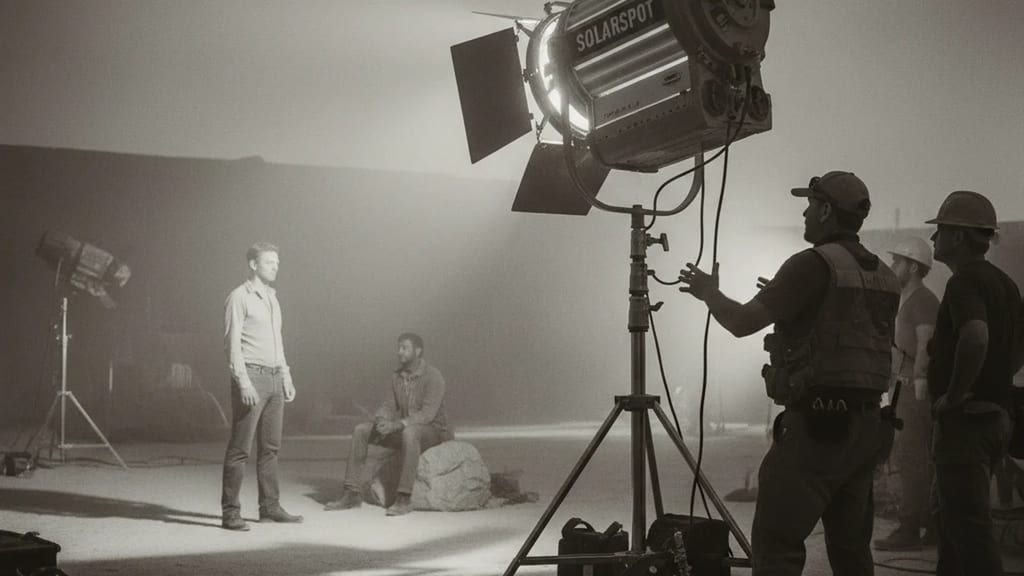
Murnau AI illustration
color temperature flow roll take

HMI Fresnel spotlight delivering up to 50,000 lux at 6000K color temperature, with focus range of 15° to 60°. Typical models like Arri M18 weigh 7.8 kg.

Technical Details

Solarspots utilize Fresnel lens systems and achieve illuminance levels of up to 50,000 lux at a distance of one meter. The lamps operate at a color temperature of approximately 6000K and require electronic ballasts with frequencies of 1000Hz or higher for flicker-free shooting. Common models like the Arri M18 weigh 7.8 kg, while 12K variants reach up to 15 kg. The units offer continuous focusing from 15° (spot) to 60° (flood) and DMX-512 control for remote operation.

History & Development

Arri introduced the first professional HMI solarspot, the M8, in 1982, replacing the then-common 10K Tungsten Fresnel spotlights. Osram simultaneously advanced HMI lamp technology, making the first 18K solarspots possible in 1987. A milestone was the introduction of the Electronic Ballast generation in 1995, which reduced ballast weight by 40% and enabled the hot-strike function.

Practical Use in Film

Roger Deakins extensively used solarspots for the desert sequences in "Sicario" (2015) to simulate the harsh Mexican sun. For interior shots, 6K solarspots serve as window light through large windows, as seen in Emmanuel Lubezki's cinematography for "Birdman" (2014). The typical workflow involves using diffusion gels or silk frames at a distance of 2-3 meters to modulate the hard light. Disadvantages include high power consumption and a warm-up time of 3-5 minutes after ignition.

Comparison & Alternatives

Solarspots differ from Tungsten Fresnel spotlights through their higher light output with less heat development – a 6K HMI is equivalent to approximately a 20K Tungsten spotlight. Since 2018, LED panels like the Arri SkyPanel S360-C have offered an alternative with variable color temperature, but they do not achieve the pinpoint light quality of a solarspot. For extreme wide-angle shots or large sets, 18K solarspots are still used, while 2.5K models suffice for close-ups and smaller productions.
From the crafts

Perspectives

Cinematographer

Ich setze Solarspots hauptsächlich für harte Schatten und kontrastreiche Beleuchtung ein - der M18 durch ein 12x12 Silk erzeugt perfektes Window Light mit der nötigen Durchschlagskraft für große Räume. Die präzise Fokussierbarkeit erlaubt mir, gezielt Gesichtskonturen zu modellieren, ohne dass ich mehrere kleinere Leuchten kombinieren muss.

Director

Solarspots geben mir die Macht, Tageszeiten und Stimmungen unabhängig von den natürlichen Lichtverhältnissen zu schaffen - ich kann die brutale Mittagssonne für einen Verhörszene oder warmes Nachmittagslicht für eine Familienszene erzeugen. Die harten Schatten verstärken Drama und Spannung, während diffusiert eingesetzt eine natürliche, unaufdringliche Atmosphäre entsteht.

Producer

Ein 6K-Solarspot kostet täglich etwa 180-220 Euro Miete plus Ballast und Strom, rechtfertigt sich aber durch Zeitersparnis bei Location-Wechseln und Wetterunabhängigkeit. Die hohe Stromaufnahme von bis zu 18 kW erfordert oft Generator-Anmietung für 800-1200 Euro täglich, was bei längeren Drehs ins Budget schlägt.

More in the lexikon

Related terms

Test your knowledge

Quiz

1. Zu welchem Department gehört „Solarspot"?

2. Wie viele verschiedene Fachperspektiven bietet dieser Eintrag?

Report an error
From the Filmfarm ecosystem

Understand visual language, budget productions, connect crew.

The Lexikon is part of the Filmfarm ecosystem — alongside budgeting (FilmBalance), an industry magazine (FilmCircus) and crew networking (FilmCall, CrewMesh). One shared vocabulary for the whole production.

FilmFarm FilmRadarComing soonFilmPulseComing soonFilmNumbersComing soonFilmCapitalComing soonFilmLabComing soonFilmBalanceComing soonFilmCircusComing soon