Cinematographer
Aus DoP-Perspektive ist dieses Element essentiell für die visuelle Gestaltung. Es ermöglicht mir die gewünschte Farbstimmung und das ästhetische Bild konsistent umzusetzen.
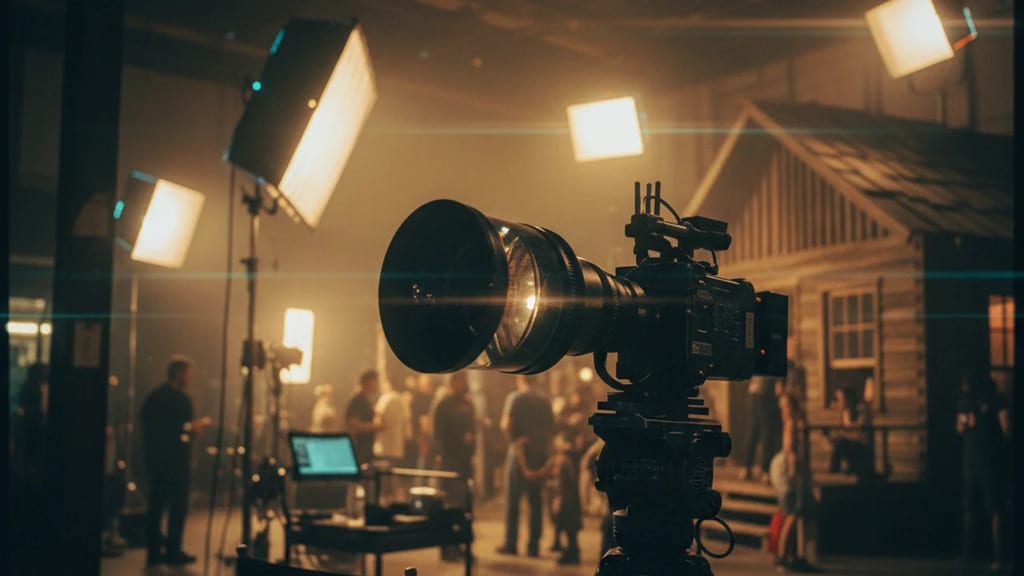
Flood lens: an interchangeable diffusing lens that widens the light beam of a fixture (opposite of spot lens).
In film lighting, a Flood Lens (German: Flut- oder Streulinse) refers to an interchangeable or adjustable optic that widens the beam of a light fixture, creating a broad, even flood of the scene. It is the counterpart to the Spot Lens, which concentrates and narrows the beam. The term does not refer to a specific manufacturer or fixture model, but rather a class of optics or a function within a lens system.
Flood lenses appear in two forms: as fixed interchangeable lenses that are inserted or screwed into a housing (classic with the ETC Source Four PAR), and as part of a lens set or attachment system for LED fixtures (e.g., Litepanels Nanoptic Lens Set). With Fresnel and focusable LED spotlights, the flood setting is achieved not by an interchangeable lens, but by moving the lamp and reflector relative to the lens.
Flood optics are typically distinguished by standardized abbreviations that describe the beam pattern (from narrow/Spot to wide/Flood). For the common ETC Source Four PAR, the following interchangeable lenses, among others, are standard:
| Abbreviation | Designation | Field Angle (approx.) | Beam Shape |
|---|---|---|---|
| VNSP | Very Narrow Spot | 18° | round |
| NSP | Narrow Spot | 19° | round |
| MFL | Medium Flood | 32° x 23° | oval |
| WFL | Wide Flood | 48° x 31° | oval |
| XWFL | Extra Wide Flood | very wide | round |
With the ETC Source Four PAR, only the Medium Flood (MFL) and Wide Flood (WFL) lenses produce an oval light field; the precise orientation of this oval beam can be adjusted by rotating the lens in its frame. The narrower lenses (VNSP, NSP) and the Extra Wide Flood lens (XWFL), on the other hand, deliver a round beam. The specific angles depend on the respective lens set and fixture and should be taken from the manufacturer's datasheet.
Flood lenses are used when a surface needs to be illuminated broadly and softly, for example, for backgrounds, fill light, or general ambient brightness. The wider the lens spreads, the larger the illuminated area and the lower the pinpoint light intensity (illuminance in lux) at the center, as the same amount of light is distributed over a larger area. Conversely, spot lenses provide a narrower, more intense beam for greater throw or targeted accents.
Since the light characteristic can be changed solely by swapping the lens, without changing the fixture itself, flood optics offer the lighting team a flexible tool to quickly adapt an existing fixture to different requirements.
Aus DoP-Perspektive ist dieses Element essentiell für die visuelle Gestaltung. Es ermöglicht mir die gewünschte Farbstimmung und das ästhetische Bild konsistent umzusetzen.
Diese professionelle Lösung erhöht die Produktionseffizienz und reduziert Post-Production-Anforderungen. Sie ermöglicht flexible, schnelle Anpassungen während des Drehs.
Als Gaffer ist dies ein unverzichtbares Werkzeug meines täglichen Handwerkszeugs. Es ermöglicht mir professionelle Lichtkontrolle und schnelle Anpassungen auf Set, was Zeit spart und Qualität sichert.
1. Was beschreibt „Flood-Linse" am besten?
2. Zu welchem Department gehört „Flood-Linse"?
3. Wie viele verschiedene Fachperspektiven bietet dieser Eintrag?
The Lexikon is part of the Filmfarm ecosystem — alongside budgeting (FilmBalance), an industry magazine (FilmCircus) and crew networking (FilmCall, CrewMesh). One shared vocabulary for the whole production.