Filmlexikon.
Support
Soft Silver
Lighting · Terms

Soft Silver

Murnau AI illustration
color temperature flow roll take

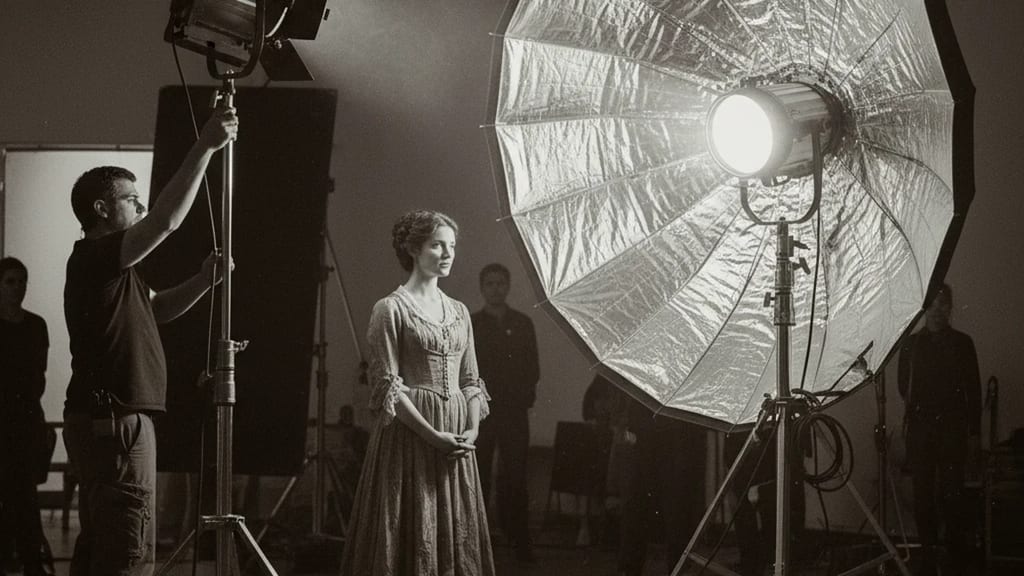
Reflective material with irregularly distributed silver particles (20–50 micrometers) that produces soft, even light without hotspots and delivers 40–50% more intensity than white reflectors.

Technical Details

Soft Silver consists of a base fabric (usually nylon or polyester) with silver particles applied in an irregular distribution. The grain size of the silver coating is typically 20-50 micrometers, creating a semi-matte surface. Standard reflectors measure 107x107cm or 122x122cm with a weight of 400-600g. The color temperature remains constant at 5600K ±200K, while the light loss compared to hard silver is approximately 15-20%. Common variants include foldable round reflectors (diameter 80-150cm) and rectangular frame reflectors up to 244x122cm.

History & Development

In 1983, Westcott developed the first commercial Soft Silver surface as an alternative to the then-common white fabric reflectors and bare silver foils. Matthews Studio Equipment standardized the designation "Soft Silver" for their Butterfly reflectors in 1987. In the 1990s, manufacturers like Chimera and Photoflex established various weave structures to optimize diffusion characteristics. Modern LED panels began integrating Soft Silver coatings directly into light source housings from 2010 onwards.

Practical Application in Film

DoP Janusz Kamiński extensively used Soft Silver reflectors in "Saving Private Ryan" (1998) for natural-looking skin fill in daylight scenes. For exterior shots, Soft Silver is primarily used for shadow fill – the reflector is usually placed 1-3 meters from the subject at a 45° angle to the camera. Indoors, it serves as a bounce surface for hard artificial light sources like HMI spotlights. The advantage lies in even light distribution without hotspots, the disadvantage in lower light output compared to bare silver.

Comparison & Alternatives

Compared to white reflectors, Soft Silver produces 40-50% more light intensity with cooler color rendering. While bare silver foils provide more output, they create harsh shadows and specular highlights. Modern alternatives include LED panels with built-in diffusion or digital lighting technology with controllable spread. Gold-silver mixtures warm the reflected light by 200-400K. With direct sun exceeding 50,000 lux, hard silver remains the first choice, while Soft Silver delivers optimal results under cloudy skies or in shaded areas.
From the crafts

Perspectives

Cinematographer

Ich verwende Soft Silver hauptsächlich für Porträts im Available Light, weil es die Schatten aufhellt ohne die natürliche Lichtrichtung zu zerstören. Der Reflektor muss nah genug stehen um zu wirken, aber nicht so nah dass er ins Bild kommt - meist arbeite ich mit 1,5-2 Meter Abstand. Bei digitalen Kameras mit hoher ISO-Performance reicht die Lichtausbeute auch bei schwächeren Lichtverhältnissen völlig aus.

Director

Soft Silver hilft mir dabei, Gesichter lesbar zu machen ohne das naturalistische Lichtgefühl zu verfälschen. Wenn ich eine intime Szene im Schatten drehe, kann der Reflektor die Emotionen in den Augen sichtbar machen ohne dass es nach Studiolicht aussieht. Die Schauspieler werden nicht geblendet und können natürlich agieren, während die Kamera trotzdem genug Details in den Schatten einfängt.

Producer

Ein 5-in-1 Reflektor mit Soft Silver kostet etwa 150-300 Euro und ersetzt oft teure Zusatzbeleuchtung samt Stromversorgung. Bei Außendrehs spare ich damit Generatorkosten und Aufbauzeit, weil kein Starkstrom nötig ist. Ein Beleuchter kann den Reflektor allein bedienen, während für HMI-Scheinwerfer meist zwei Mann nötig sind - das reduziert die Personalkosten spürbar.

More in the lexikon

Related terms

Test your knowledge

Quiz

1. Zu welchem Department gehört „Soft Silver"?

2. Wie viele verschiedene Fachperspektiven bietet dieser Eintrag?

Report an error
From the Filmfarm ecosystem

Understand visual language, budget productions, connect crew.

The Lexikon is part of the Filmfarm ecosystem — alongside budgeting (FilmBalance), an industry magazine (FilmCircus) and crew networking (FilmCall, CrewMesh). One shared vocabulary for the whole production.

FilmFarm FilmRadarComing soonFilmPulseComing soonFilmNumbersComing soonFilmCapitalComing soonFilmLabComing soonFilmBalanceComing soonFilmCircusComing soon