Filmlexikon.
Support
Slate
Production · Terms

Slate

Murnau AI illustration
foley mixer mix production sound mixer re recording mixer sound mixer zoom recorder sound devices zoom

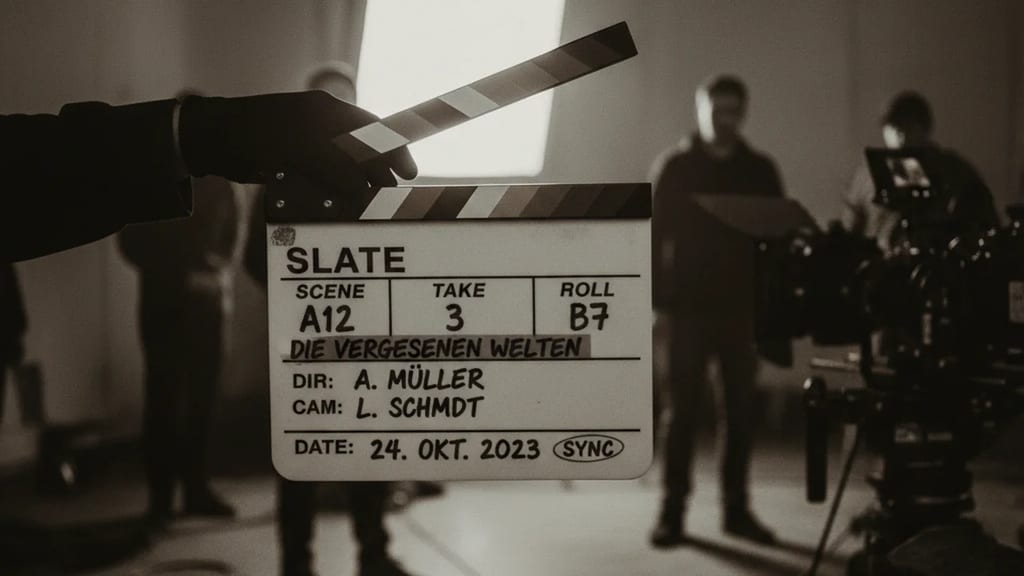
Clapperboard with two hinged boards that synchronize picture and sound via the distinctive clap impact; displays production data including scene and take numbers.

Technical Details

Professional film slates consist of two boards: the upper movable "sticks" (2-3 cm thick) and the lower board with a black or white surface. Standard fields include Scene, Take, Roll, Date, Cameraman, and Production Title. Digital Smart-Slates integrate LED displays with timecode generators that synchronize precisely to 1/100th of a second. Electronic variants transmit synchronization signals directly to audio recording devices via radio or cable. Special versions for underwater filming use waterproof housings and reinforced hinges.

History & Development

The first documented use of a film slate occurred in 1929 at Bell Telephone Laboratories for early sound film experiments. Engineer Frank B. Jewett developed the system to solve the synchronization problem between separate picture and sound recordings. In 1930, the slate became an industry standard in Hollywood. The digital revolution brought the first Smart-Slate from Ambient Recording in 1992 with an integrated timecode display. Modern RFID slates have been automatically transferring metadata into digital workflows since 2018.

Practical Use in Film

For "Dunkirk" (2017), Christopher Nolan used waterproof special slates for underwater sequences with divers. Multi-camera productions like "The Avengers" (2012) rely on wirelessly synchronized Smart-Slates for up to 15 cameras running simultaneously. The "Academy Color Encoding System" reference colors on modern slates enable precise color correction in post-production. Silent slates (soft sticks) with foam buffers are used in intimate dialogue scenes to avoid breaking an actor's concentration.

Comparison & Alternatives

Hand claps replace slates in spontaneous documentary shoots but do not provide visual production data. Automatic sync software like PluralEyes reduces reliance on mechanical slates through audio analysis. Timecode jam-sync synchronizes cameras and sound devices electronically without a slate clap. Smart-Slates combine both methods: mechanical backup synchronization and digital metadata transfer. In live broadcasts, the slate is completely omitted in favor of Genlock systems for real-time image synchronization.

From the crafts

Perspectives

Cinematographer

Ich verwende die Klappe zur Überprüfung der Belichtung auf den schwarz-weißen Referenzfeldern und zur Weißabgleichkalibrierung. Bei Multi-Kamera-Setups stelle ich sicher, dass alle Kameras den Klappschlag im Bild erfassen, um auch bei Timecode-Ausfällen einen mechanischen Sync-Punkt zu haben. Die reflektierenden Eigenschaften moderner Smart-Slates berücksichtige ich bei der Lichtführung, da sie ungewollte Spiegelungen verursachen können.

Director

Ich nutze die Klappe als psychologisches Instrument zur Konzentration der Schauspieler - der Klappschlag markiert den definitiven Übergang in die Szene. Bei emotionalen Takes verwende ich Soft-Sticks, um die aufgebaute Atmosphäre nicht zu durchbrechen. Die sichtbaren Take-Nummern helfen mir bei der direkten Kommunikation mit meinem Script-Supervisor über verwendbare Aufnahmen ohne komplizierte Codes.

Producer

Eine professionelle Smart-Slate kostet 2.800-4.200 Euro, amortisiert sich aber durch eingesparte Postproduktionszeit bei der Synchronisation. Bei 60 Drehtagen spare ich durchschnittlich 40 Stunden Editor-Zeit, was 3.200 Euro entspricht. Defekte oder vergessene Klappen kosten mich 15 Minuten Setup-Zeit pro Take, bei 180 Takes täglich summiert sich das zu erheblichen Mehrkosten durch Crew-Überstunden.

More in the lexikon

Related terms

Test your knowledge

Quiz

1. Was beschreibt „Filmklappe" am besten?

2. Zu welchem Department gehört „Filmklappe"?

3. Wie viele verschiedene Fachperspektiven bietet dieser Eintrag?

Report an error
From the Filmfarm ecosystem

Understand visual language, budget productions, connect crew.

The Lexikon is part of the Filmfarm ecosystem — alongside budgeting (FilmBalance), an industry magazine (FilmCircus) and crew networking (FilmCall, CrewMesh). One shared vocabulary for the whole production.

FilmFarm FilmRadarComing soonFilmPulseComing soonFilmNumbersComing soonFilmCapitalComing soonFilmLabComing soonFilmBalanceComing soonFilmCircusComing soon