Filmlexikon.
Support
Head Slate
Production · Terms

Head Slate

Murnau AI illustration
foley mixer mix production sound mixer re recording mixer sound mixer zoom recorder sound devices zoom

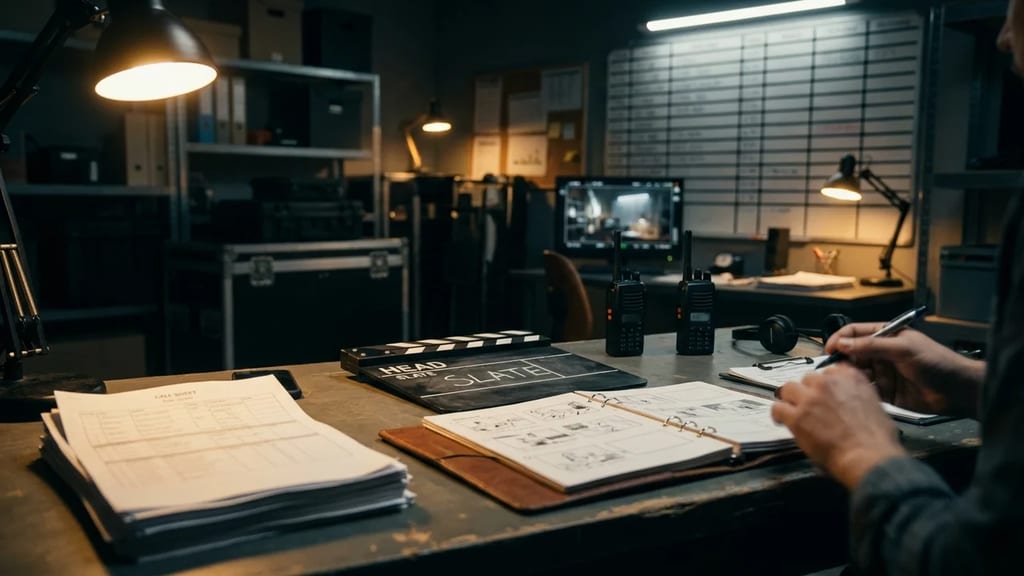
Digital metadata overlay in the camera image displaying production title, scene, take number, and timecode. Replaces mechanical clapperboards in multi-camera setups.

Technical Details

Modern head slate systems operate with a font size of at least 24pt at 1920x1080 resolution to remain legible even with compressed dailies. The overlay is done via the Camera Control Interface (CCI) directly in the camera or via an external monitoring system. Standard data fields include production title, date, scene/setup, take number, camera ID (A/B/C), timecode, and frame rate. In multi-camera productions, all cameras synchronize via Ambient Lockit boxes or comparable timecode generators to ±0.1 frame accuracy.

History & Development

The head slate evolved from 2008 onwards out of the necessity to simplify synchronization in digital multi-camera setups. While analog and early digital productions relied on mechanical slates, cameras like the RED One enabled direct metadata overlays for the first time. In 2012, SMPTE standardized digital slate functionality with Standard 12M-2. Since 2018, camera systems like ARRI Alexa Mini LF and Sony Venice have integrated the head slate natively into their menu systems.

Practical Use in Film

On "Avengers: Endgame" (2019), up to eight cameras running simultaneously were coordinated via digital head slates, allowing post-production to assign 14 hours of raw footage daily with frame accuracy. Since 2020, Netflix productions have been standardizing head slates with QR codes that contain additional metadata such as GPS coordinates and weather parameters. For handheld or Steadicam shots, the head slate eliminates the risk of camera collisions with physical slates, as can occur during action-heavy sequences.

Comparison & Alternatives

The traditional film slate (clapperboard) remains standard for single-camera productions and 35mm film, as acoustic synchronization is achieved via the clapper sound. Smart slates like the Denecke TS-C combine both methods with an LED timecode display and a mechanical clapper. Pure head slates are primarily suitable for dialogue scenes and controlled sets, while hybrid solutions are often used for stunt sequences or documentaries.
From the crafts

Perspectives

Cinematographer

Als DoP schätze ich die Kopfklappe besonders bei Gimbal- und Drohnenaufnahmen, wo physische Klappen das Equipment gefährden oder ins Bild ragen würden. Die direkte Timecode-Einblendung im Sucher erspart mir das ständige Überprüfen der Synchronisation zwischen den Kameras. Bei Low-Light-Szenen kann ich auf die störende LED-Beleuchtung der Smart-Slates verzichten und arbeite ausschließlich mit der digitalen Variante.

Director

Die Kopfklappe gibt mir mehr Kontrolle über den Rhythmus einer Szene, da ich nicht auf den Klappe-Assistent warten muss und sofort nach "Action" mit der eigentlichen Performance beginnen kann. Bei emotionalen Szenen stört keine physische Klappe die Konzentration der Darsteller, und ich kann mehrere Takes nahtlos hintereinander fahren. Die stumme Synchronisation ist besonders bei Musikaufnahmen oder Live-Ton-sensiblen Drehs unverzichtbar.

Producer

Kopfklappen reduzieren meine Personalkosten um einen 2nd Assistant Camera pro zusätzlicher Kamera, da die Synchronisation automatisch erfolgt. Die Postproduktions-Kosten sinken um etwa 15%, weil die frame-genaue Zuordnung der Aufnahmen ohne manuelles Suchen nach Klappen-Markern funktioniert. Bei internationalen Koproduktionen vereinfacht die digitale Slate die Workflow-Standards zwischen verschiedenen Ländern erheblich.

More in the lexikon

Related terms

Test your knowledge

Quiz

1. Was beschreibt „Kopfklappe" am besten?

2. Zu welchem Department gehört „Kopfklappe"?

3. Wie viele verschiedene Fachperspektiven bietet dieser Eintrag?

Report an error
From the Filmfarm ecosystem

Understand visual language, budget productions, connect crew.

The Lexikon is part of the Filmfarm ecosystem — alongside budgeting (FilmBalance), an industry magazine (FilmCircus) and crew networking (FilmCall, CrewMesh). One shared vocabulary for the whole production.

FilmFarm FilmRadarComing soonFilmPulseComing soonFilmNumbersComing soonFilmCapitalComing soonFilmLabComing soonFilmBalanceComing soonFilmCircusComing soon