Overview
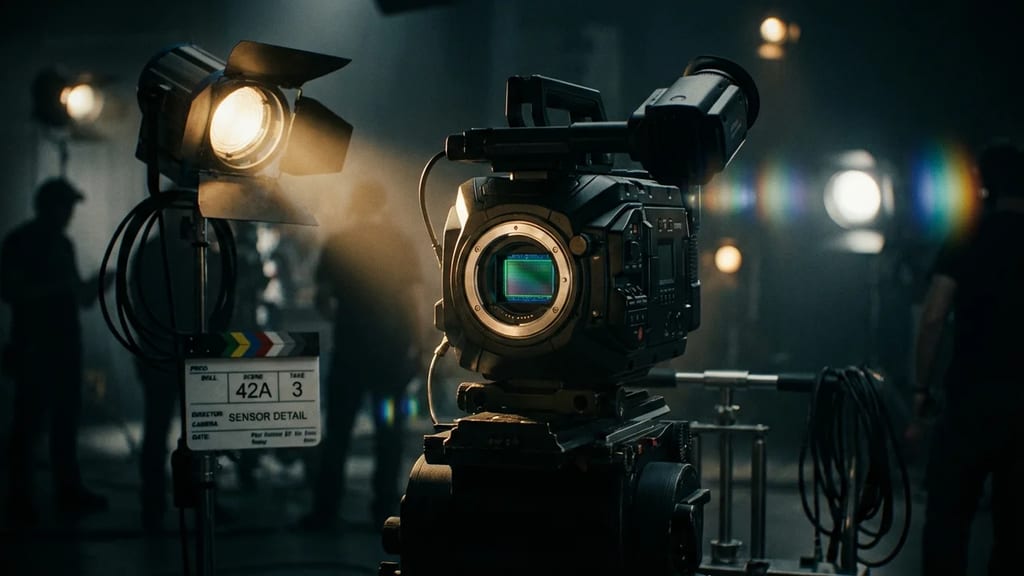
The sensor (image sensor, image converter) is the central light-sensitive component of a digital film or video camera. It is located behind the lens in the image plane and converts the incident light into an electrical signal via a grid of light-sensitive pixels (photodiodes), from which the camera calculates the digital image. In digital cinematography, the sensor has taken over the function that the film negative fulfilled in the analog workflow: it defines the image format, resolution, sensitivity to light, dynamic range, and thus the image aesthetic.
The physical size of the sensor, together with the lens, determines the angle of view and depth of field, making it one of the most important creative and technical parameters of a camera.
Sensor Technologies
Two types are distinguished in camera technology:
- CMOS (Complementary Metal-Oxide-Semiconductor): today the dominant technology in cinema and video cameras; readout is usually line by line (Rolling Shutter).
- CCD (Charge-Coupled Device): older design, largely superseded by CMOS in modern cinema cameras.
For color separation, the Bayer matrix is common, where color filters (red, green, blue) are placed in front of individual pixels, and the color information is subsequently interpolated (Debayering).
Sensor Formats
The sensor size is based on established recording formats. Commonly used formats include:
| Format | Size | Note |
|---|
| Full Frame | 36 mm x 24 mm | Based on 35mm still photography format |
| Super 35 | Manufacturer-dependent (range around 24-28 mm width) | No uniform measurement; each manufacturer deviates slightly |
While "Full Frame" with 36 mm x 24 mm is fixed, "Super 35" is a format family: different manufacturers refer to sensors of different sizes as Super 35. As a concrete example, the Super 35 sensor of the ARRI ALEXA 35 has an active area of 27.99 mm x 19.22 mm.
On-Set Usage
For camera, lighting, and grip departments, the sensor format is relevant in several ways: it determines which lenses provide a sufficient image circle (vignetting with too small an image circle), and it influences the effective focal length (crop factor) and thus the choice of optics. The sensor's sensitivity to light (base ISO/EI) and its dynamic range directly influence lighting setups and exposure decisions. When panning or with fast movements, the line-by-line readout process of CMOS sensors can lead to distortions (rolling shutter effect), which must be considered when planning movements and effects.