Overview
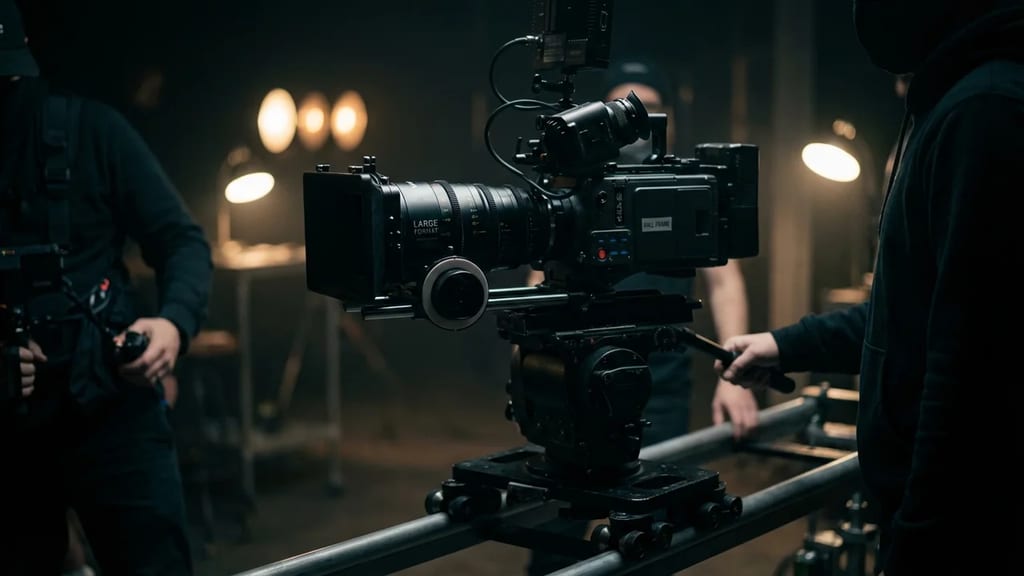
Large Format (LF) in camera and recording technology refers to all image formats whose sensor or film area is larger than the classic Super 35 format. The term encompasses several tiers: the Full-Frame format (also "Vollformat," derived from the 35mm film or VistaVision standard) and the significantly larger 65mm Large Format. In digital cinematography, "Large Format" is often used synonymously with Full Frame, but in a stricter sense, it refers to sensors that exceed the 36x24mm Full-Frame standard.
The larger recording area alters the optical image rendering compared to Super 35: for the same framing composition, the depth of field is shallower, and longer focal lengths are required for the same field of view. This results in the characteristic "Large-Format Look" with soft background separation and a gentle focus fall-off.
Format Tiers and Typical Cameras
- Super 35 – long-standing reference format, sensor area significantly smaller than Full Frame (approximately 25mm image width).
- Full Frame / Large Format – sensor size equivalent to 35mm film. Examples: ARRI Alexa LF / Alexa Mini LF, Sony VENICE, RED Monstro/V-Raptor (VV/8K), Canon C700 FF.
- 65mm Large Format – largest commonly used digital format, significantly larger than Full Frame. Example: ARRI Alexa 65.
Technical Data (Sensor Active Area)
| Format / Camera | Active Sensor Area | Source |
|---|
| Sony VENICE (Full Frame) | 36 x 24 mm | Sony Cinematography |
| ARRI Alexa Mini LF / LF | 36.70 x 25.54 mm | ARRI Technical Data |
| ARRI Alexa 65 (65mm) | 54.12 x 25.58 mm | ARRI Rental |
For comparison: a Super 35 sensor area is approximately 25mm in image width and thus significantly smaller than Full Frame. The dimensions of individual sensors vary depending on the manufacturer and the chosen recording format.
On-Set Usage
Large Format productions place special demands on lenses and focus: optics must illuminate a sufficiently large image circle ("LF Coverage"), otherwise vignetting will occur. The shallower depth of field increases the pressure on the focus assistant (1st AC) as the focus range becomes narrower. For lighting and grip, the larger format generally does not require a fundamentally different approach than with Super 35, but lighting and background separation are influenced by the look difference, impacting creative decisions.
In addition to established systems, Sony announced the RIALTO 65 in 2026, a 65mm sensor block for the VENICE 2 platform (announced sensor area approx. 53.75 x 35.83 mm, diagonal approx. 64.6 mm; market launch according to the manufacturer in the first half of 2027). This demonstrates the ongoing trend towards ever-larger recording formats in high-end cinematography.