Overview
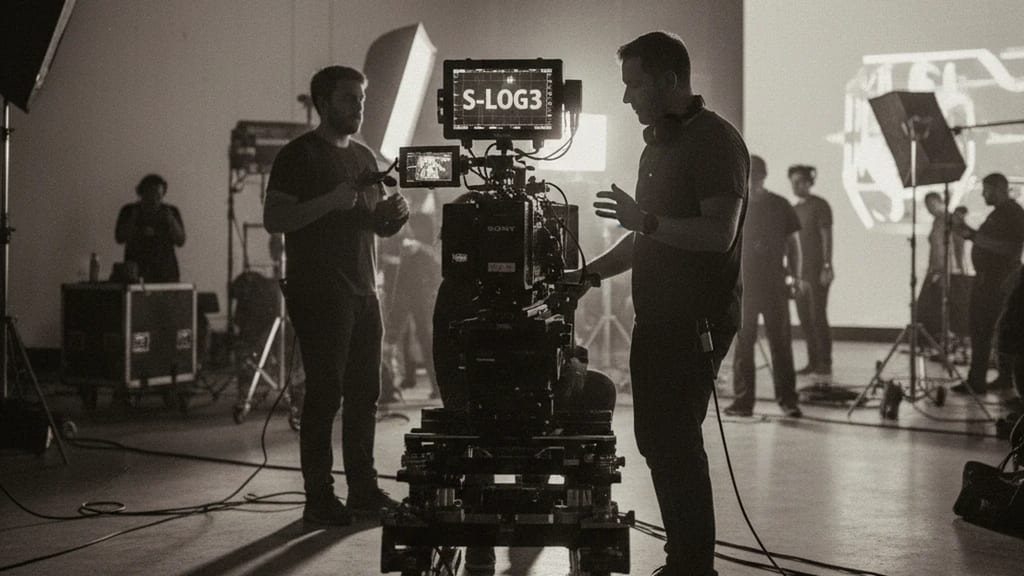
S-Log3 is a logarithmic gamma curve (log encoding) developed by Sony for recording motion pictures with a high dynamic range. It is not lighting or grip equipment, but a camera-side recording profile: tonal values are intentionally stored flat and with low contrast, so that as much latitude as possible is retained in highlights and shadows during later color grading.
S-Log3 is the third generation of the S-Log family, following S-Log and S-Log2. It is based on a film transfer curve and behaves closer to a "pure" log encoding than the older S-Log2, which facilitates log-based grading. In camera menus, it appears either under "Log Shooting Setting" (newer models) or as a Picture Profile (e.g., PP8 with S-Gamut3.Cine).
Color Space and Curve Behavior
S-Log3 is used in combination with Sony's wide-gamut color spaces:
- S-Gamut3.Cine – a slightly narrower color space designed for a film post-pipeline (according to Sony, slightly wider than DCI-P3), practical for grading.
- S-Gamut3 – a wider gamut, closer to the camera's native color space, for maximum reserve.
Characteristic of S-Log3: Above middle gray, brighter stops are distributed comparatively evenly across the available data values in the sense of log encoding (a simplification – the distribution is not exactly linear per stop across the entire range). This allows a large dynamic range to be accommodated even with limited bit depth, but at the expense of data quantity per highlight stop. The image appears flat and desaturated directly from the camera and must be viewed via a monitor LUT or Gamma Display Assist (e.g., Rec.709 display) for evaluation.
Reference Exposure Values
According to Sony's specifications, S-Log3 distributes the most important reference levels as follows:
| Reference | IRE | 10-Bit Code Value |
|---|
| 18% Middle Gray | 41% | 420 |
| 90% White | 61% | 598 |
Accordingly, many Sony cameras set Zebra marks at 41% (middle gray) and 61% (white) to correctly expose S-Log3.
On-Set Usage
S-Log3 is the central recording mode of Sony's Cinema Line and Alpha cameras (including VENICE, FX9, FX6, FX3, FX30, a7S III). For exposure, the camera is ideally set to its native base ISO, where noise behavior and latitude are best (model-dependent, e.g., ISO 800 as the lower base ISO for several models).
In CineEI mode, the S-Log3 recording, including the curve, remains unchanged for each set Exposure Index (EI); only the brightness of the monitor LUT for evaluation changes. This is the fundamental difference from ARRI's logic: with ARRI, the EI affects the actual recording – the Log-C curve and thus the exposure midpoint of the recording shifts per EI – whereas with Sony, the recording remains untouched and only the display changes. Relevant for gaffers and grips: Due to the large dynamic range, S-Log3 reacts forgivingly to high contrast, which is why on set, exposure is often pushed moderately beyond the Sony specification ("expose to the right") to reduce noise in the shadows. Consistent lighting and a defined reference color temperature facilitate the later LUT/grading workflow.