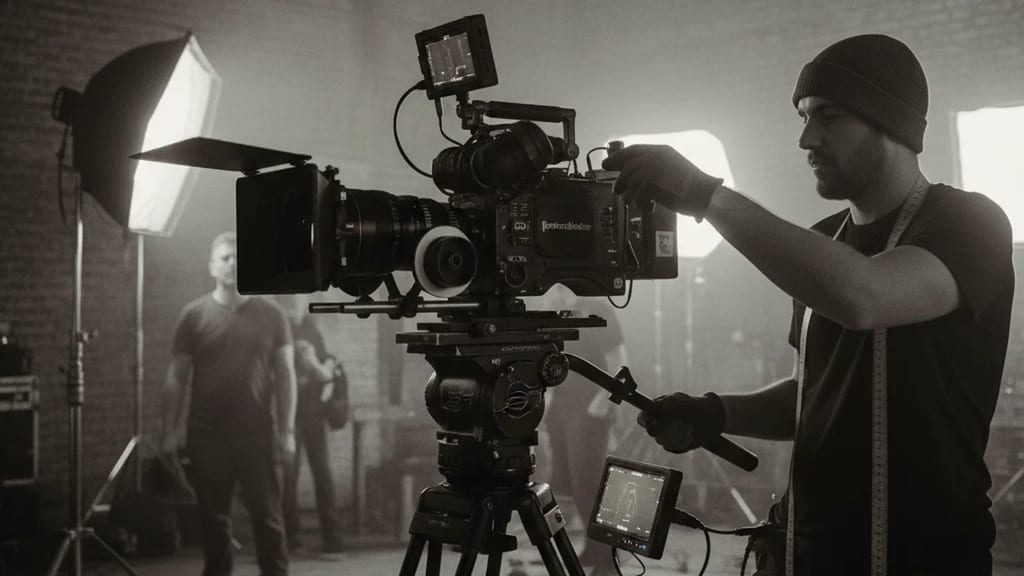
Technical Details
The flagship Atlas 30 carries payloads up to 30 kg with a tare weight of 8.5 kg and utilizes a proprietary silicone fluid system with temperature-compensated viscosity (-20°C to +60°C). The counterbalance mechanism operates with 15 precise spring stages, enabling tilt angles from +90° to -90° with constant balance. Smaller models like the Vector 7 (up to 7 kg) and Atlas 7 (up to 15 kg) complement the product line for lighter setups.
The characteristic red color scheme and CNC-milled aluminum components are hallmarks. Each head undergoes a 72-hour quality inspection with 10,000 pan and tilt movements.
History & Development
Ron Baker developed the first fluid head in 1946 upon his return from World War II, inspired by hydraulic systems from aviation. In 1962, the legendary Model 2B was created, dominating BBC and British film studios for over three decades.
In 1985, Mike Baker took over the company and modernized the product line. The breakthrough came in 1992 with the Atlas system, which perfectly combined counterbalance and fluid damping for the first time. In 2018, collaboration with Cartoni led to the Atlas-FDV series with improved locking mechanisms.
Practical Use in Film
Roger Deakins used Ronford-Baker Atlas 30 for the Steadicam sequences in "1917" (2019), as only these heads ensured the precise balance for 8-minute long takes. Hoyte van Hoytema relied on the Vector 7 for handheld IMAX shots in "Dunkirk" (2017) because its compact design offered maximum mobility.
Typical workflow: Balance adjustment takes 30 seconds, fluid adjustment is made during shooting via side knobs. The mechanical precision eliminates micro-jitters during slow pans below 0.5°/second.
Comparison & Alternatives
Sachtler heads offer similar fluid quality, but with electronic touch controls instead of mechanical precision. O'Connor heads dominate ultra-heavy setups over 45 kg. Cartoni excels in the ENG sector, while Ronford-Baker remains unbeatable in narrative productions with controlled conditions.
Miller heads cost 40% less but do not achieve the long-term stability of the handcrafted Ronford-Baker mechanics. Modern gimbal systems only replace tripod heads for specific movement patterns, not for classic pan/tilt shots.