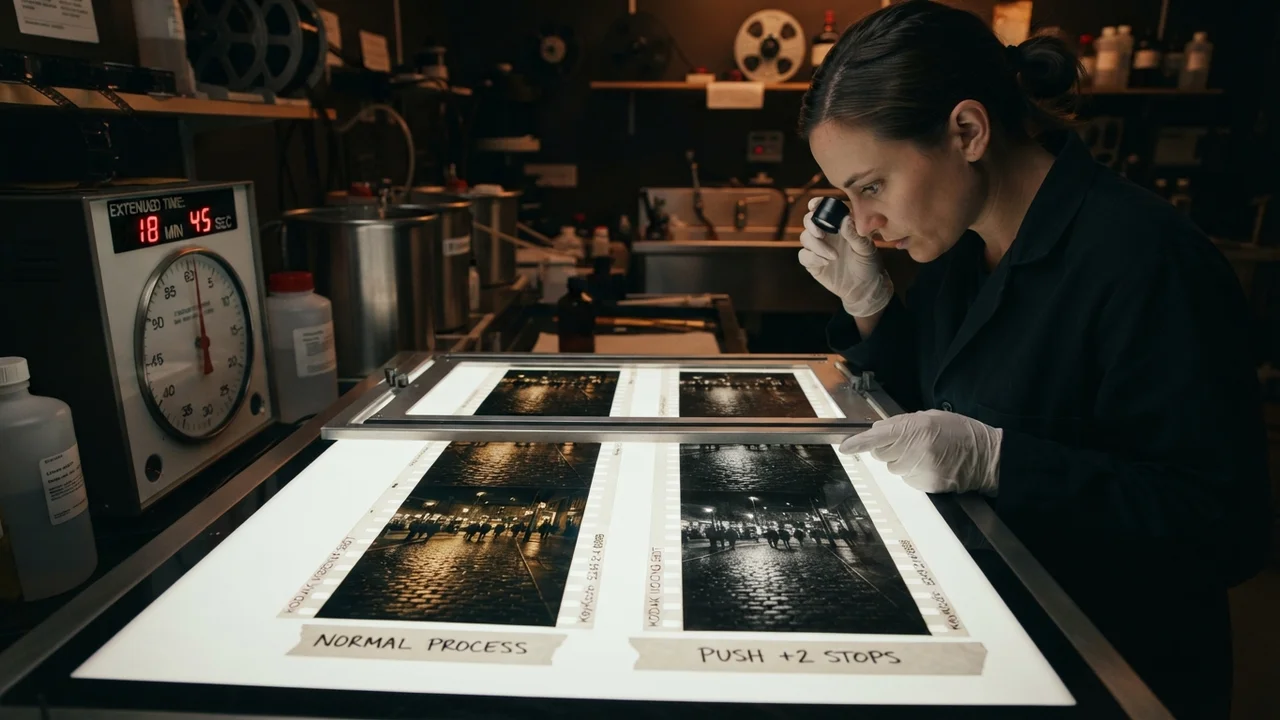
Extended lab development measured in stops: compensates underexposure while raising grain and contrast — often used deliberately as a texture tool.
Push processing means: the film is developed in the lab for longer than the standard dictates, measured in stops. A one-stop push compensates for one stop of underexposure — a 500T effectively becomes a 1000. The price: more grain, more contrast, slightly shifted colors. This very price is now often the reason for the push.
Two Motives
The classic motive is necessity — too little light, too slow stock. The creative motive dominates today: a deliberately roughened image. The counterpart is pull processing (shorter development): less contrast, finer grain, rescue in case of overexposure.
Practical Application
Pushing is done per roll, not per scene — the decision is made during shooting and goes from the camera report to the lab. Usual range: +1/2 to +2 stops. Above +2, the shadows become dense and skin tones turn harsh. Labs charge extra for push processing per roll.
Practical Tips
- Test beforehand: have the same scene developed normally and pushed — grain and contrast react very differently depending on the stock (500T tolerates push more gently than 50D).
- Expose for the shadows, push for the texture — push does not replace basic exposure, it amplifies what is there.
- Speak to the colorist early: pushed material grades differently (denser blacks, highlights clipping sooner).
- Clearly mark push rolls on the camera report — an accidentally normally developed push roll will be one stop too dark.
Related terms
Quiz
1. Was beschreibt „Push-Entwicklung" am besten?
2. Zu welchem Department gehört „Push-Entwicklung"?