Cinematographer
Photo-Sonics war das Werkzeug für Film-High-Speed bevor Digital existierte. Die 4C und 4E lieferten 35mm bei 360+ fps – echtes Kino-Slow-Motion. Der Look ist bis heute unerreicht.
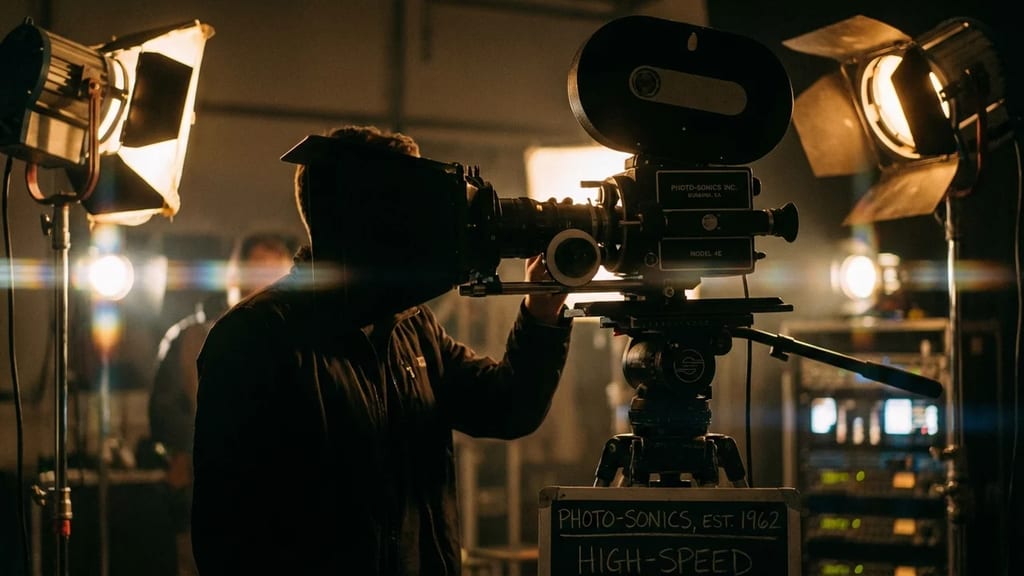
American manufacturer of film high-speed cameras since 1962. With the legendary 4B/4C/4E models, Photo-Sonics defined the standard for 35mm high-speed film in Hollywood.
Photo-Sonics is an American manufacturer of 35mm film high-speed cameras based in Burbank, California. Since 1962, the company has produced cameras for extreme frame rates on real film stock – the legendary 4B, 4C, and 4E models defined the Hollywood standard for high-speed cinematography before the digital era.
| Year | Milestone |
|---|---|
| 1962 | Founded |
| 1960s | First high-speed cameras |
| 1970s | 4 Series developed |
| 1980s | Hollywood standard |
| 1990s | 4E – 360 fps |
| 2000s | Digital competition |
| Today | Niche for film purists |
| Model | Max. fps | Format | Era |
|---|---|---|---|
| 4B | 200 | 35mm | 1970s |
| 4C | 360 | 35mm | 1980s |
| 4E | 360 | 35mm | 1990s |
| 4ER | 360 | 35mm | Reflex |
| 1VN | 500 | 16mm | Variable |
| Feature | Details |
|---|---|
| Principle | Continuous film transport |
| Compensation | Rotating prism |
| Advantage | Higher fps than claw mechanism |
| Disadvantage | Slight blur possible |
Conventional cameras stop the film for each exposure (intermittent transport). At 360 fps, the mechanical stress would destroy the film. Photo-Sonics uses continuous transport with optical motion compensation.
| Characteristic | Photo-Sonics 4E | ARRI 435 Xtreme |
|---|---|---|
| Max. fps | 360 | 150 |
| Transport | Continuous | Intermittent |
| Sharpness | Very good | Perfect |
| Cost/Min | Extremely high | High |
| Noise | Loud | Quiet |
| Shot | Film Consumed |
|---|---|
| 1 second | 5.5 m |
| 10 seconds | 55 m (half roll) |
| 1 minute | 330 m (3 rolls) |
| Item | Cost (approx.) |
|---|---|
| Film (330 m) | €1,000 |
| Processing | €500 |
| Scan (4K) | €1,500 |
| Per Minute | €3,000+ |
| Film | Year | Sequence |
|---|---|---|
| The Matrix | 1999 | Bullet-Time (element) |
| Terminator 2 | 1991 | Explosions |
| Die Hard | 1988 | Stunts |
| Lethal Weapon | 1987 | Action |
| Various commercials | 1980–2000 | Slow-motion |
| Application | fps |
|---|---|
| Explosions | 200–360 |
| Stunts | 120–200 |
| Liquids | 200–360 |
| Glass breaking | 360 |
| Component | Details |
|---|---|
| Camera | 4C or 4E |
| Magazine | 300m (1,000 ft) |
| Lens | Specialized for high-speed |
| Lighting | Enormous amounts required |
At 360 fps and 1/720s exposure, massive lighting is needed – often only possible in daylight or with cinema lights.
| Era | Standard |
|---|---|
| 1970–2000 | Photo-Sonics (film) |
| 2005–present | Phantom (digital) |
| Aspect | Details |
|---|---|
| Status | Niche |
| Availability | Very limited |
| Rental | Specialized houses |
| Application | Film purists, nostalgia |
| Competition | Phantom (dominates) |
Photo-Sonics war das Werkzeug für Film-High-Speed bevor Digital existierte. Die 4C und 4E lieferten 35mm bei 360+ fps – echtes Kino-Slow-Motion. Der Look ist bis heute unerreicht.
Bevor es Phantom gab, waren Photo-Sonics-Kameras die einzige Möglichkeit für extreme Slow-Motion in Spielfilmqualität. Jeder klassische Explosionsshot wurde damit gedreht.
Photo-Sonics-Equipment war teuer im Betrieb – enorme Filmmengen für wenige Sekunden. Aber für bestimmte Shots gab es keine Alternative.
1. Was beschreibt „Photo-Sonics" am besten?
2. Zu welchem Department gehört „Photo-Sonics"?
3. Wie viele verschiedene Fachperspektiven bietet dieser Eintrag?
The Lexikon is part of the Filmfarm ecosystem — alongside budgeting (FilmBalance), an industry magazine (FilmCircus) and crew networking (FilmCall, CrewMesh). One shared vocabulary for the whole production.