Technical Details
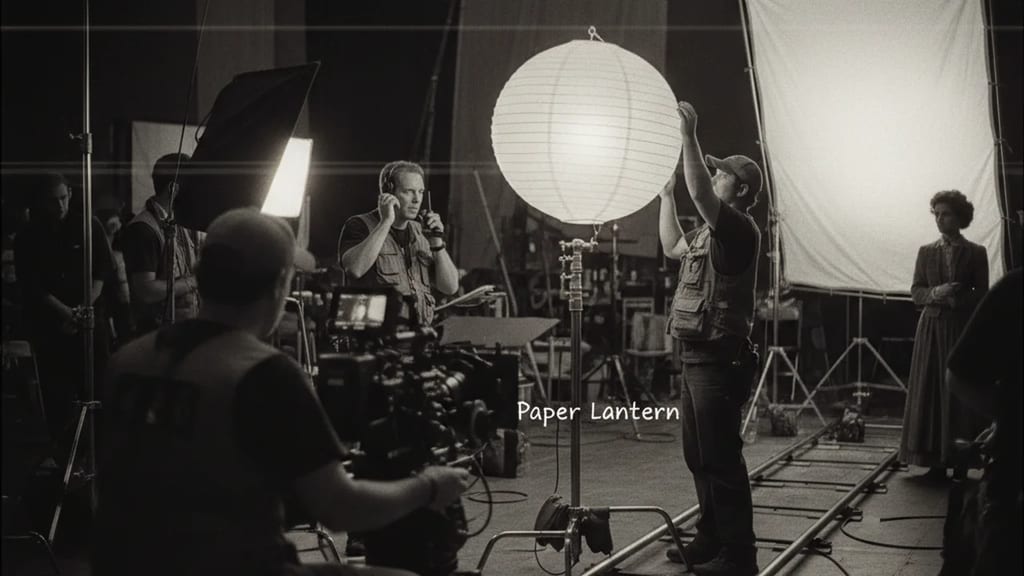
Paper lanterns consist of a collapsible wire frame made of 2-3 mm spring steel, covered with 80-120 g/m² rice paper or chintz fabric. Standard sizes range from 20 cm (8") to 150 cm (60") in diameter, with 60-90 cm being the most commonly used. Light attenuation is typically 1.5-2 stops with a color temperature shift of +200-300K warmer. Modern variants use heat-resistant Tyvek material or fire-retardant fiberglass textiles. Oval lanterns (China Balls Oval) with dimensions like 60x90 cm offer directional light distribution for portrait shots.
History & Development
Paper lanterns were first used professionally in the 1950s by documentary filmmaker Richard Leacock, who discovered them for mobile 16mm productions in Asia. Hollywood cinematographer Haskell Wexler systematically popularized them from 1965 onwards as "China Balls" for naturalistic lighting in films like "Who's Afraid of Virginia Woolf?". In the 1980s, Chimera developed versions optimized for film with reinforced suspensions and a more homogeneous light pattern. Today, manufacturers like Aputure offer LED-specific variants with precise color rendering.
Practical Use in Film
Paper lanterns simulate natural light sources like a full moon or diffuse daylight through windows. In "Her" (2013), cinematographer Hoyte van Hoytema used large 120cm lanterns as the main light for intimate apartment scenes to enhance emotional closeness. They are particularly suitable for 360° shots as they emit light evenly from all angles. Typical workflow: LED panel or Tungsten spot (2-5K) mounted centrally, lantern placed over it, height adjusted via Autopole or C-stand. Disadvantages include the fragility of the material and difficulty in controlling light direction.
Comparison & Alternatives
Unlike softboxes, paper lanterns create circular rather than rectangular catchlights in the eyes and scatter light more uncontrollably in all directions. Modern LED panels with built-in diffusion, such as Aputure Nova or ARRI SkyPanel, achieve similar light quality with more precise control but cost 50-100 times more. For controlled diffusion, Silk frames or bounce boards are suitable. Paper lanterns remain unbeatable for spontaneous available light situations and low-budget productions with a lighting budget under 1000 Euros.