Filmlexikon.
Support
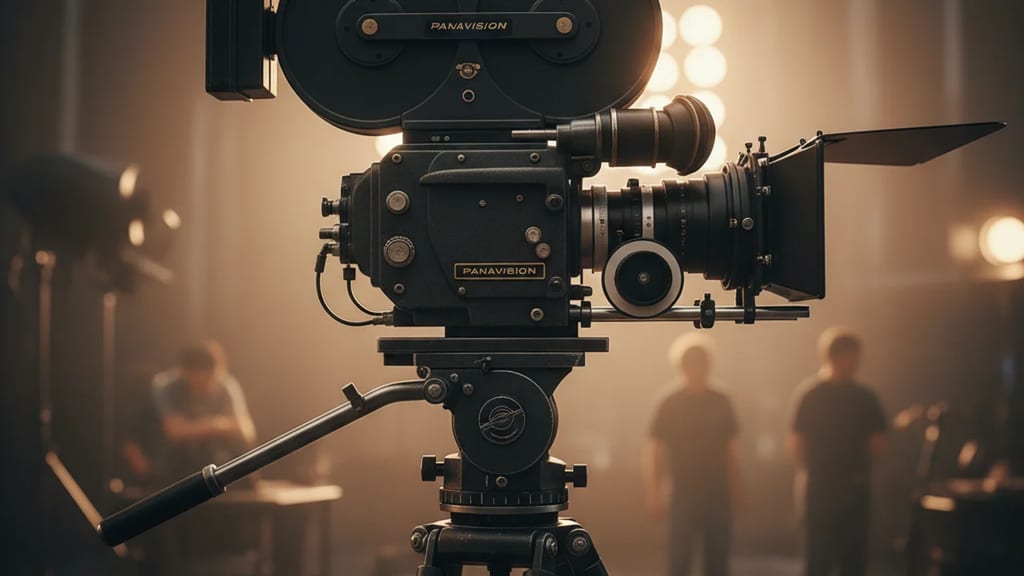
Panavision Super Panavision 70
Camera · Equipment

Panavision Super Panavision 70

Murnau AI illustration
arri skypanel astera hydrapanel company move cooke panchro cooke speed panchro led panel litepanels astra litepanels gemini

Panavision 65mm large-format system using spherical lenses and 65mm negative film, projected as 70mm prints without anamorphic compression.

Technical Details

The system uses 65mm negative film with an effective image area of 52.6mm width and 23.0mm height with a perforation of 5 holes per frame (5-perf). The camera speed is standard 24 frames per second. Super Panavision 70 operates with spherical lenses instead of anamorphic lenses, meaning no optical compression occurs. The Panavision cameras use the Mitchell movement mechanism with precise film guidance via registration pins. For cinema projection, the 65mm negative is transferred to 70mm prints, with the additional 5mm utilized for up to six magnetic soundtracks.

History & Development

Panavision introduced Super Panavision 70 in 1959 as a competitor to Todd-AO. The first film was "Ben-Hur" (1959) directed by William Wyler. The system arose from the need to offer a 70mm format without the licensing fees of Todd-AO. Robert Gottschalk, founder of Panavision, developed the system in collaboration with MGM. In the 1960s, Super Panavision 70 established itself as the preferred large format for epic films and roadshow productions.

Practical Use in Film

Notable productions include "Lawrence of Arabia" (1962), "Doctor Zhivago" (1965), and "2001: A Space Odyssey" (1968). Stanley Kubrick utilized the format for his precise compositions and the high detail resolution in space sequences. David Lean appreciated the ability to capture landscapes with extreme sharpness without anamorphic distortion. The workflow required specially equipped cinemas with 70mm projectors and magnetic sound playback, which limited screenings to premium theaters.

Comparison & Alternatives

In contrast to Panavision Anamorphic 35mm, Super Panavision 70 operates without optical compression, thus offering distortion-free images with higher resolution. Compared to Todd-AO (also 65mm/70mm), it uses different camera systems and lenses but achieves identical technical specifications. Modern alternatives include IMAX 65mm with a larger image format (70mm × 48.5mm) and digital systems like ARRI Alexa 65. Today, Super Panavision 70 is used for projects that aim to combine analog large-format aesthetics with a classic aspect ratio.
From the crafts

Perspectives

Cinematographer

Als DoP schätze ich bei Super Panavision 70 die extreme Schärfentiefe und Detailauflösung, die selbst feinste Texturen in Weitwinkelaufnahmen präzise wiedergibt. Das sphärische System eliminiert die Randverzerrungen anamorpher Optiken, wodurch ich Horizontlinien und Architektur ohne Korrekturen komponieren kann. Die größere Filmfläche erlaubt mir aggressive Crops in der Postproduktion ohne Qualitätsverlust.

Director

Ich nutze das 2,20:1-Format für epische Erzählungen, wo die Breite der Leinwand Landschaften und Menschenmassen gleichermaßen zur Geltung bringt. Die analoge Körnigkeit des 65mm-Films verleiht historischen Stoffen eine organische Textur, die digital schwer replizierbar ist. Super Panavision 70 zwingt mich zu präziser Bildkomposition, da jedes Detail gestochen scharf wiedergegeben wird.

Producer

Super Panavision 70 bedeutet Mehrkosten von 300-400% gegenüber 35mm durch teure Filmrohstoffe, spezialisierte Kamera-Crews und aufwendige Postproduktion. Ich plane nur 15-20% der ursprünglich geplanten Drehtage, da Setup-Zeiten und Filmwechsel deutlich länger dauern. Die limitierte Anzahl kompatibler Kinos erfordert eine sorgfältige Distributionsstrategie mit Fokus auf Premium-Standorte.

More in the lexikon

Related terms

Test your knowledge

Quiz

1. Was beschreibt „Panavision Super Panavision 70" am besten?

2. Zu welchem Department gehört „Panavision Super Panavision 70"?

3. Wie viele verschiedene Fachperspektiven bietet dieser Eintrag?

Report an error
From the Filmfarm ecosystem

Understand visual language, budget productions, connect crew.

The Lexikon is part of the Filmfarm ecosystem — alongside budgeting (FilmBalance), an industry magazine (FilmCircus) and crew networking (FilmCall, CrewMesh). One shared vocabulary for the whole production.

FilmFarm FilmRadarComing soonFilmPulseComing soonFilmNumbersComing soonFilmCapitalComing soonFilmLabComing soonFilmBalanceComing soonFilmCircusComing soon