Filmlexikon.
Support
Panavision Super Speed
Camera · Equipment

Panavision Super Speed

Murnau AI illustration
arri skypanel astera hydrapanel company move cooke panchro cooke speed panchro led panel litepanels astra litepanels gemini

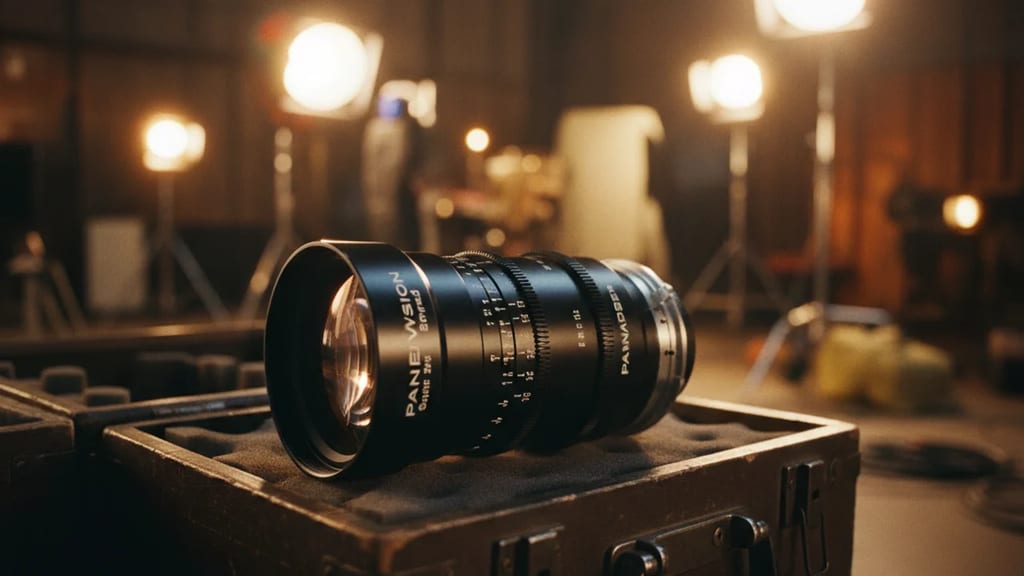
High-speed lens series by Panavision with apertures up to T1.4, enabling low-light shooting with shallow depth of field.

Technical Details

The series comprises eight focal lengths: 24mm, 28mm, 35mm, 40mm, 50mm, 55mm, 75mm, and 85mm, all with a constant T1.4 aperture. The optical design is based on a modified Gauss construction with 6-8 lens elements depending on the focal length. The minimum focus distance ranges from 45-60cm, depending on the focal length. A special feature is the spherical aberration at wide-open aperture, which creates a characteristic "glow" effect around bright light sources. The filter thread diameter is uniformly 95mm, and the housing weighs between 2.8 and 4.2 kg.

History & Development

Panavision developed the Super Speeds starting in 1969 under the direction of Tak Miyagishima in response to the demand for faster lenses for available light shooting. First production use was in 1971 for "The French Connection." Production ended in 1980 with approximately 200 complete sets. In 2010, Panavision introduced the "Super Speed Rehoused" – the original optics in modern PL-mount housings. Since 2019, Panavision has been producing limited reissues of the original construction.

Practical Use in Film

Stanley Kubrick used the Super Speeds for the famous candlelight scenes in "Barry Lyndon" (1975), combined with special f/0.7 NASA lenses. Michael Ballhaus used them in "Goodfellas" (1990) for the low-light sequences in the Copacabana. The characteristic spherical aberration at T1.4 creates a soft, dreamy look with pronounced lens flares. Modern productions like "Her" (2013) or "Moonlight" (2016) use the rehoused versions for their organic, intimate image style. The workflow requires precise focus pulling, as the depth of field at T1.4 is extremely shallow.

Comparison & Alternatives

Unlike modern T1.3 lenses such as the Leica Summilux-C, the Super Speeds exhibit significantly more optical "personality" through aberrations and vignetting. Zeiss Super Speeds (T1.3) offer similar light sensitivity but a more neutral rendering. Modern alternatives include Sigma Cine High Speed (T1.5) or the Cooke S7/i (T2.0). The Super Speeds are chosen when the characteristic vintage look is desired, while modern alternatives are preferred for technically demanding productions or 4K/8K shooting.
From the crafts

Perspectives

Cinematographer

Ich setze die Super Speeds gezielt für ihren einzigartigen Low-Light-Look ein – bei T1.4 bekomme ich diesen warmen Glow um Lichtquellen, der digital nicht replizierbar ist. Das Fokus-Pulling wird zur Herausforderung, da bei 50mm und T1.4 nur wenige Zentimeter scharf sind, aber genau das erzeugt diese intime Bildsprache. Die sphärischen Aberrationen am Bildrand nutze ich bewusst für emotionale Höhepunkte.

Director

Die Super Speeds geben mir die Möglichkeit, auch bei schwächstem Licht noch natürlich zu drehen, ohne auf künstliche Beleuchtung angewiesen zu sein – das macht die Schauspielerführung authentischer. Der charakteristische Glow verstärkt romantische oder nostalgische Momente, während die geringe Schärfentiefe meinen Protagonisten vom Hintergrund isoliert. Ich kann Intimität visuell verstärken, ohne explizit darüber sprechen zu müssen.

Producer

Ein kompletter Super Speed-Satz kostet 150.000-200.000 Dollar in der Anschaffung, die Tagesmiete liegt bei 800-1.200 Dollar – deutlich mehr als Standard-Optiken. Dafür spare ich Beleuchtungskosten bei Available Light-Szenen und verkürze Setup-Zeiten. Die begrenzte Verfügbarkeit erfordert frühzeitige Buchung, besonders bei A-Produktionen. Der Vintage-Look rechtfertigt die Mehrkosten, wenn er zum Projekt passt.

More in the lexikon

Related terms

Test your knowledge

Quiz

1. Was beschreibt „Panavision Super Speed" am besten?

2. Zu welchem Department gehört „Panavision Super Speed"?

3. Wie viele verschiedene Fachperspektiven bietet dieser Eintrag?

Report an error
From the Filmfarm ecosystem

Understand visual language, budget productions, connect crew.

The Lexikon is part of the Filmfarm ecosystem — alongside budgeting (FilmBalance), an industry magazine (FilmCircus) and crew networking (FilmCall, CrewMesh). One shared vocabulary for the whole production.

FilmFarm FilmRadarComing soonFilmPulseComing soonFilmNumbersComing soonFilmCapitalComing soonFilmLabComing soonFilmBalanceComing soonFilmCircusComing soon