Filmlexikon.
Support
Overtonal Montage
Editing · Terms

Overtonal Montage

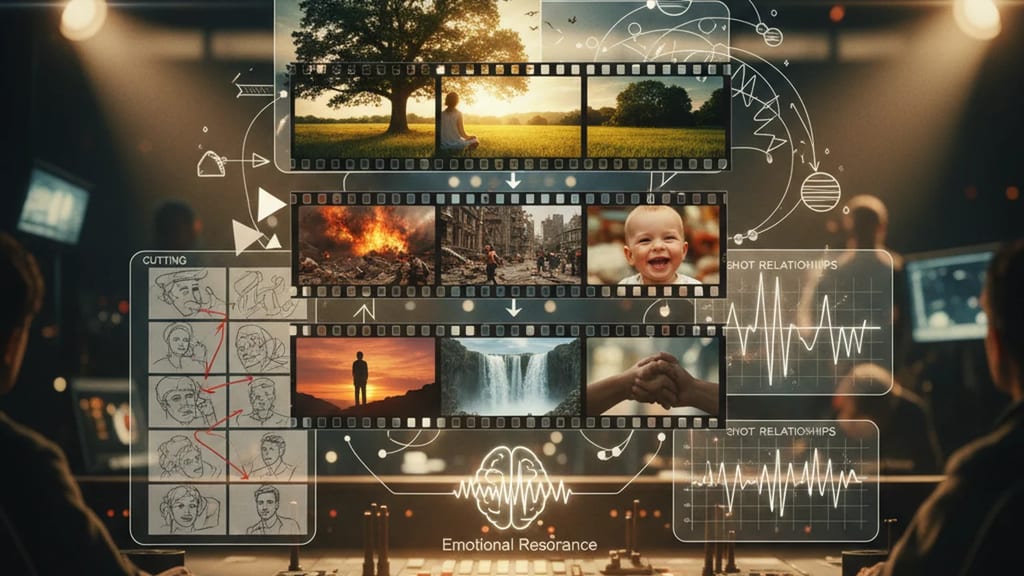
Murnau AI illustration
flow montage roll tonal montage

Eisenstein's montage technique combining three or more methods (metric, rhythmic, tonal, contrapuntal) to create emotional resonance in the viewer.

Technical Details

Overtonal Montage functions through the interplay of at least three of the four basic montage types: metric editing sequences (usually 24-48 frames per cut), rhythmic movement patterns within shots, tonal brightness and color values, and contrapuntal contrasts. The resulting emotional resonances cannot be calculated mathematically but arise from the overall effect. Eisenstein distinguished between primary overtones (direct emotional reactions) and secondary overtones (complex psychological associations).

History & Development

Eisenstein developed the concept in 1929 in his theoretical essay "Beyond the Shot." The first practical application of Overtonal Montage was in "The General Line" (1929), and it was systematically elaborated in "Alexander Nevsky" (1938) and "Ivan the Terrible" (1944/46). The theory influenced the Nouvelle Vague of the 1960s, particularly Godard's "Breathless" (1960). Modern applications can be found in filmmakers like Terrence Malick, who creates overtone effects through nature imagery and classical music in "The Tree of Life" (2011).

Practical Application in Film

A classic example is the crematorium sequence in "Night and Fog" (1956), where Resnais creates an overtone of grief through the combination of static black-and-white shots, slow camera movements, and Hanns Eisler's music. Kubrick's "2001" (1967) uses Overtonal Montage in the Star Gate sequence: metric flashes of light, rhythmic color changes, and Ligeti's atonal music create psychedelic states of consciousness. The workflow requires precise planning from the screenplay stage, as all design levels must be coordinated.

Comparison & Alternatives

Overtonal Montage differs from intellectual montage by its unconscious effect – while intellectual montage provokes rational conclusions, Overtonal Montage aims for emotional resonances. Modern digital color correction and sound design allow for more precise overtone effects than in Eisenstein's time. Alternative terms include "associative montage" or "psychological montage," although Overtonal Montage specifically refers to the synthesis of multiple montage levels, not just thematic connections.
From the crafts

Perspectives

Cinematographer

Ich muss bei Obertonmontage-Sequenzen bereits beim Dreh die tonalen Werte und Bewegungsrichtungen präzise planen, da diese später die emotionale Wirkung bestimmen. Die Belichtung wird zur dramaturgischen Komponente – jede Einstellung braucht einen definierten Helligkeitswert, der sich in die Gesamtkomposition einfügt. Spontane Korrekturen in der Post sind kontraproduktiv, da sie die geplante Obertonwirkung zerstören.

Director

Ich nutze Obertonmontage, um Emotionen zu transportieren, die sich nicht in Dialogen ausdrücken lassen – Melancholie, Sehnsucht oder existenzielle Angst entstehen durch die Synthese von Bild, Schnitt und Ton. Bei "traumartigen" Sequenzen plane ich bewusst Obertöne ein, die das Unterbewusstsein der Zuschauer ansprechen. Die Gefahr liegt darin, zu manipulativ zu werden – Obertonmontage funktioniert nur bei authentischen Emotionen.

Producer

Obertonmontage-Sequenzen sind kostspielig, da sie intensive Vorplanung und längere Postproduktion erfordern – rechne mit 40% mehr Schnittzeit als bei konventioneller Montage. Der Erfolg lässt sich schwer in Testscreenings messen, da die Wirkung unterbewusst erfolgt. Kommerziell riskant, aber bei Festivalfilmen ein Differenzierungsmerkmal – "Tree of Life" gewann Cannes trotz durchwachsener Publikumsreaktionen.

More in the lexikon

Related terms

Test your knowledge

Quiz

1. Zu welchem Department gehört „Obertonmontage"?

2. Wie viele verschiedene Fachperspektiven bietet dieser Eintrag?

Report an error
From the Filmfarm ecosystem

Understand visual language, budget productions, connect crew.

The Lexikon is part of the Filmfarm ecosystem — alongside budgeting (FilmBalance), an industry magazine (FilmCircus) and crew networking (FilmCall, CrewMesh). One shared vocabulary for the whole production.

FilmFarm FilmRadarComing soonFilmPulseComing soonFilmNumbersComing soonFilmCapitalComing soonFilmLabComing soonFilmBalanceComing soonFilmCircusComing soon