Cinematographer
Der OTS ist mein Arbeitspferd für Dialoge. Er verbindet zwei Personen im Bild, zeigt wer spricht und wer zuhört. Die Schärfe, die Schulter-Position, der Bildausschnitt – alles muss stimmen.
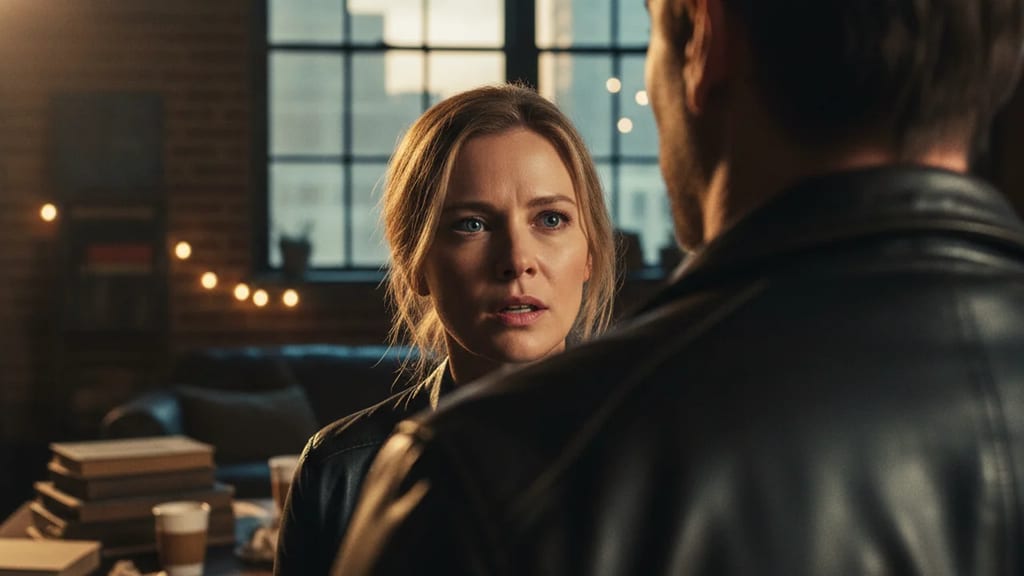
The camera looks over the shoulder of one person at another – standard for dialogue. Establishes spatial relationship and eyeline between characters.
The OTS (English: Over-the-Shoulder Shot or Over-Shoulder) shows a person over the shoulder of another. The foreground figure is out of focus, the background figure is in sharp focus. Standard for dialogue scenes and spatial orientation.
| Aspect | Details |
|---|---|
| Camera Position | Behind a figure |
| Direction of View | Towards a second figure |
| Foreground | Shoulder/Head (out of focus) |
| Focus | On the speaking person |
| Element | Position | Function |
|---|---|---|
| Shoulder | Edge of frame, out of focus | Framing, orientation |
| Head Cut-off | Often visible | Shows who is listening |
| Focus Person | Center/Thirds | Main subject |
| Headroom | Minimal | Closeness |
| Variant | Shoulder Percentage | Effect |
|---|---|---|
| Dirty OTS | Lots of shoulder | More presence |
| Clean OTS | Little shoulder | More focused |
| Tight OTS | Very tight | Intense |
| Effect | Description |
|---|---|
| Connection | Two people in dialogue |
| Orientation | Who is looking at whom? |
| Closeness | Closer than a two-shot |
| Perspective | Viewer "behind" the figure |
| Function | Application |
|---|---|
| Dialogue | Visualizing conversations |
| Confrontation | Building tension |
| Interview | Documentary style |
| Reaction | Showing the listener |
| Shot | Description | Usage |
|---|---|---|
| Master | Two-shot | Overall overview |
| OTS A | Over A onto B | B is speaking |
| OTS B | Over B onto A | A is speaking |
| Single A | Only A | Close-up emotion |
| Single B | Only B | Close-up emotion |
| Cut | Shot | Rule |
|---|---|---|
| Cut 1 | OTS A→B | B is speaking |
| Cut 2 | OTS B→A | A is answering |
| Cut 3 | OTS A→B | B is reacting |
| Film | Director | Special Feature |
|---|---|---|
| Casablanca | Curtiz | Classic Hollywood |
| The Godfather | Coppola | Dark, tight OTS |
| Heat | Mann | Café scene |
| Marriage Story | Baumbach | Emotional intensity |
| Characteristic | Description |
|---|---|
| Characteristic | Lots of shoulder in the frame |
| Effect | Presence, weight |
| Application | Confrontation |
| Characteristic | Description |
|---|---|
| Characteristic | Little shoulder |
| Effect | More focused |
| Application | Emotion in the foreground |
| Characteristic | Description |
|---|---|
| Characteristic | More space visible |
| Effect | Context |
| Application | Establishing in dialogue |
| Parameter | Recommendation |
|---|---|
| Focal Length | 50–85mm |
| Aperture | f/2.8–4 (shallow depth of field) |
| Eye Level | Of the focus person |
| 180° Rule | Absolutely adhere to |
| Mistake | Solution |
|---|---|
| Too much shoulder | Reduce cropping |
| Crossing the Line | Observe the 180° axis |
| Both in focus | Open aperture |
| No nose | Reposition shoulder |
| Shot | Characteristic | Connection |
|---|---|---|
| OTS | Over the shoulder | High |
| Two-Shot | Both in frame | Medium |
| Single | Only one person | Low |
| Subjective | Eyes of a person | Maximum |
| Element | Explanation |
|---|---|
| Axis | Imaginary line between figures |
| Rule | Camera always on one side |
| Break | Confusion, jump |
| OTS A | OTS B | Result |
|---|---|---|
| Left of axis | Left of axis | ✓ Correct |
| Left of axis | Right of axis | ✗ Jump |
The OTS is the backbone of the dialogue scene – so fundamental that its absence is noticeable.
| Aspect | Details |
|---|---|
| Frequency | Very frequent |
| Equipment | Standard setup |
| Cost | No additional |
| Trend | More experimental alternatives |
Some filmmakers (e.g., Refn, Villeneuve) avoid classic OTS in favor of singles or unconventional angles – a conscious deviation from the standard.
Der OTS ist mein Arbeitspferd für Dialoge. Er verbindet zwei Personen im Bild, zeigt wer spricht und wer zuhört. Die Schärfe, die Schulter-Position, der Bildausschnitt – alles muss stimmen.
Der OTS gibt dem Zuschauer einen Platz im Gespräch. Er ist näher als der Two-Shot, aber verbundener als der Single. Für die meisten Dialoge ist er meine erste Wahl.
OTS-Coverage ist Standard – zwei Kamerapositionen für ein Gespräch. Effizient und schnittfreundlich. Jeder Editor kann damit arbeiten.
1. Was beschreibt „Über-die-Schulter-Aufnahme" am besten?
2. Zu welchem Department gehört „Über-die-Schulter-Aufnahme"?
3. Wie viele verschiedene Fachperspektiven bietet dieser Eintrag?
The Lexikon is part of the Filmfarm ecosystem — alongside budgeting (FilmBalance), an industry magazine (FilmCircus) and crew networking (FilmCall, CrewMesh). One shared vocabulary for the whole production.