Filmlexikon.
Support
Single
Directing · Terms

Single

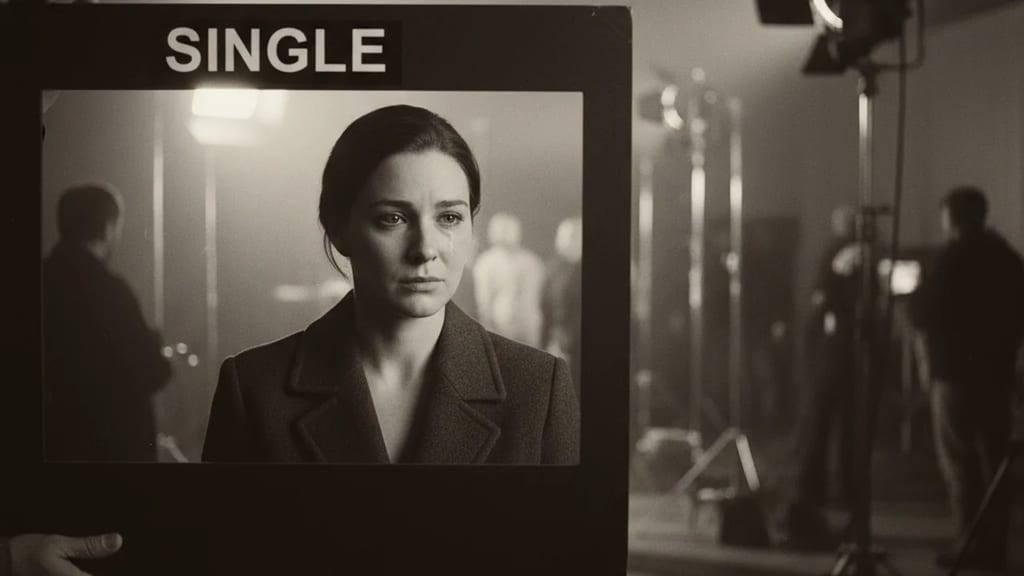
Murnau AI illustration
close up reaction shot coverage

A shot that frames a single character in isolation, typically used for emotional close-ups, reactions, or to focus viewer attention on one person.

Definition

The Single (German: Einer) is a camera shot that isolates a single character. Unlike a two-shot or a master shot, only one character is visible within the frame. A single can be wide (showing the full body) or tight (showing the face).

Functions of the Single

Emotional Focus

  • Concentrates attention on one person
  • Reveals inner psychological depth
  • Creates intimate moments

Showing Reaction

  • Demonstrates how a character reacts to something
  • Off-screen action becomes apparent through reaction
  • Emotional punctuation without dialogue

Isolation

  • Depicts a character's loneliness or isolation
  • A psychological statement
  • Can be metaphorical

Dialogue Variety

  • Alternative to two-shots or over-the-shoulder shots
  • Establishes visual rhythm
  • Gives the audience time to reflect

Types of Singles

Tight Single

  • Head and shoulders
  • Very intimate
  • Maximum emotional proximity

Medium Single

  • Head to waist
  • Classic
  • Balances intimacy and context

Wide Single

  • Shows the entire body
  • Context is important
  • Less intimate

Profile Single

  • Side profile
  • Psychologically interesting
  • Less direct connection with the audience

Three-Quarter Single

  • Slightly turned away
  • Appears natural
  • Often preferred

"Persona" (Bergman, 1966)

Bergman uses long singles of faces. Often minimally cut, long takes. The faces become landscapes of psychological complexity.

"Taxi Driver" (Scorsese, 1976)

Robert De Niro's solo shots in the monologue scenes. The singles become a psychological deconstruction of the character.

"The Wrestler" (Aronofsky, 2008)

Long, uncomfortable singles of Mickey Rourke's face. The shots avoid beautification – they show vulnerability and age.

"Stalker" (Tarkovsky, 1979)

Long singles of characters. The shots are meditative and psychologically intense.

Single vs. Close-up vs. Reaction

Single

  • Frame shows one character
  • Can be various sizes
  • Wider than just the face
  • Often includes background

Close-up

  • Very tight
  • Typically just the face
  • Maximum detail
  • Most intimate framing

Reaction Shot

  • Specific reaction to something
  • Temporally limited
  • Psychological reaction is central
  • Often used as a cutaway

Single Planning

Pre-Production

  1. Determine framing – Tight, Medium, or Wide?
  2. Lens choice – 85-135mm for intimacy, 35-50mm for context
  3. Background – Out-of-focus or relevant?
  4. Lighting – Direct or diffused?
  5. Movement – Static or with camera movement?

Production

  1. Position character on mark
  2. Fine-tune lighting – face must be interesting
  3. Focus precisely on the eyes
  4. Shoot multiple takes for different moods
  5. Rehearse camera movement if necessary

Post-Production

  • Length of individual shots is crucial
  • Edit balanced with other shots
  • Color grading coherent
  • Timing for emotional impact

Common Mistakes with Singles

Boring Lighting

  • Too flat, no modeling
  • Face is uninteresting
  • Looks dull

Incorrect Focus

  • Not on the eyes
  • Background sharper than the face
  • Distracting

Too Long Without a Cut

  • Audience becomes impatient
  • Timing is lost
  • If long, it must be psychologically powerful

Lack of Context

  • Audience doesn't know what's happening
  • Too intimate for the context
  • Isolation is unintentional

Singles in Different Genres

Drama

  • Subtle and psychological
  • Longer singles
  • Focus on inner feelings

Horror

  • Often used for suspense
  • Can feel unsettling
  • Often combined with visual effects

Thriller

  • Fast rhythm
  • Reveals psychological states
  • Often used with dialogue

Comedy

  • Reaction singles
  • Timing is central
  • Can be humorous or poignant

Action

  • Fewer singles
  • If used, then for context
  • Quickly cut

Technical Specifications

  • Focal Length: 50-135mm (depending on desired intimacy)
  • Aperture: f/2.0 - f/2.8 (for depth)
  • Focus: Precise on the eyes
  • Lighting: Sculpting, interesting
  • Length: 2-30 seconds depending on context

The single is simple, but when executed correctly, it can deliver the most powerful emotional statement in a film. A great single is all you need.

From the crafts

Perspectives

Cinematographer

Ein Einer erfordert subtile Beleuchtung. Das Gesicht muss interessant sein, aber nicht zu kalt oder zu hart. Ich nutze oft längere Brennweiten (85-135mm) um das Gesicht vom Hintergrund zu isolieren. Das schafft psychologische Intensität und Nähe.

Director

Der Einer ist mein emotionales Werkzeug. Mit einem Einer kann ich die ganze Aufmerksamkeit auf die innere Welt eines Charakters legen. Ein guter Einer sagt mehr als Dialog. Manchmal brauche ich einen langen, unbewegten Einer um die psychologische Wahrheit eines Moments einzufangen.

Editor

Einer sind meine emotionalen Werkzeuge. Sie erlauben mir längere Momente zu erzählen und psychologische Tiefe zu schaffen. Ein langer Einer kann einen Dialog tragen oder unterbrechen. Manchmal ist ein einfacher Einer die stärkste emotionale Aussage.

Producer

Einer brauchen Extra-Setup-Zeit – jede Single braucht individuelle Beleuchtung. Aber Einer sind essential für Schnitt-Flexibilität. Ein guter Einer kann schlechte Coverage retten. Ich budgetiere Einer-Zeit als essentiell, nicht optional.

More in the lexikon

Related terms

Test your knowledge

Quiz

1. Zu welchem Department gehört „Einer / Einzelaufnahme"?

2. Wie viele verschiedene Fachperspektiven bietet dieser Eintrag?

Report an error
From the Filmfarm ecosystem

Understand visual language, budget productions, connect crew.

The Lexikon is part of the Filmfarm ecosystem — alongside budgeting (FilmBalance), an industry magazine (FilmCircus) and crew networking (FilmCall, CrewMesh). One shared vocabulary for the whole production.

FilmFarm FilmRadarComing soonFilmPulseComing soonFilmNumbersComing soonFilmCapitalComing soonFilmLabComing soonFilmBalanceComing soonFilmCircusComing soon