Technical Details
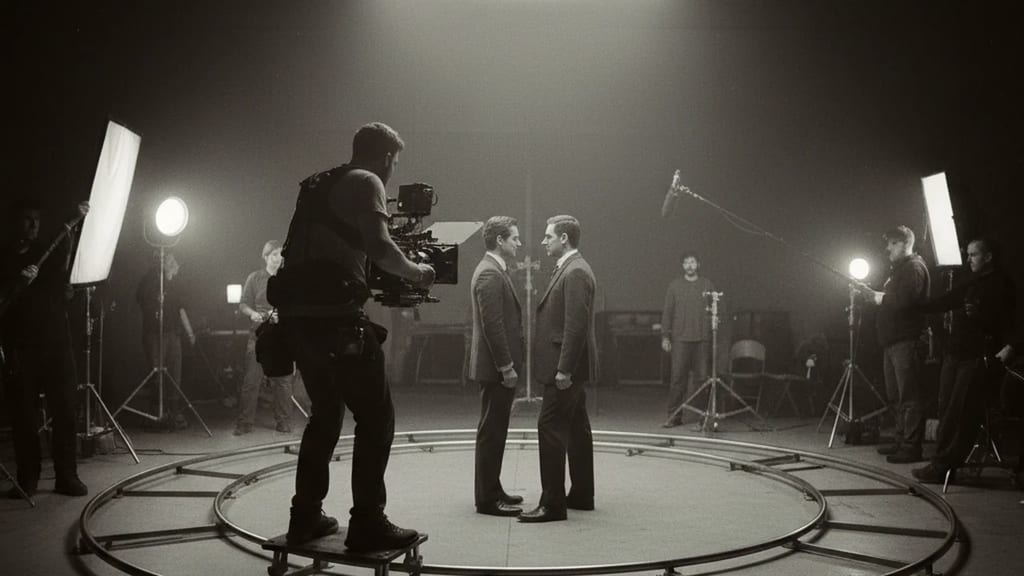
Traditionally, the orbit shot is realized with dollies on circular track systems, using standard radii of 3m, 5m, and 8m. Modern gimbal systems like the MōVI Pro achieve rotation speeds of up to 360°/s with positional accuracy of ±0.02°. Technocranes additionally enable vertical movement components with a reach of up to 22 meters. Drone-based orbit shots operate at altitudes between 3 and 120 meters with GPS-assisted path tracking and a deviation tolerance of under 30 centimeters.
History & Development
The first documented orbit shots originated in 1927 in F.W. Murnau's "Sunrise" using hand-pushed dollies on improvised circular tracks. Stanley Kubrick perfected the technique in 1968 in "2001: A Space Odyssey" with precision-engineered 360° track systems. The breakthrough came in 1999 with "The Matrix" and the "Bullet Time" technique, which used 120 static cameras in a 360° array. Since 2010, computer-controlled gimbal systems and drones have dominated the market, enabling GPS-assisted orbit shots with millimeter precision.
Practical Application in Film
Martin Scorsese uses a 180° orbit shot in "Goodfellas" (1990) in the Copacabana club at a speed of 45°/s. Darren Aronofsky employs extreme close-ups with 270° rotations in "Requiem for a Dream" (2000) to create disorientation. The planning phase requires precise surveying of the location and calculation of lighting for every angle. Modern productions use Virtual Reality for pre-visualization of the camera path.
Comparison & Alternatives
In contrast to a pan movement, the spatial position of the camera continuously changes during an orbit shot. The 360° camera arrays from "The Matrix" have been replaced by slow-motion drone shots, which are more cost-effective and flexible. Steadicam orbit shots offer more spontaneity but do not achieve the mechanical precision of track systems. For budgets under €50,000, gimbal solutions dominate; above that, Technocranes or specialized motion control systems are typically used.