Filmlexikon.
Support
Oreston 50
Camera · Terms

Oreston 50

Murnau AI illustration
flow para roll take

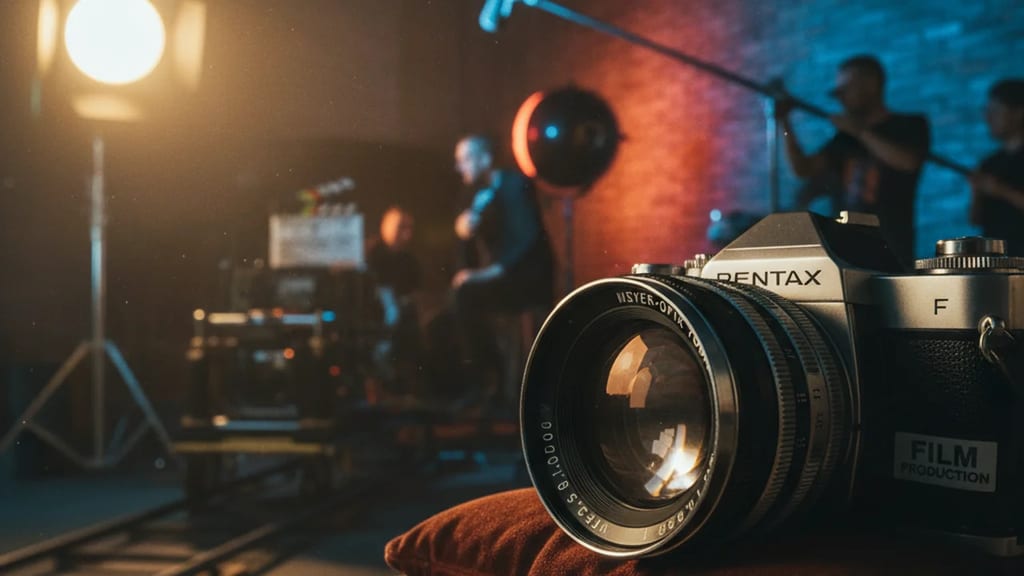
Meyer-Optik Görlitz 50mm f/1.8 lens with six elements, developed 1959 for 16mm film. Known for soft bokeh and neutral color rendition.

Technical Details

The Oreston 50 f/1.8 features six lens elements in four groups, a 43.3mm image circle diameter, and a minimum focusing distance of 0.5 meters. The aperture can be adjusted steplessly from f/1.8 to f/16, with the aperture blades creating an approximately round opening. The lens weighs 285 grams with a physical length of 42mm and uses the standard M42 screw mount. A rare variant for professional 16mm film cameras was manufactured with an Arriflex mount and achieved a maximum aperture of f/1.4.

History & Development

Meyer-Optik Görlitz introduced the Oreston 50 in 1959 as an evolution of the Primotar design. Chief designer Harry Zöllner specifically developed the lens formula for the emerging 16mm film market of GDR film studios. After reunification, Pentacon GmbH took over production in 1991 but ceased it again in 1997. Since 2014, the re-established Meyer Optik Görlitz has been producing a modern version with multi-layer coating and optimized mechanics.

Practical Use in Film

The Oreston 50 was used in DEFA productions of the 1960s, including Frank Beyer's "Spur der Steine" (1966), where it was employed for portrait shots and available-light scenes. Its characteristic bokeh quality with slight softness towards the edges and neutral color rendering made it a preferred lens for documentary work. Cinematographers appreciated its short minimum focusing distance for close-ups and its low distortion in interior architectural shots.

Comparison & Alternatives

Compared to the contemporary Zeiss Pancolar 50mm f/1.8, the Oreston exhibits a softer transition into blur but lower contrast at wide apertures. The West German Schneider-Kreuznach Xenon 50mm f/1.9 achieves higher resolution but costs three times as much. Modern alternatives like the Zeiss Planar T* 50mm f/1.4 or the Canon EF 50mm f/1.8 STM offer better optical correction and autofocus but do not reproduce the Oreston's characteristic vintage look.

From the crafts

Perspectives

Cinematographer

Ich verwende das Oreston 50 gezielt für Szenen, wo ich diesen weichen, leicht träumerischen Look brauche – die Offenblende gibt mir eine schöne Hauttextur bei Porträts, auch wenn die Schärfe in den Ecken etwas abfällt. Bei Available-Light-Situationen ist die f/1.8-Öffnung gerade noch ausreichend, aber ich muss mit dem etwas trägen Fokussierring leben und plane entsprechend mehr Zeit für präzise Schärfenzieherei ein.

Director

Das Oreston transportiert diese nostalgische, leicht melancholische Stimmung der 60er Jahre, die perfekt zu Rückblenden oder Coming-of-Age-Geschichten passt. Die Art, wie es Licht streut und Hautpartien weich zeichnet, verleiht meinen Charakteren eine verletzliche, authentische Ausstrahlung – besonders in emotionalen Nahaufnahmen wirkt es weniger steril als moderne Objektive.

Producer

Mit 800-1200 Euro für ein gebrauchtes Oreston liegt es preislich im mittleren Segment der Vintage-Objektive, aber die Verfügbarkeit ist kritisch – oft warten wir wochenlang auf ein brauchbares Exemplar. Die M42-Adaptierung auf moderne Kameras erfordert zusätzliches Equipment und Testzeit, was ich bei der Kalkulation der Prep-Days einrechnen muss.

More in the lexikon

Related terms

Test your knowledge

Quiz

1. Zu welchem Department gehört „Oreston 50"?

2. Wie viele verschiedene Fachperspektiven bietet dieser Eintrag?

Report an error
From the Filmfarm ecosystem

Understand visual language, budget productions, connect crew.

The Lexikon is part of the Filmfarm ecosystem — alongside budgeting (FilmBalance), an industry magazine (FilmCircus) and crew networking (FilmCall, CrewMesh). One shared vocabulary for the whole production.

FilmFarm FilmRadarComing soonFilmPulseComing soonFilmNumbersComing soonFilmCapitalComing soonFilmLabComing soonFilmBalanceComing soonFilmCircusComing soon