Cinematographer
Aus DoP-Perspektive ist dieses Element essentiell für die visuelle Gestaltung. Es ermöglicht mir die gewünschte Farbstimmung und das ästhetische Bild konsistent umzusetzen.
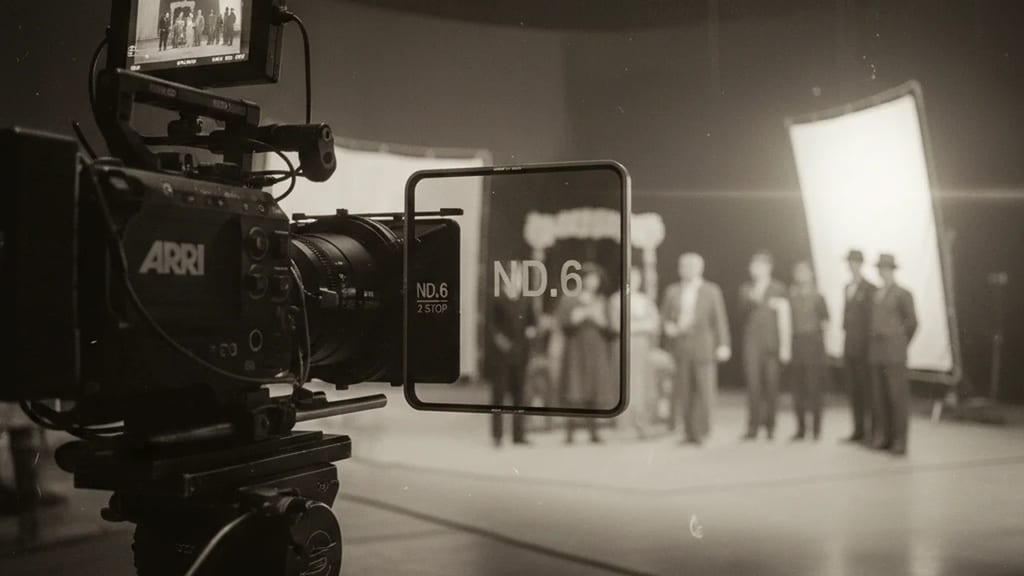
Neutral Density filter (ND 0.6) reducing light by 2 stops to approximately 25% transmission without color shift.
ND.6 (also known as N.6 or 0.6 ND) refers to a Neutral Density (ND) filter sheet with an optical density of 0.6. It is not a light source or grip equipment, but a filter sheet that reduces the amount of light without noticeably altering the color temperature or spectral composition of the light. The number in the name (.6) is the density value: the higher the density, the stronger the dimming.
ND filters are standard equipment for lighting and grip on set. They are used in front of luminaires, in window frames, or as large-area sheets in front of glass surfaces to reduce brightness, balance light contrasts, or adjust exterior light to interior exposure. Unlike diffusion material, ND filters do not scatter light; they merely attenuate it.
ND.6 reduces light by two stops (factor of 4), with a residual transmission of approximately 25%. The exact values may vary slightly depending on the manufacturer and light source.
| Property | Value |
|---|---|
| Optical Density | 0.6 |
| Light Reduction | 2 stops (factor 4) |
| Transmission (Rosco Cinegel 3403) | approx. 25% |
| Transmission (LEE 210) | approx. 23.5% (daylight) / 24.5% (tungsten) |
| Color Shift | neutral, not significant |
Typical products on the market include Rosco Cinegel 3403 (N.6) and LEE 210. They are available as individual sheets (e.g., 20 x 24 inches) as well as rolls in various widths.
Neutral Density filters are typically offered in density increments of 0.3, with each 0.3 increment halving the light by exactly one stop.
The most common application is window treatment: for interior shots with visible windows, the daylight outside is often several stops brighter than the interior lighting. Applying ND.6 to the window panes reduces the exterior brightness by two stops, so that the interior and exterior are within a workable contrast range, and the view outside does not blow out.
Other typical uses include dimming individual lights when they are still too bright even at their lowest setting, as well as grading light sources within a frame. ND filters can be combined with other filter types (diffusion, color conversion) or layered multiple times to achieve stronger reductions.
Aus DoP-Perspektive ist dieses Element essentiell für die visuelle Gestaltung. Es ermöglicht mir die gewünschte Farbstimmung und das ästhetische Bild konsistent umzusetzen.
Diese professionelle Lösung erhöht die Produktionseffizienz und reduziert Post-Production-Anforderungen. Sie ermöglicht flexible, schnelle Anpassungen während des Drehs.
Als Gaffer ist dies ein unverzichtbares Werkzeug meines täglichen Handwerkszeugs. Es ermöglicht mir professionelle Lichtkontrolle und schnelle Anpassungen auf Set, was Zeit spart und Qualität sichert.
1. Zu welchem Department gehört „ND.6 (2 Stops)"?
2. Wie viele verschiedene Fachperspektiven bietet dieser Eintrag?
The Lexikon is part of the Filmfarm ecosystem — alongside budgeting (FilmBalance), an industry magazine (FilmCircus) and crew networking (FilmCall, CrewMesh). One shared vocabulary for the whole production.