Cinematographer
Aus DoP-Perspektive ist dieses Element essentiell für die visuelle Gestaltung. Es ermöglicht mir die gewünschte Farbstimmung und das ästhetische Bild konsistent umzusetzen.
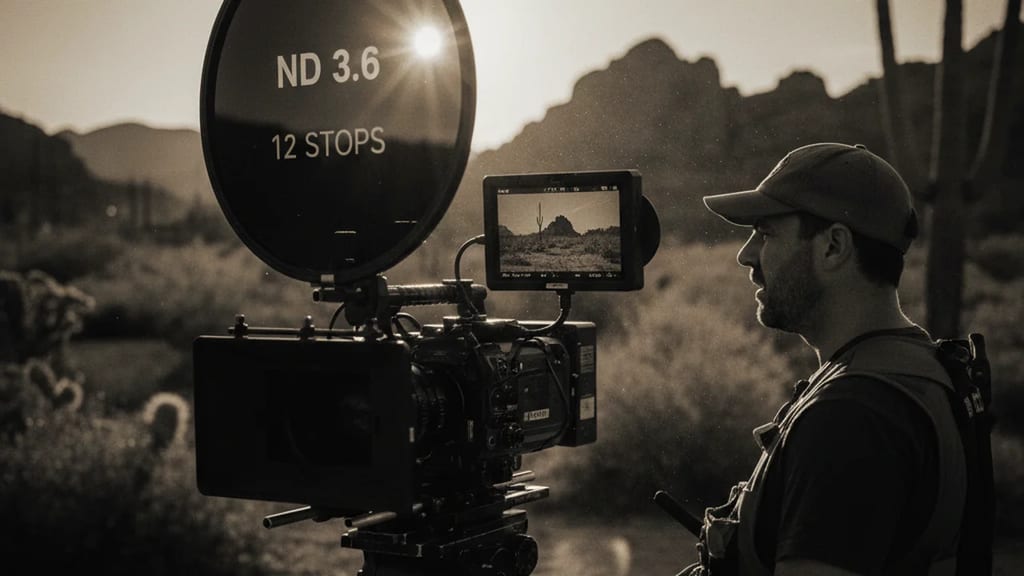
ND 3.6: neutral density filter with optical density 3.6, reducing light by approximately 12 stops.
"ND 3.6" is not a device or manufacturer designation, but an indication of Neutral Density. The number 3.6 is the value of optical density. Neutral density filters and ND gels reduce the amount of light uniformly across the visible spectrum without changing the color temperature – they act like "gray sunglasses" for the camera or light source.
With a density of 3.6, ND 3.6 is at the very strong end of the scale. More common in sets are graduated values of 0.3 / 0.6 / 0.9 / 1.2 (1 to 4 stops). A value of 3.6 is significantly denser and is usually achieved – if needed at all – by stacking multiple filters or gels.
There is a fixed mathematical relationship between optical density, stops, and transmission:
For ND 3.6, this results in:
| Parameter | Value |
|---|---|
| Optical Density | 3.6 |
| Light Reduction | ≈ 12 stops |
| Residual Light Transmission | ≈ 0.025% (approx. 1/4000) |
Each additional density of 0.3 halves the light (one stop). Therefore, ND 3.6 allows only a minuscule fraction of the incident light to pass through.
Such extremely high ND values are used to control very bright lighting situations – such as direct sun or glaring windows – in order to still be able to shoot with an open aperture (for shallow depth of field) or with a specific shutter speed. Two typical applications are distinguished:
A density of 3.6 is an extreme value: single filters of this strength are rare; in practice, the value is often achieved by combining multiple ND grades. When stacking, the densities add up (e.g., 1.2 + 1.2 + 1.2 = 3.6).
Aus DoP-Perspektive ist dieses Element essentiell für die visuelle Gestaltung. Es ermöglicht mir die gewünschte Farbstimmung und das ästhetische Bild konsistent umzusetzen.
Diese professionelle Lösung erhöht die Produktionseffizienz und reduziert Post-Production-Anforderungen. Sie ermöglicht flexible, schnelle Anpassungen während des Drehs.
Als Gaffer ist dies ein unverzichtbares Werkzeug meines täglichen Handwerkszeugs. Es ermöglicht mir professionelle Lichtkontrolle und schnelle Anpassungen auf Set, was Zeit spart und Qualität sichert.
1. Zu welchem Department gehört „ND 3.6 (12 Stops)"?
2. Wie viele verschiedene Fachperspektiven bietet dieser Eintrag?
The Lexikon is part of the Filmfarm ecosystem — alongside budgeting (FilmBalance), an industry magazine (FilmCircus) and crew networking (FilmCall, CrewMesh). One shared vocabulary for the whole production.