Cinematographer
Aus DoP-Perspektive ist dieses Element essentiell für die visuelle Gestaltung. Es ermöglicht mir die gewünschte Farbstimmung und das ästhetische Bild konsistent umzusetzen.
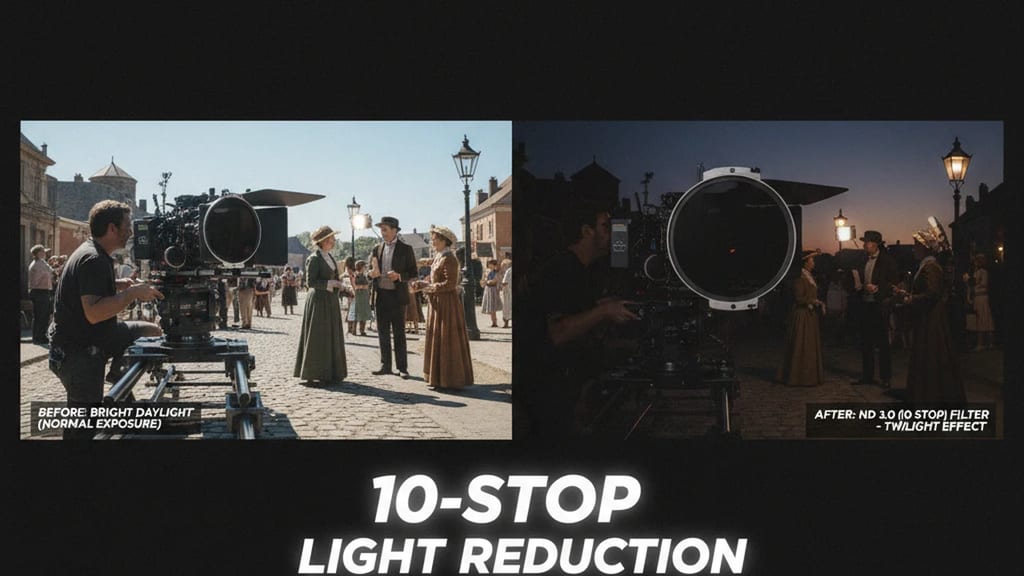
Neutral density filter with optical density 3.0, reducing light by 10 stops (approximately 0.1% transmission).
"ND 3.0" does not refer to a specific manufacturer or device type, but rather a strength designation for a Neutral Density filter (ND). The number 3.0 is the optical density of the filter – a logarithmic measure of how much the transmitted light is attenuated without changing the color temperature (ideally neutral, hence the name).
This notation is used in two related areas: firstly, for camera filters (glass or film filters in matte box/screw-in filter format, often also as IRND with additional infrared blocking), and secondly, for lighting and window films (Neutral Density gels) used to dim daylight through windows or the brightness of individual lights. In both cases, the scale signifies the same principle.
The conversion from optical density to f-stops is standardized: a density of 0.3 corresponds exactly to 1 f-stop (halving the amount of light). This results in the ND stop scale.
| Optical Density | f-stops | Light Transmission (approx.) |
|---|---|---|
| ND 0.3 | 1 Stop | 50 % |
| ND 0.6 | 2 Stops | 25 % |
| ND 0.9 | 3 Stops | 12.5 % |
| ND 1.2 | 4 Stops | 6.25 % |
| ND 3.0 | 10 Stops | ≈ 0.1 % |
ND 3.0 is therefore a very strong setting: the filter allows only about one-thousandth of the light to pass through (filter factor approx. 1024, i.e., 210). In some product lines, the same strength is alternatively named by the filter factor (e.g., ND1000 or ND1024 in photography); the cinema and lighting world predominantly uses the density notation shown here.
A reduction of 10 f-stops is exceptionally strong for normal shooting operations. Typical applications:
In practice, ND strengths are often stacked or combined; ND 3.0 marks the upper limit of commercially available individual strengths. The quality of neutrality is important: very dense ND filters can produce a color cast, which is why IRND variants with infrared correction are often used for cameras with strong NDs.
Aus DoP-Perspektive ist dieses Element essentiell für die visuelle Gestaltung. Es ermöglicht mir die gewünschte Farbstimmung und das ästhetische Bild konsistent umzusetzen.
Diese professionelle Lösung erhöht die Produktionseffizienz und reduziert Post-Production-Anforderungen. Sie ermöglicht flexible, schnelle Anpassungen während des Drehs.
Als Gaffer ist dies ein unverzichtbares Werkzeug meines täglichen Handwerkszeugs. Es ermöglicht mir professionelle Lichtkontrolle und schnelle Anpassungen auf Set, was Zeit spart und Qualität sichert.
1. Zu welchem Department gehört „ND 3.0 (10 Stops)"?
2. Wie viele verschiedene Fachperspektiven bietet dieser Eintrag?
The Lexikon is part of the Filmfarm ecosystem — alongside budgeting (FilmBalance), an industry magazine (FilmCircus) and crew networking (FilmCall, CrewMesh). One shared vocabulary for the whole production.