Overview
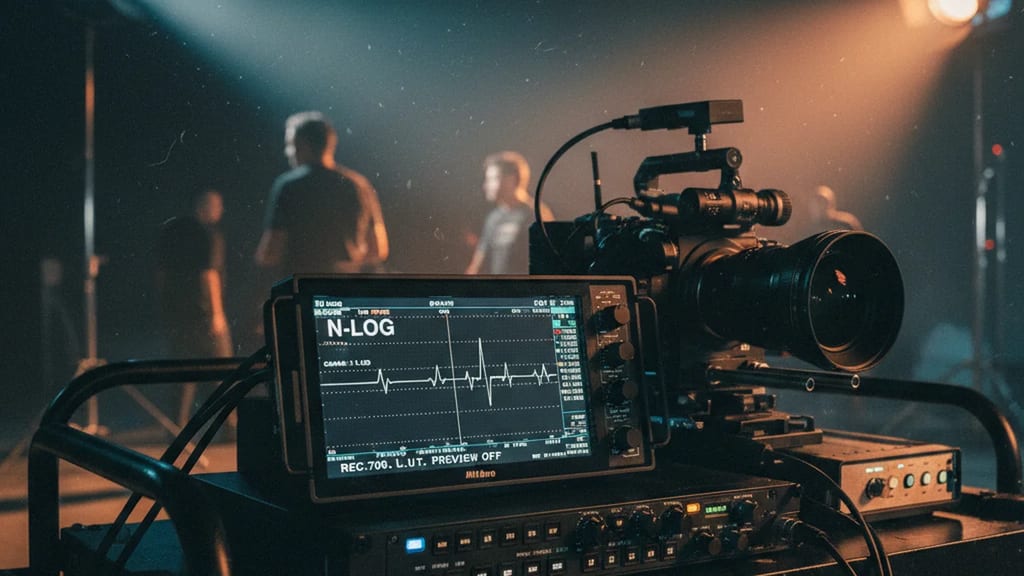
N-Log is Nikon's logarithmic gamma curve (log profile) for video recording. The name is a combination of "N" (Nikon) and "Log" (logarithmic function). Instead of recording a high-contrast, finished-looking image, N-Log distributes tonal values logarithmically, thus preserving detail in highlights and shadows – the footage is flat and desaturated, and is only brought to the target color space in post-production color grading.
N-Log is not lighting or grip equipment, but an in-camera recording technique. It is Nikon's counterpart to log profiles from other manufacturers such as S-Log (Sony), Log-C (ARRI), or V-Log (Panasonic) and was introduced with the Z-series mirrorless cameras.
Technical Specifications
According to Nikon's official "N-Log Specification Document" (Version 1.0.0, September 1, 2018), the following applies:
- Optimization: The curve is designed for 10-bit recording.
- Reference Point: 18% reflectance (middle gray) corresponds to "Stop 0".
- Color Space (Gamut): identical to the wide-gamut color space ITU-R BT.2020.
- White Point: D65 (CIE xy = 0.3127 / 0.3290).
- Dynamic Range: Nikon states an achievable dynamic range of up to 12 stops for N-Log footage.
| Primary Color / White Point | CIE x | CIE y |
|---|
| White Point (D65) | 0.3127 | 0.3290 |
| Red | 0.708 | 0.292 |
| Green | 0.170 | 0.797 |
| Blue | 0.131 | 0.046 |
The transfer function from N-Log to reflectance is defined in the spec document (x = 10-bit codepoint, y = reflectance): for x < 452, y = (x/650)³ − 0.0075 applies, otherwise y = exp[(x − 619)/150].
On-Set Usage
N-Log is selected as the tonal mode in the camera and, depending on the model, can be recorded internally (e.g., in H.265 10-bit, ProRes 422 HQ 10-bit, or as N-RAW/ProRes RAW) or, with older Z cameras (Z 6, Z 7), exclusively via the HDMI output to an external 10-bit recorder like the Atomos Ninja. Since N-Log delivers a flat, desaturated image, the cameras display a View Assist function that presents the monitor image with more contrast, without altering the recording.
For post-production, Nikon provides a 3D LUT that converts N-Log to the Rec. 709 color space; it serves as a starting point for grading. Practical consideration for lighting: Due to the shifted base sensitivity and the wide dynamic range, N-Log is usually slightly overexposed on set ("exposed to the right") and lit cleanly to avoid noise in the shadows.