Technical Details
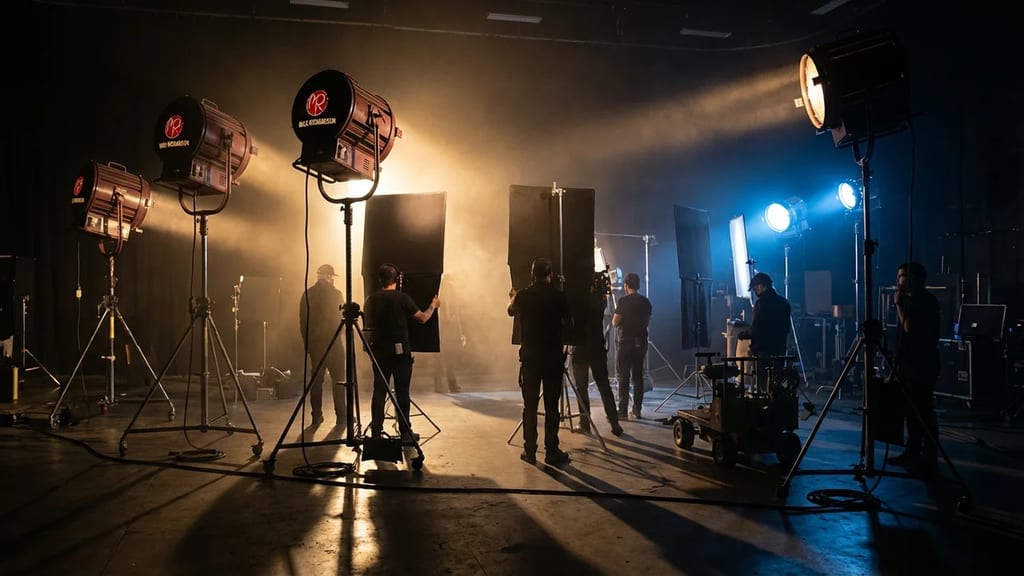
Mole-Richardson fixtures use Fresnel lenses with diameters ranging from 3 to 20 inches (7.6 to 50.8 cm). The classic "Baby" (1K) operates with 1000-watt tungsten-halogen lamps at a 3200K color temperature, while the "Senior" (5K) delivers 5000 watts. Focusing is achieved via a flood/spot mechanism with beam angles between 12° (spot) and 60° (flood). Modern LED variants like the Vari-Senior LED offer a 400-watt power consumption with a 5K light equivalent and stepless color temperature adjustment from 2700K to 6500K. The robust die-cast aluminum housings weigh between 4.5 kg (Baby) and 27 kg (20K Senior).
History & Development
Peter Mole and Elmer Richardson founded the company in 1927 in Los Angeles. In 1935, they developed the first portable Fresnel spotlight for film productions, replacing the heavy arc lamps. The breakthrough came in 1939 with the "Type 412 Baby," which became an industry standard. In the 1950s, Mole-Richardson introduced quartz-halogen technology to Hollywood. In 2010, the transition to LED technology began with the Tweenie LED series. Today, the company produces classic tungsten fixtures and modern LED systems.
Practical Application in Film
Mole-Richardson fixtures have shaped Hollywood lighting for decades. The Baby spot serves as a standard key light for close-ups, while Senior spots enable large-area illumination. In "Citizen Kane" (1941), Gregg Toland used Mole spots for characteristic deep focus lighting. Modern productions like "La La Land" (2016) combined classic Mole tungsten spots with LED panels for night scenes. Precise light control through barn doors and scrims allows for exact shadow and contrast shaping.
Comparison & Alternatives
Main competitors include Arri (Compact series), Kino Flo (fluorescent technology), and ARRI (SkyPanel LED series). While Mole-Richardson is known for robust tungsten fixtures, Arri excels with more compact HMI systems. LED alternatives like Litepanels Gemini offer lower power consumption but do not reach the light intensity of large tungsten spots. For controlled sets, Mole spots remain the first choice, while location shoots increasingly rely on battery-powered LED systems.