Filmlexikon.
Support
Mir-20
Camera · Terms

Mir-20

Murnau AI illustration
flow para roll take

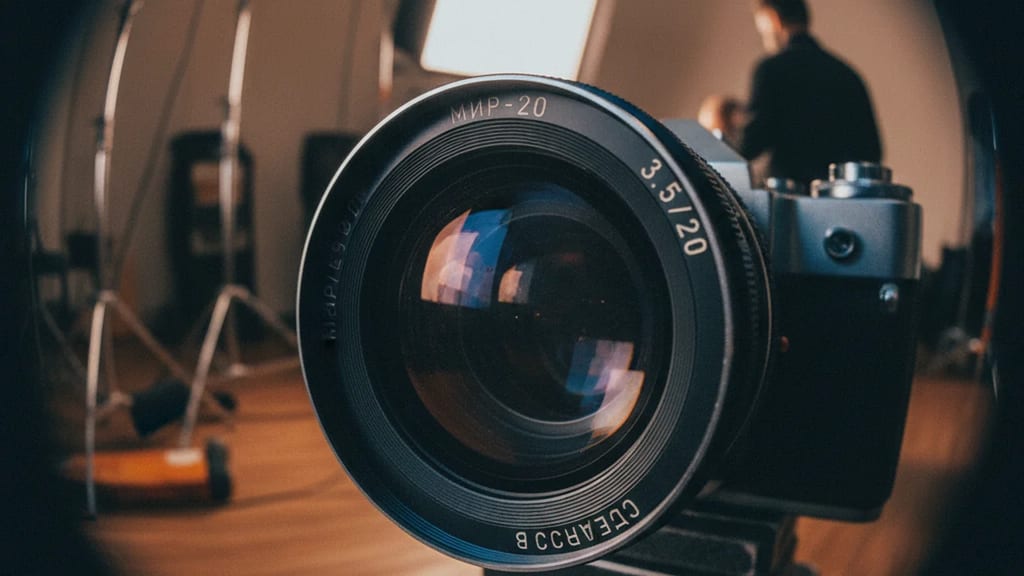
Soviet 20mm f/3.5 wide-angle lens by Arsenal Kyiv (1971–1991), based on Zeiss Flektogon design; known for distinctive distortion and soft vintage aesthetic.

Technical Details

The Mir-20 features a retrofocus design consisting of 9 elements in 7 groups, covering a 94° angle of view on 35mm film format. The minimum focusing distance is 0.18 meters, and the filter diameter is 62mm. The lens weighs 290 grams and measures 53mm in length. It was produced in various versions: early versions with a zebra-striped focus ring, later ones with black or silver finishes. The aperture operates with a preset ring and closes down to f/16.

History & Development

The Mir-20 was manufactured from 1971 at the Arsenal factory in Kyiv, based on design documents from the VEB Carl Zeiss Jena Flektogon 20mm f/4. The Soviet variant was designed with a wider aperture of f/3.5, one stop faster. Several production runs with different mechanical designs were created until the late 1980s. After the collapse of the Soviet Union, Arsenal ceased production in 1991.

Practical Use in Film

Soviet cinematographers used the Mir-20 for dramatic wide-angle shots in films like Andrei Tarkovsky's "Stalker" (1979), where it enhanced the oppressive atmosphere of the Zone. Its characteristic distortion and soft fall-off at the edges created a distinctive look, now appreciated as the "Soviet Glass" aesthetic. Modern DoPs adapt Mir-20 lenses for digital cameras in low-budget productions, as they deliver an organic, cinematic character despite lower sharpness performance compared to modern lenses.

Comparison & Alternatives

Compared to the original Zeiss Flektogon 20mm f/4, the Mir-20 exhibits more chromatic aberrations due to its wider aperture, but also a smoother bokeh. Today's alternatives like the Canon EF 20mm f/2.8 or Sigma 20mm f/1.4 Art offer significantly higher optical precision but cannot replicate the characteristic vintage look of the Soviet lens. Collectors value early Mir-20 units for their mechanical robustness and unique rendering style.
From the crafts

Perspectives

Cinematographer

Als DoP schätze ich die Mir-20 für ihre organische Bildwiedergabe, die digitalen Aufnahmen eine filmische Textur verleiht – besonders bei Available Light dreht sie durch f/3.5 noch gut mit. Der weiche Randabfall und die leichte Verzeichnung können dramaturgisch eingesetzt werden, allerdings muss ich bei kritischen Schärfen im Randbereich vorsichtig sein.

Director

Die charakteristische Optik der Mir-20 transportiert sofort eine bestimmte Zeitstimmung und Authentizität, die ich für Periodenfilme oder bewusst nostalgische Erzählweisen nutze. Der spezielle Look des sowjetischen Glases erzeugt eine emotionale Distanz, die perfekt zu melancholischen oder dystopischen Geschichten passt.

Producer

Vintage Mir-20 Objektive koste auf dem Gebrauchtmarkt zwischen 150-400 Euro je nach Zustand, was sie zu günstigen Alternativen für Indie-Produktionen macht. Allerdings muss ich Adapter-Kosten einkalkulieren und die Crew auf mögliche mechanische Eigenarten wie schwergängige Fokussierung vorbereiten.

More in the lexikon

Related terms

Test your knowledge

Quiz

1. Zu welchem Department gehört „Mir-20"?

2. Wie viele verschiedene Fachperspektiven bietet dieser Eintrag?

Report an error
From the Filmfarm ecosystem

Understand visual language, budget productions, connect crew.

The Lexikon is part of the Filmfarm ecosystem — alongside budgeting (FilmBalance), an industry magazine (FilmCircus) and crew networking (FilmCall, CrewMesh). One shared vocabulary for the whole production.

FilmFarm FilmRadarComing soonFilmPulseComing soonFilmNumbersComing soonFilmCapitalComing soonFilmLabComing soonFilmBalanceComing soonFilmCircusComing soon