Technical Details
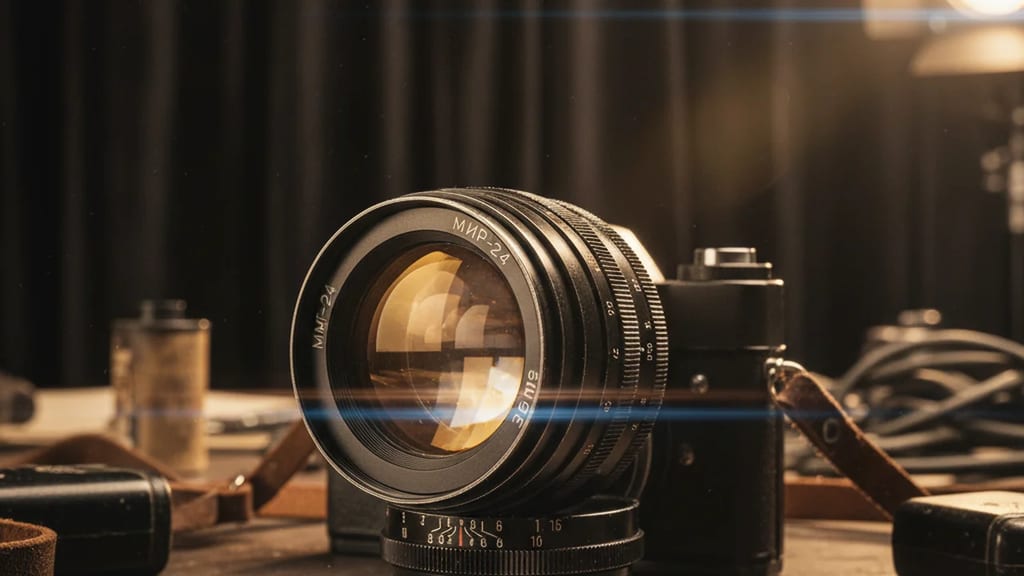
The Mir-24 weighs 18.5 kg and consists of a three-axis gyroscope system with electromechanical stabilizers. The system compensates for roll, pitch, and yaw movements with a reaction time of 0.02 seconds. The maximum payload is 8 kg, sufficient for 35mm cameras like the Arriflex 35 or Mitchell systems. Power is supplied via 24V DC with a power consumption of 120 watts. A characteristic feature is the gimbal suspension mechanism made of anodized aluminum with hardened steel ball bearings.
The system operates with piezoelectric sensors for motion detection and hydraulic dampers for vibration reduction. Three different versions exist: Mir-24A for standard aerial shots, Mir-24B with an extended temperature range (-40°C to +60°C), and Mir-24C with improved electronics for long-term operation.
History & Development
In 1974, the Moscow Institute of Cinematography, under the direction of Igor Petrov, developed the first Mir-24 for state film production. The prototype was first used for aerial shots for Sergei Bondarchuk's "They Fought for Their Country." Series production began in 1976 at the Krasnogorsk factory, primarily for export to socialist countries.
DEFA acquired two units in 1978 for 45,000 East German Marks each. Western production companies began importing the system in 1982 through indirect channels, despite embargo regulations. In 1989, Krasnogorsk ceased production as electronic systems began to replace mechanical gyro stabilizers.
Practical Use in Film
Ridley Scott used a Mir-24 for the desert sequences in "Legend" (1985) to achieve incredibly smooth shots over the terrain from low-flying helicopters. The BBC employed the system in the 1980s for nature documentaries, as it enabled stable shots even in strong winds.
The workflow requires a 30-minute lead time for the gyroscopes to settle. The mechanical inertia of the system leads to characteristic, slow camera movements that define the "Soviet look" of many aerial shots from the 1980s. The high weight and maintenance requirements of the mechanical components are disadvantages.
Comparison & Alternatives
In contrast to the contemporary Tyler Major Mount, the Mir-24 is based on mechanical rather than pneumatic dampers, resulting in more precise stabilization at a lower cost. The American Cinema Products Tyler Helicopter Mount cost three times as much as a Mir-24 in 1980.
Modern successors like the Shotover F1 or Newton S2 utilize electronic stabilization with reaction times of 0.001 seconds. While these achieve more precise results, they do not reproduce the characteristic "float" of the mechanical Mir-24 stabilization, which is why some cinematographers resort to restored units for retro productions.