Filmlexikon.
Support
Magic Cloth
Lighting · Terms

Magic Cloth

Murnau AI illustration
color temperature flow roll take

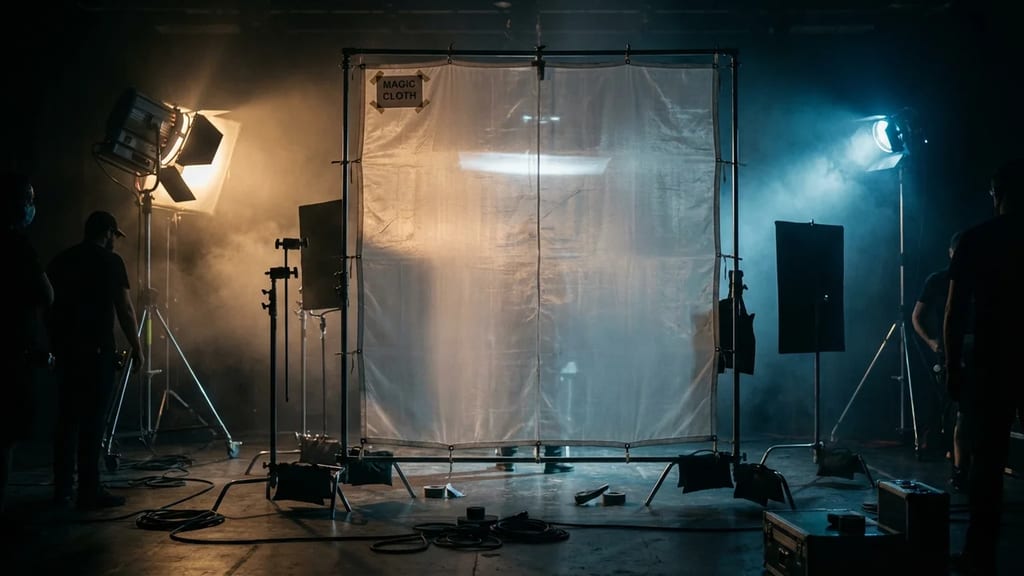
Black cotton velvet (98% light absorption) moved in front of the lens during shooting to gradually darken image areas; used for on-set vignetting and exposure control.

Technical Details

Standard Magic Cloths typically measure 60x90 cm or 90x120 cm and are made of black cotton velvet with a light absorption of over 98%. The material thickness is 2-3 mm to ensure opacity on the one hand and precise handling on the other. Professional variants feature a thin wire frame around the edge for shape-stable guidance. Special versions such as "Graduated Magic Cloth" offer a gradual transition from opaque to semi-transparent over a length of approximately 30 cm.

History & Development

The technique evolved in the 1920s in Hollywood studios, where cinematographers like Gregg Toland first systematically used moving shadings during shooting. The term "Magic Cloth" became established in the 1940s on the set of Orson Welles' "Citizen Kane" (1941), where the technique was perfected for dramatic lighting design. With the introduction of Digital Intermediate (DI) from the late 1990s onwards, the technique was partially replaced by digital post-production, but has experienced a renaissance since 2010 through cinematographers like Roger Deakins, who prefer the organic in-camera look.

Practical Application in Film

Magic Cloth is mainly used for portrait shots to selectively darken halves of the face or eliminate disturbing reflections on glasses. In Emmanuel Lubezki's work on "The Revenant" (2015), the technique was used to selectively shape image areas in available light situations. The focus puller or a dedicated operator moves the cloth at a distance of 15-30 cm in front of the lens with fluid movements that remain invisible at shutter speeds below 1/60s. Precise timing is critical: the cloth must cover an image area for a maximum of 30-40% of the exposure time to avoid visible shadows.

Comparison & Alternatives

Unlike flags or gobos, Magic Cloth has a gradual effect and leaves soft transitions instead of hard shadow edges. Modern LED panels with DMX control can create similar effects digitally, but do not achieve the organic randomness of manual movement. Variable ND filters offer static shading, whereas Magic Cloth allows for dynamic adjustments during shooting. For slow-motion shots above 120fps, the technique becomes ineffective as the cloth's movement becomes visible.

From the crafts

Perspectives

Cinematographer

Ich setze Magic Cloth hauptsächlich bei Available Light-Situationen ein, wo ich keine zusätzlichen Flags positionieren kann, ohne ins Bild zu ragen. Besonders bei 85mm-Porträts mit offener Blende kann ich damit störende Spitzlichter auf der Stirn oder Nasenwurzel eliminieren, ohne die natürliche Lichtführung zu zerstören. Die Bewegung muss absolut flüssig sein – jede Unterbrechung wird als Flackern sichtbar.

Director

Magic Cloth gibt mir die Möglichkeit, emotionale Zustände subtil zu verstärken, indem Gesichter während eines Dialogs graduell heller oder dunkler werden, ohne dass es als technischer Effekt wahrgenommen wird. In Verhörszenen kann ich die psychologische Spannung steigern, indem der Verdächtige langsam "ins Dunkel" gleitet. Der organische, unvorhersagbare Charakter der Technik erzeugt eine Lebendigkeit, die digitale Nachbearbeitung nicht erreicht.

Producer

Magic Cloth spart mir teure Nachbearbeitungszeit, da Lichtmodellierungen bereits in-camera entstehen und nicht digital korrigiert werden müssen. Ein erfahrener Operator kostet 280€/Tag, während vergleichbare DI-Korrekturen schnell 150€/Stunde erreichen. Allerdings steigt das Risiko von Wiederholungen, wenn die Technik nicht perfekt sitzt – deshalb plane ich bei kritischen Szenen 20% mehr Drehtage ein.

More in the lexikon

Related terms

Test your knowledge

Quiz

1. Zu welchem Department gehört „Magic Cloth"?

2. Wie viele verschiedene Fachperspektiven bietet dieser Eintrag?

Report an error
From the Filmfarm ecosystem

Understand visual language, budget productions, connect crew.

The Lexikon is part of the Filmfarm ecosystem — alongside budgeting (FilmBalance), an industry magazine (FilmCircus) and crew networking (FilmCall, CrewMesh). One shared vocabulary for the whole production.

FilmFarm FilmRadarComing soonFilmPulseComing soonFilmNumbersComing soonFilmCapitalComing soonFilmLabComing soonFilmBalanceComing soonFilmCircusComing soon