Cinematographer
Aus DoP-Perspektive ist dieses Element essentiell für die visuelle Gestaltung. Es ermöglicht mir die gewünschte Farbstimmung und das ästhetische Bild konsistent umzusetzen.
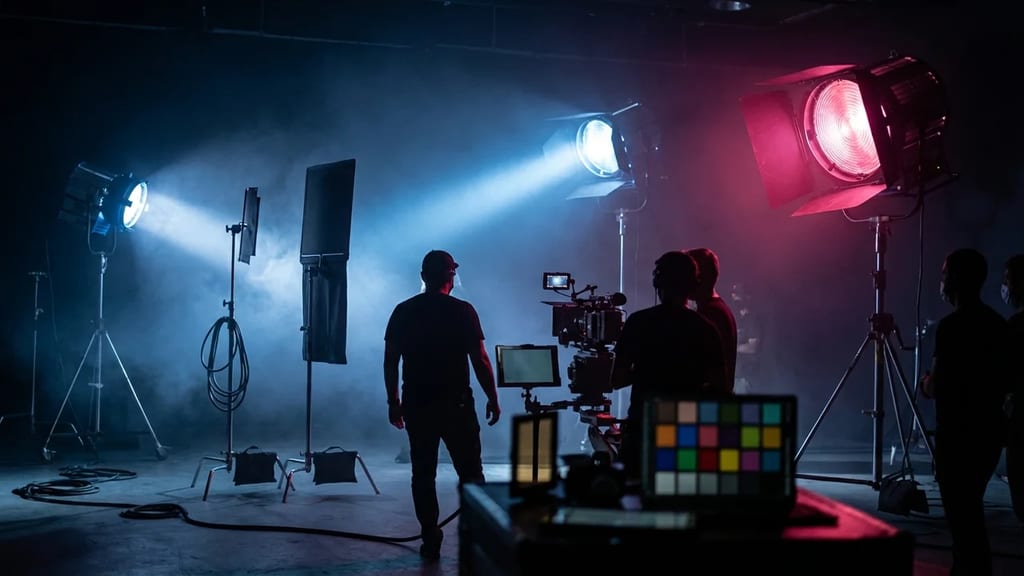
Color shift toward magenta on the green-magenta axis (negative Duv, below the Planck curve); corrected with plus-green gel or tint adjustment.
The term Magenta Shift refers to the displacement of a light source along the green-magenta axis towards a magenta (red-violet) tint. Unlike the shift along the warm-cold axis (blue ↔ orange), which is described by color temperature in Kelvin, the magenta shift cannot be captured by the Kelvin value alone. Two lights with identical Correlated Color Temperature (CCT, e.g., both "5600 K") can still look different – one neutral, one leaning towards magenta or green – depending on where their color point lies relative to the Planckian locus (blackbody locus).
A magenta shift typically occurs with LED lights, fluorescent lights, and mixed lighting situations. In LED panels, it arises from non-spectral emission, spectral peaks, or scattering in the LED binning of a production batch. In practice, the term is the counterpart to the more frequently discussed green spike / green tint.
The magenta shift is quantified by the metric Duv (Delta u,v), which indicates the distance of the color point from the Planckian locus in the chromaticity diagram:
In cameras and color meters, the same axis is referred to as Tint (or CC points). As a rule of thumb, the tint value roughly corresponds to 1000 times the Duv; Adobe software calculates with 3000 times. The ARRI Alexa, for example, displays the warm-cold axis in Kelvin and the green-magenta axis in "+/−" CC points.
| Position relative to Planck Curve | Duv | Color Tint | Correction |
|---|---|---|---|
| below | negative | Magenta | Plus Green / Tint towards Green |
| on the curve | ≈ 0 | neutral | none |
| above | positive | Green | Minus Green / Tint towards Magenta |
A magenta-tinted light is pulled back towards neutral with a plus-green filter – the added green component neutralizes the magenta portion. Conversely, a minus-green filter (filter effect magenta) corrects a green tint; the Rosco Cinegel filter Tough MinusGreen in full strength corresponds approximately to a CC30 magenta filter.
Alternatively or additionally, the magenta shift can be compensated for in the camera using the tint/CC control (tint towards green). However, because a magenta or green tint often results from spectral gaps rather than a pure color temperature shift, a simple white balance correction does not always yield a clean result. For critical skin tones, it is recommended to record a ColorChecker chart under the light and refine the correction via LUT or Hue-vs-Hue in post-production.
Aus DoP-Perspektive ist dieses Element essentiell für die visuelle Gestaltung. Es ermöglicht mir die gewünschte Farbstimmung und das ästhetische Bild konsistent umzusetzen.
Diese professionelle Lösung erhöht die Produktionseffizienz und reduziert Post-Production-Anforderungen. Sie ermöglicht flexible, schnelle Anpassungen während des Drehs.
Als Gaffer ist dies ein unverzichtbares Werkzeug meines täglichen Handwerkszeugs. Es ermöglicht mir professionelle Lichtkontrolle und schnelle Anpassungen auf Set, was Zeit spart und Qualität sichert.
1. Zu welchem Department gehört „Magenta-Verschiebung"?
2. Wie viele verschiedene Fachperspektiven bietet dieser Eintrag?
The Lexikon is part of the Filmfarm ecosystem — alongside budgeting (FilmBalance), an industry magazine (FilmCircus) and crew networking (FilmCall, CrewMesh). One shared vocabulary for the whole production.