Cinematographer
Aus DoP-Perspektive ist dieses Element essentiell für die visuelle Gestaltung. Es ermöglicht mir die gewünschte Farbstimmung und das ästhetische Bild konsistent umzusetzen.
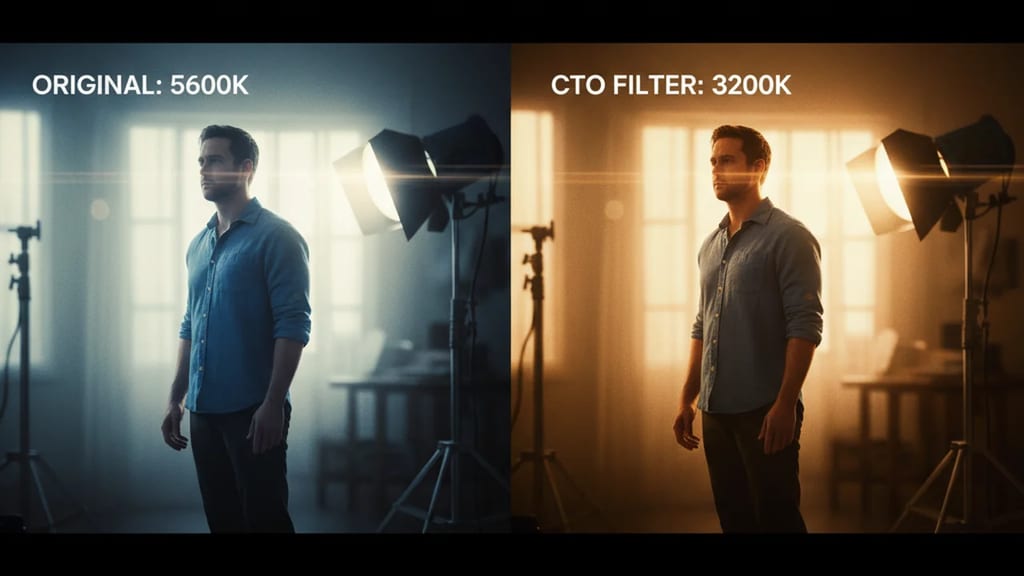
Constant additive shift value of a color conversion filter on the Mired scale (1,000,000/Kelvin), used to calculate color temperature corrections on set.
"Mired Shift" (also Mired-Verschiebung) is not a device or a manufacturer, but a calculated value for color temperature correction on set. The Mired scale (from "micro reciprocal degree", also MK⁻¹) is derived from the color temperature in Kelvin: Mired = 1,000,000 / Kelvin. A light color of 3200 K thus corresponds to around 312 Mired, 5600 K to around 179 Mired.
The decisive advantage over Kelvin: The correction value of a conversion filter (CTO/CTB gel) is *constant* in Mired, regardless of the initial color temperature it is correcting. This exact fixed value is called Mired Shift. Measured in Kelvin, the shift would vary depending on the initial temperature; in Mired, it remains the same. This makes filter values on set easily addable and subtractable.
Manufacturer convention (e.g., Lee, Rosco): A negative Mired Shift increases the color temperature (cools the light) and is produced by blue gels (CTB, Color Temperature Blue). A positive Mired Shift lowers the color temperature (warms it up) and comes from orange gels (CTO, Color Temperature Orange).
Calculation example for daylight to artificial light: If daylight at 6500 K (≈ 154 Mired) is to be brought to 3200 K (≈ 312 Mired), a requirement of approximately +159 Mired results – this corresponds to a Full CTO gel (Lee 204). With a different starting value, the difference changes: From 5700 K (≈ 175 Mired) to 3200 K, only about +137 Mired would be needed, meaning a weaker gel than a full CTO.
Because the values are additive, intermediate stages can be combined: multiple gels stacked together sum their Mired values. This allows for corrections for which no single gel exists.
Approximate values of common Lee conversion gels (manufacturer specifications; sign according to the convention mentioned above):
| Gel | Effect | Mired Shift (approx.) |
|---|---|---|
| Full CTB (Lee 201) | Artificial Light → Daylight | −137 |
| 1/4 CTB (Lee 203) | Slightly cool | −35 |
| 1/8 CTB (Lee 218) | Minimally cool | −18 |
| Full CTO (Lee 204) | Daylight → Artificial Light | +159 |
| 1/4 CTO (Lee 206) | Slightly warm | +64 |
Note: The exact values vary slightly depending on the manufacturer and batch (Rosco values differ slightly) – always refer to the current datasheet of the gel being used.
The Gaffer uses Mired Shift to match lights of different color temperatures to each other or to existing ambient light – for example, Tungsten sources to window light. Procedure: Convert the current color temperature and target color temperature to Mired, calculate the difference, and select the appropriate gel(s) based on the Mired value. With modern LED and RGBW lights, correction can often be done directly electronically via the Kelvin setting; the Mired principle remains relevant for mixing gelled Tungsten/HMI sources and for residual gel corrections. A gel costs additional light output (transmission loss), which must be factored into exposure planning.
Aus DoP-Perspektive ist dieses Element essentiell für die visuelle Gestaltung. Es ermöglicht mir die gewünschte Farbstimmung und das ästhetische Bild konsistent umzusetzen.
Diese professionelle Lösung erhöht die Produktionseffizienz und reduziert Post-Production-Anforderungen. Sie ermöglicht flexible, schnelle Anpassungen während des Drehs.
Als Gaffer ist dies ein unverzichtbares Werkzeug meines täglichen Handwerkszeugs. Es ermöglicht mir professionelle Lichtkontrolle und schnelle Anpassungen auf Set, was Zeit spart und Qualität sichert.
1. Zu welchem Department gehört „Mired-Verschiebung"?
2. Wie viele verschiedene Fachperspektiven bietet dieser Eintrag?
The Lexikon is part of the Filmfarm ecosystem — alongside budgeting (FilmBalance), an industry magazine (FilmCircus) and crew networking (FilmCall, CrewMesh). One shared vocabulary for the whole production.