Filmlexikon.
Support
Magic Arm
Lighting · Terms

Magic Arm

Murnau AI illustration
color temperature flow roll take

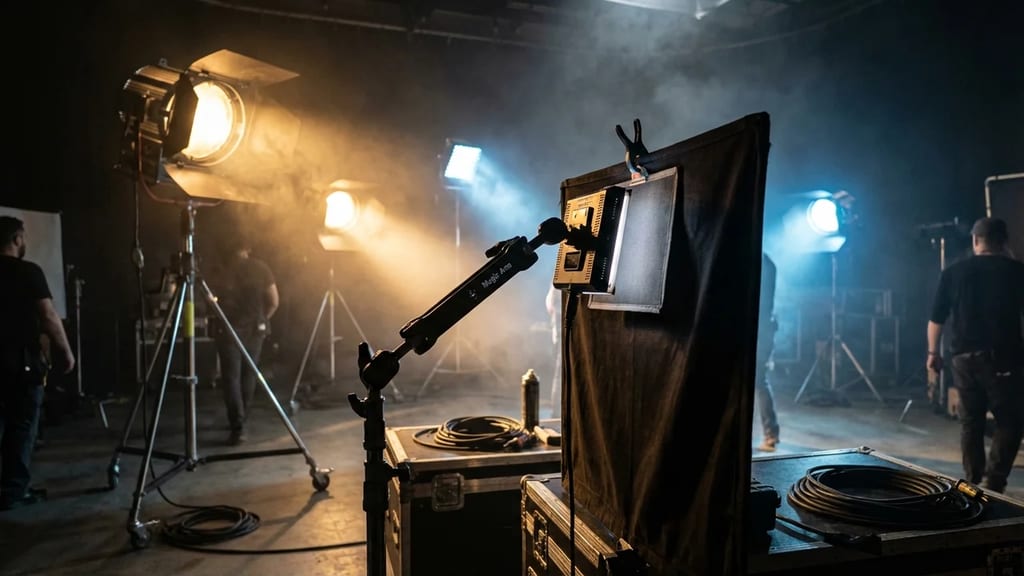
Three-segment articulated aluminum arm with ball joints, mounts lights flexibly on C-stands without obstructing tripod legs.

Technical Details

The construction consists of three aluminum segments: two outer arms (9.5 cm each) and a central segment (9 cm) with two integrated ball joints. A 1/4"-20 threaded rod runs through the entire system and is tensioned via a knob with a ratchet mechanism. The end pieces feature 5/8" studs (Baby Pins) and 1/4"-20 threads. Variants include Super Magic Arms (load capacity 6.8 kg), Mini Magic Arms (15 cm length), and special versions with C-clamp mounts or camera tripod threads.

History & Development

Matthews Studio Equipment introduced the first Magic Arm in 1987 as the "Articulating Arm," developed by grip veteran Connie Matthews for complex lighting tasks on set. The name "Magic Arm" only became common parlance in the late 1990s. In 2003, Manfrotto expanded the concept with smaller versions for DSLR cameras and monitors. Modern iterations integrate quick-release mechanisms and carbon-reinforced components.

Practical Application in Film

On "Blade Runner 2049" (2017), DoP Roger Deakins used Magic Arms for precise LED accent lighting in the cramped spinner cockpits where conventional stands failed. The typical workflow involves attaching to C-stands or pipe clamps, followed by rough positioning with the arm loosened, and final fixation via the tension lever. Magic Arms eliminate shadows from tripod legs and enable asymmetrical light placement. Disadvantages become apparent with heavy fixtures over 2 kg, where the joints tend to slip.

Comparison & Alternatives

Unlike rigid extension arms, Magic Arms offer three-axis flexibility, while gobo arms provide only horizontal extension. Friction arms use friction clutches instead of ball joints and are suitable for lighter loads under 1 kg. Modern alternatives like the Noga Magnetic Base combine Magic Arm principles with magnetic bases for metal surfaces. For loads over 3 kg, grip heads with separate extension arms are used.
From the crafts

Perspectives

Cinematographer

Als DoP schätze ich Magic Arms für punktgenaue Prakticals und Augenlicht, besonders in beengten Räumen wo normale C-Stands nicht hinpassen. Die schnelle Repositionierung zwischen Takes spart kostbare Zeit, aber bei schweren LED-Panels über 2 kg wechsele ich zu Grip Heads mit separaten Arms. Der 28cm-Radius reicht für 90% meiner Akzentbeleuchtung aus.

Director

Magic Arms ermöglichen mir spontane Lichtakzente für emotionale Beats, ohne das Set mit zusätzlichen Stativen zu überladen. Besonders in Dialogszenen kann ich über den DoP schnell motiviertes Licht von Laptops oder Handys positionieren lassen. Die Flexibilität unterstützt meine Inszenierung, da wir auch während der Probe noch Anpassungen vornehmen können.

Producer

Ein Magic Arm kostet 180-220 Euro, amortisiert sich aber durch Zeitersparnis beim Umbau zwischen Setups. Standard-Grip-Trucks führen 12-15 Stück mit, was für 95% der Produktionen ausreicht. Die Robustheit rechtfertigt die Investition – defekte Magic Arms entstehen meist durch Überlastung, nicht durch Verschleiß.

More in the lexikon

Related terms

Test your knowledge

Quiz

1. Zu welchem Department gehört „Magic Arm"?

2. Wie viele verschiedene Fachperspektiven bietet dieser Eintrag?

Report an error
From the Filmfarm ecosystem

Understand visual language, budget productions, connect crew.

The Lexikon is part of the Filmfarm ecosystem — alongside budgeting (FilmBalance), an industry magazine (FilmCircus) and crew networking (FilmCall, CrewMesh). One shared vocabulary for the whole production.

FilmFarm FilmRadarComing soonFilmPulseComing soonFilmNumbersComing soonFilmCapitalComing soonFilmLabComing soonFilmBalanceComing soonFilmCircusComing soon