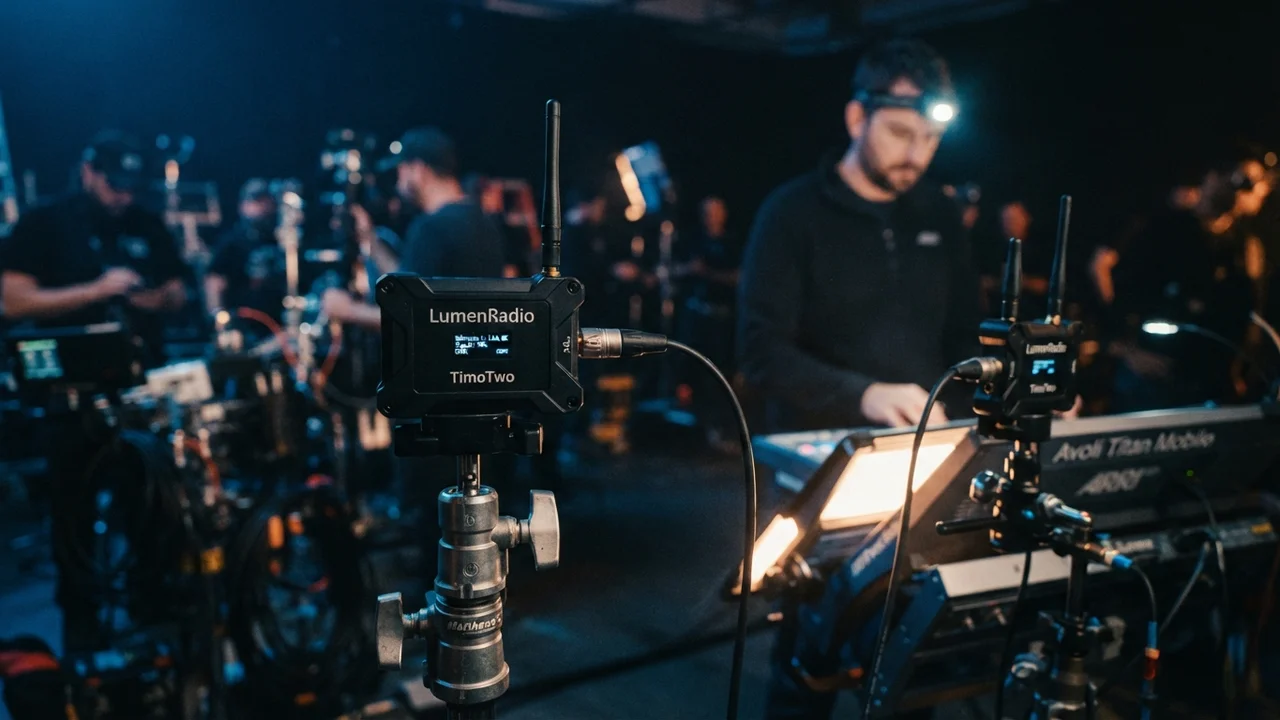
Technical Details
The CRMX protocol utilizes Cognitive Coexistence Technology with automatic frequency selection between 2.402 and 2.480 GHz. The transmitters operate with an output power of 100 mW (20 dBm) and support DMX512 and RDM data transmission. Current models like the TimoTwo offer 5-Pin XLR DMX connectors, battery-powered runtimes up to 14 hours, and 128-bit AES encryption. The SuperNova series achieves ranges up to 3 kilometers and supports multiple universe transmission with up to 63 separate DMX universes.
History & Development
LumenRadio was founded in Stockholm in 2009 and introduced its first CRMX system in 2010. In 2012, the first generation of wireless DMX transmitters for professional film productions was launched. In 2015, the company licensed the CRMX technology to other manufacturers such as ETC and Avolites. In 2018, the TimoTwo generation with improved battery life and RDM support came to market. Since 2020, CRMX has been integrated as an OEM solution in over 150 lighting manufacturers.
Practical Application in Film
For exterior shoots, LumenRadio systems enable lighting control over long distances without cable laying. For chase scenes, battery-powered receivers are mounted on vehicle headlights and controlled centrally. In underwater productions, waterproof SuperNova transmitters are used. The systems prove their worth during rapid location changes as no DMX cabling is required. Disadvantage: potential interference with other 2.4 GHz devices (WLAN, Bluetooth) in densely populated areas.
Comparison & Alternatives
In contrast to W-DMX (Wireless Solution), LumenRadio uses the more open CRMX protocol with better device compatibility across different manufacturers. City Theatrical's SHoW DMX Neo operates in the less crowded 900 MHz band but has lower data rates. Wired DMX remains more reliable and cheaper for stationary setups. LumenRadio is particularly suitable for mobile productions, hard-to-reach positions, and temporary installations, while wired solutions are more cost-effective for permanent studios.