Cinematographer
Aus DoP-Perspektive ist dieses Element essentiell für die visuelle Gestaltung. Es ermöglicht mir die gewünschte Farbstimmung und das ästhetische Bild konsistent umzusetzen.
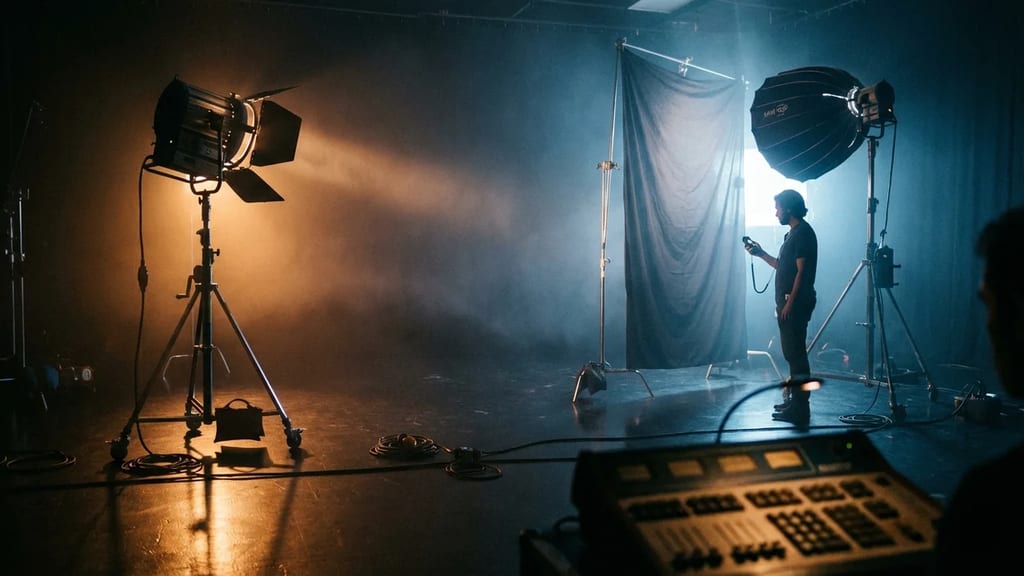
Lumen (lm) is the SI unit of luminous flux, measuring the total visible light output of a light source.
Lumens (unit symbol lm) is the SI unit of luminous flux (formula symbol Φ). It indicates the total amount of visible light emitted by a source in all directions. Unlike electrical power in watts, the lumen value evaluates light based on the sensitivity of the human eye (luminosity function), thus weighting each wavelength according to how bright it appears to the eye.
On set, the distinction between lumens and lux is crucial: lumens describe the source (the total amount of light emitted), while lux describes the illuminance at the subject – how much light actually hits a surface. What arrives at the subject is relevant for exposure; therefore, in practice, cinematographers and gaffers measure in lux or footcandles, not lumens.
A lumen is defined as candela times steradian (1 lm = 1 cd·sr). A light source with a luminous intensity of 1 candela, radiating uniformly into a solid angle of one steradian, emits exactly one lumen of luminous flux into that solid angle. An isotropic (radiating uniformly in all directions) point source with 1 candela produces a total luminous flux of approximately 12.57 lumens over the full sphere (4π sr).
The most important relationships at a glance:
| Quantity | Unit | Description |
|---|---|---|
| Luminous flux | Lumens (lm) | Total visible light output of the source |
| Luminous intensity | Candela (cd) | Luminous flux per solid angle (beam spread) |
| Illuminance | Lux (lx) | Luminous flux per area, 1 lx = 1 lm/m² |
From this, it follows that the same luminous flux is distributed with varying intensity depending on the area. 1,000 lumens spread over 1 m² result in 1,000 lux; the same 1,000 lumens spread over 10 m² result in only 100 lux. The illuminance unit commonly used in Anglo-American regions, the footcandle (fc), is approximately equal to 10.76 lux.
The amount of lumens a lamp delivers per watt consumed is called luminous efficacy (lm/W). The theoretical maximum value is around 683 lm/W – this corresponds to monochromatic light at 555 nm, the wavelength of maximum eye sensitivity. Real light sources achieve very different values depending on the technology:
| Lamp Type | Luminous Efficacy (approx.) |
|---|---|
| Incandescent / Tungsten | 8–17.5 lm/W |
| Halogen | approx. 16–25 lm/W |
| Fluorescent Lamp | approx. 46–100 lm/W |
| HMI / Metal Halide | approx. 65–115 lm/W |
| White LED | approx. 75–217 lm/W |
This explains why HMIs and LEDs emit significantly more light than tungsten fresnels for the same electrical power – relevant for power planning, heat development, and battery operation on set.
Aus DoP-Perspektive ist dieses Element essentiell für die visuelle Gestaltung. Es ermöglicht mir die gewünschte Farbstimmung und das ästhetische Bild konsistent umzusetzen.
Diese professionelle Lösung erhöht die Produktionseffizienz und reduziert Post-Production-Anforderungen. Sie ermöglicht flexible, schnelle Anpassungen während des Drehs.
Als Gaffer ist dies ein unverzichtbares Werkzeug meines täglichen Handwerkszeugs. Es ermöglicht mir professionelle Lichtkontrolle und schnelle Anpassungen auf Set, was Zeit spart und Qualität sichert.
1. Zu welchem Department gehört „Lumen"?
2. Wie viele verschiedene Fachperspektiven bietet dieser Eintrag?
The Lexikon is part of the Filmfarm ecosystem — alongside budgeting (FilmBalance), an industry magazine (FilmCircus) and crew networking (FilmCall, CrewMesh). One shared vocabulary for the whole production.