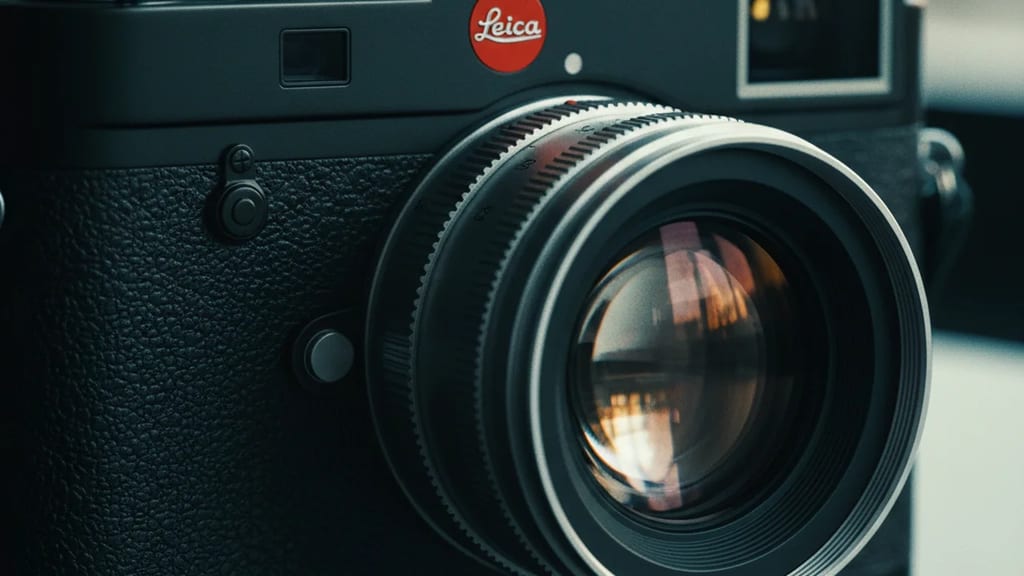
Technical Details
Leica's modern cinema cameras like the SL2-S offer 4K recording up to 60fps, while the Q2 Monochrom exclusively uses 47.3-megapixel monochrome sensors. The characteristic Summicron and Summilux lenses achieve apertures from f/1.4 to f/0.95 with exceptional sharpness and micro-contrast. Leica lenses utilize special glass types like Aspherical Elements and APO correction for minimal chromatic aberration.
The film cameras operate with full-frame CMOS sensors and offer native ISO up to 50,000, while the mechanical shutters achieve shutter speeds of 1/4000s. The M-Mount bayonet system has existed unchanged since 1954, ensuring compatibility across generations.
History & Development
In 1925, Leica introduced the first production-ready 35mm compact camera, the Leica I, developed by Oskar Barnack since 1913. In 1954, the revolutionary M-bayonet followed with the Leica M3, replacing the screw mount.
In the 1960s, Leica established itself as the standard in photojournalism through war correspondents like Robert Capa and Henri Cartier-Bresson. Digitization began in 2006 with the M8, followed by the first full-frame digital M in 2009. Since 2019, Leica has been intensively cooperating with Panasonic and Sigma in the L-Mount Alliance for cinema applications.
Practical Use in Film
Christopher Nolan used modified Leica lenses on IMAX cameras for "Dunkirk" (2017) to achieve the characteristic visual language. Luca Guadagnino employed vintage Leica Summicron lenses for "Call Me by Your Name" (2017), which enhanced the warm, nostalgic look.
Documentary filmmakers appreciate the compact Leica SL cameras for discreet shots without a film crew. The low shutter noise and precise focusing enable authentic capturing of moments. However, the high cost and limited lens selection restrict mainstream use.
Comparison & Alternatives
Leica differs from Canon or Sony through artisanal craftsmanship and optical precision rather than mass production. While RED or ARRI offer complete camera systems, Leica focuses on premium niche markets.
Zeiss lenses achieve similar optical quality with broader availability. For budget productions, Sigma or Tamron offer comparable sharpness without Leica's micro-contrast and color rendition. The M-Mount remains unique for mechanical precision, while modern E-Mount or L-Mount systems offer more electronic features.