Filmlexikon.
Support
Leica Summilux-R
Camera · Equipment

Leica Summilux-R

Murnau AI illustration
ei leitz prime leitz zoom zoom leica summicron c leica summicron r leica leica summilux c

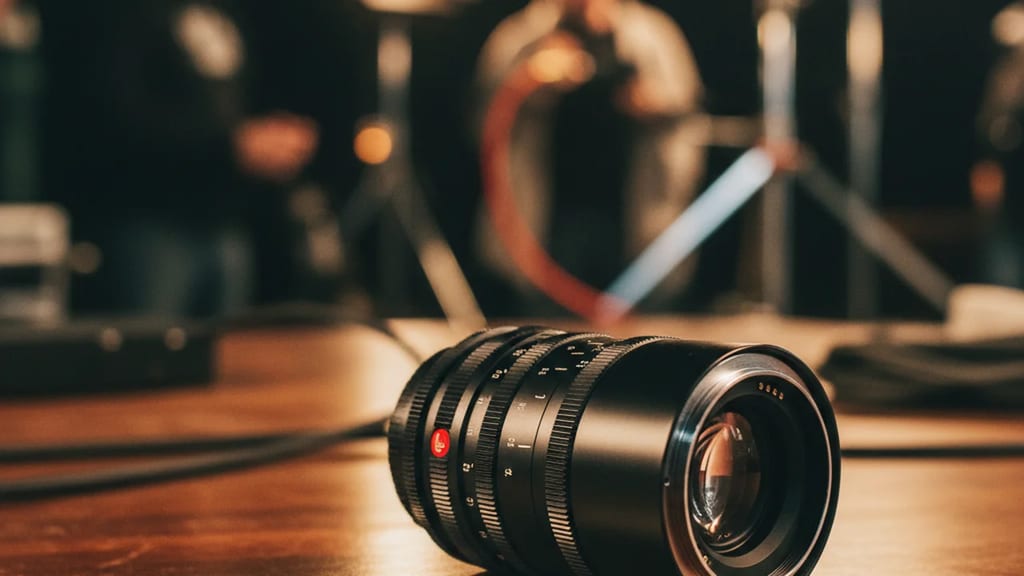
Leica Summilux-R: R-mount lenses with f/1.4 aperture — popular vintage glass known for warm, organic imagery.

Technical Details

The Summilux-R series included focal lengths of 35mm, 50mm, and 80mm, all with a constant aperture of f/1.4. The 50mm f/1.4 Summilux-R weighed 390g with a length of 53mm and consisted of 7 elements in 5 groups. The minimum focusing distance was 50cm, and the filter diameter was 55mm. The lenses featured an 11-blade iris for circular aperture openings and were equipped with floating elements for consistent sharpness performance across all distances. The coatings were multi-layered, later with Leica's proprietary Aqua-Dura coating.

History & Development

The first Summilux-R 50mm f/1.4 appeared in 1959 as part of the new Leica R-system. In 1970, the 35mm f/1.4 followed, and in 1983, the 80mm f/1.4 – at that time, the fastest 80mm lens in the world. A fundamental revision took place in 1994 with ROM contacts for the R8/R9 cameras. Production ended in 2009 with the discontinuation of the R-system, making the Summilux-R highly sought-after collector's items today.

Practical Use in Film

Cinematographers valued Summilux-R lenses for available-light situations and their characteristic depth of field at wide apertures. Stanley Kubrick used the 50mm f/1.4 for interior shots in "Barry Lyndon" (1975), combined with special Zeiss lenses. The shallow depth of field at f/1.4 allowed for precise focus on the main actors with a completely blurred background. The smooth focus transition and warm color rendition defined the "Leica look" in numerous auteur films of the 1970s and 1980s.

Comparison & Alternatives

Compared to contemporary Canon FD or Nikon AI lenses, Summilux-R offered superior build quality and sharpness performance at wide apertures, but cost three to four times as much. Modern equivalents include Leica SL-Summilux or Sigma Art lenses with f/1.4, which, however, do not replicate the specific rendering of the R-series. Today, Summilux-R lenses are used via adapters on digital cinema cameras like RED or ARRI ALEXA, with the crop factor altering the effective focal length.
From the crafts

Perspectives

Cinematographer

Ich setze das Summilux-R 50mm bei schwachem Licht ein, um ohne zusätzliche Beleuchtung arbeiten zu können - bei f/1.4 gewinne ich zwei volle Blendenstufen gegenüber einem f/2.8-Objektiv. Das charakteristische Bokeh mit den 11 Blendenlamellen erzeugt perfekt runde Unschärfekreise, die ich für emotionale Porträts nutze. Allerdings muss ich bei Offenblende extrem präzise fokussieren, da die Schärfentiefe bei 50mm und f/1.4 nur wenige Zentimeter beträgt.

Director

Das weiche, träumerische Rendering des Summilux-R verstärkt intime Momente zwischen meinen Charakteren - die geringe Schärfentiefe isoliert sie visuell von der Umgebung. Ich nutze bewusst den Übergang zwischen scharfen und unscharfen Bereichen, um die emotionale Distanz zwischen Figuren zu visualisieren. Der warme Farbcharakter des Glases unterstützt nostalgische oder melancholische Szenen, ohne dass ich in der Postproduktion korrigieren muss.

Producer

Ein gebrauchtes Summilux-R 50mm kostet heute 800-1200 Euro, deutlich weniger als moderne Cinema-Objektive mit vergleichbarer Lichtstärke, die bei 8000+ Euro liegen. Die robusten Objektive überstehen problemlos längere Drehs ohne Wartung, allerdings benötige ich teure Adapter für moderne Kameras. Da keine Ersatzteile mehr verfügbar sind, kalkuliere ich bei defekten Objektiven einen Totalverlust ein.

More in the lexikon

Related terms

Test your knowledge

Quiz

1. Was beschreibt „Leica Summilux-R" am besten?

2. Zu welchem Department gehört „Leica Summilux-R"?

3. Wie viele verschiedene Fachperspektiven bietet dieser Eintrag?

Report an error
From the Filmfarm ecosystem

Understand visual language, budget productions, connect crew.

The Lexikon is part of the Filmfarm ecosystem — alongside budgeting (FilmBalance), an industry magazine (FilmCircus) and crew networking (FilmCall, CrewMesh). One shared vocabulary for the whole production.

FilmFarm FilmRadarComing soonFilmPulseComing soonFilmNumbersComing soonFilmCapitalComing soonFilmLabComing soonFilmBalanceComing soonFilmCircusComing soon