Filmlexikon.
Support
Leica Elmarit-R
Camera · Equipment

Leica Elmarit-R

Murnau AI illustration
flow leica para roll take

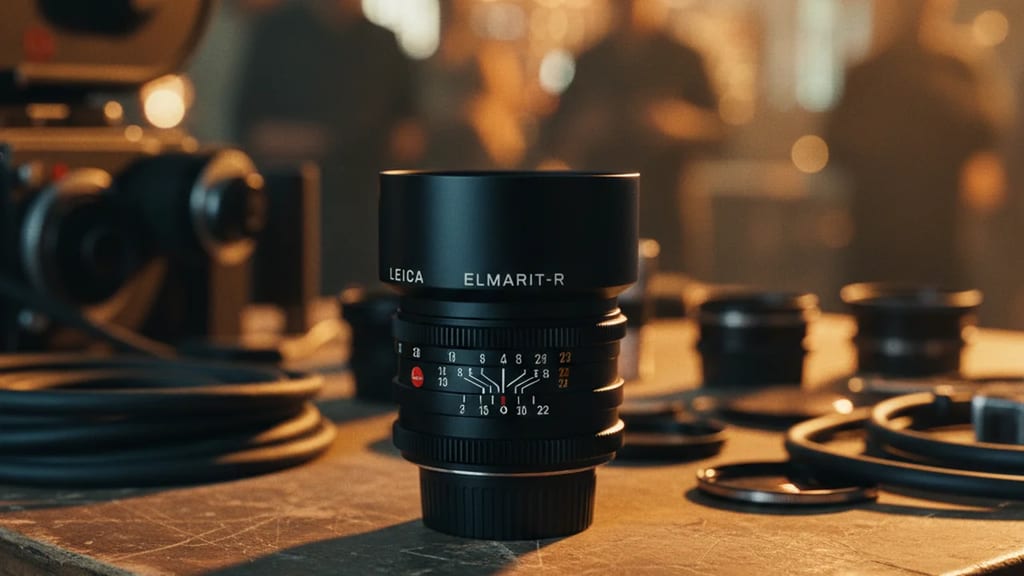
Leica Elmarit-R: SLR lens series (1964–2009) with constant f/2.8 aperture, focal lengths 19–180mm. Compact design, distinctive bokeh character, neutral color rendering.

Technical Details

The Elmarit-R series included focal lengths from 19mm to 180mm, with all lenses featuring a constant maximum aperture of f/2.8. Classic focal lengths were 24mm, 28mm, 35mm, 60mm Macro, 90mm, and 135mm. The 60mm Macro variant achieved a reproduction ratio of 1:2 without extension tubes. All lenses featured a pre-selector aperture with manual control from f/2.8 to f/16. The optical design was based on 6-8 lens elements in 4-6 groups, depending on the focal length. The focusing range typically extended from 0.3m to infinity, and for the 90mm, from 0.9m to infinity.

History & Development

In 1964, Leica introduced the first Elmarit-R 90mm f/2.8 along with the Leicaflex. In 1968, the wide-angle variants 28mm and 35mm followed. The legendary 19mm Super-Elmarit-R was launched in 1980 and was considered a benchmark for extreme wide-angle lenses until the 2000s. In 1976, the 60mm Macro-Elmarit-R expanded the series with close-up functionality. With the discontinuation of the R-System in 2009, Elmarit-R production also ended after 45 years.

Practical Use in Film

Elmarit-R lenses shaped the look of numerous independent films in the 1970s and 80s. Stanley Kubrick used the 19mm Super-Elmarit-R for extreme wide-angle shots in "Eyes Wide Shut" (1999). Their compact construction made them ideal for handheld shots and tight shooting situations. The 60mm Macro established itself in product and detail photography for films. The characteristic bokeh rendering and neutral color reproduction allowed for consistent visual language when changing focal lengths within the series.

Comparison & Alternatives

Compared to the faster Summicron-R lenses (f/2.0), Elmarit-R lenses offered more compact dimensions with slightly reduced light transmission. In comparison to Zeiss-Contax lenses of the same era, they exhibited less contrast but softer skin tones. Modern alternatives include Leica SL lenses or adapted Summicron-M lenses on mirrorless cameras. For film productions today, Zeiss CP.3 or Sigma Cine lenses are often used, offering similar focal lengths with constant T-stops.
From the crafts

Perspectives

Cinematographer

Ich schätze die Elmarit-R-Objektive für ihre kompakte Bauweise bei Steadicam-Aufnahmen - das 28mm wiegt nur 290g und belastet die Ausrüstung minimal. Die durchgängige f/2.8-Blende gibt mir bei Brennweiten-Wechseln konsistente Belichtungswerte, ohne dass ich die Lichtführung anpassen muss. Der weiche Kontrast-Verlauf ist perfekt für Hauttöne, erfordert aber mehr Aufmerksamkeit bei Gegenlicht-Situationen.

Director

Mit dem 19mm Super-Elmarit-R kann ich extreme Raumverzerrungen für psychologische Momente nutzen - es macht Räume bedrohlicher als Standard-Weitwinkel. Das 60mm Makro ermöglicht mir intimste Detail-Aufnahmen, die emotionale Subtext transportieren - Tränen, zitternde Hände, Schweißperlen. Die Serie unterstützt meinen visuellen Stil durch einheitliche Farbwiedergabe ohne störende Sprünge zwischen den Brennweiten.

Producer

Eine komplette Elmarit-R-Serie kostet heute gebraucht etwa 8.000-12.000 Euro - deutlich günstiger als moderne Cine-Objektive bei vergleichbarer optischer Qualität. Die robusten Objektive überstehen harte Drehtage ohne teure Reparaturen, allerdings benötige ich spezialisierte Techniker für Wartung des R-Bajonetts. Für Low-Budget-Produktionen rechnet sich die Anschaffung gegenüber Mietkosten ab dem dritten Projekt.

More in the lexikon

Related terms

Test your knowledge

Quiz

1. Was beschreibt „Leica Elmarit-R" am besten?

2. Zu welchem Department gehört „Leica Elmarit-R"?

3. Wie viele verschiedene Fachperspektiven bietet dieser Eintrag?

Report an error
From the Filmfarm ecosystem

Understand visual language, budget productions, connect crew.

The Lexikon is part of the Filmfarm ecosystem — alongside budgeting (FilmBalance), an industry magazine (FilmCircus) and crew networking (FilmCall, CrewMesh). One shared vocabulary for the whole production.

FilmFarm FilmRadarComing soonFilmPulseComing soonFilmNumbersComing soonFilmCapitalComing soonFilmLabComing soonFilmBalanceComing soonFilmCircusComing soon