Technical Details
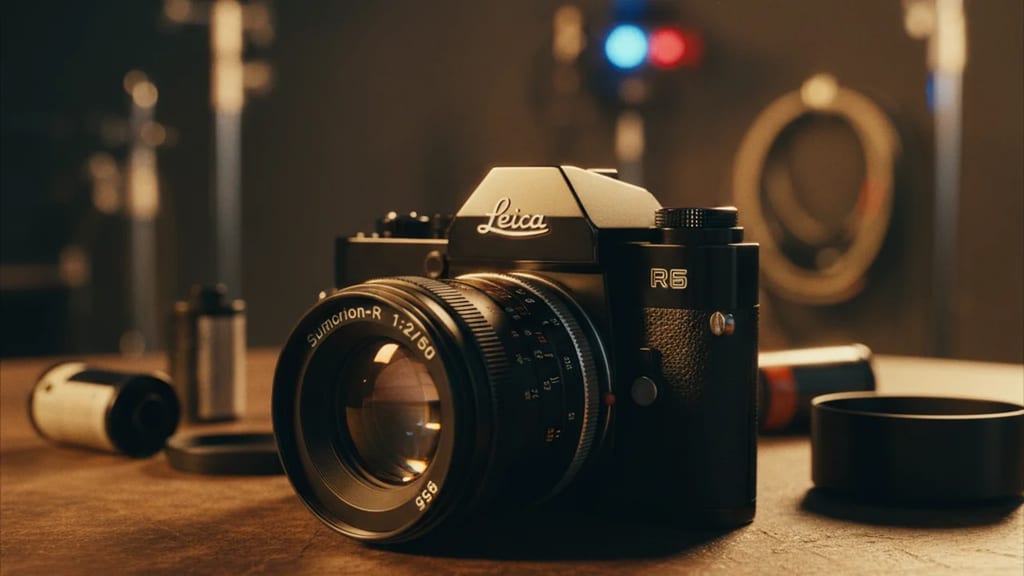
The Summicron-R series comprises three main generations: Version I (1964-1970) with 6 lenses and an integrated lens hood, Version II (1970-1994) with improved coating and a detachable lens hood, and Version III (1994-2009) with multi-coating and optimized color reproduction. All versions operate with aperture values from f/2.0 to f/16, a 55mm filter thread, and mechanical aperture coupling. The optical design utilizes high-refraction glass (Lanthanum crown glass) for minimal chromatic aberrations and achieves a resolution of over 100 line pairs per millimeter in the center.
History & Development
Leica introduced the Summicron-R in 1964 as a standard lens for the new R-system, developed in collaboration with Minolta. The second generation from 1970 improved flare suppression through optimized lens coating and a modified aperture construction. Version III from 1994 integrated multi-layer coating and adapted glass types for digital sensors. Production ended in 2009 with the discontinuation of the entire R-system in favor of the mirrorless L-Mount alliance.
Practical Use in Film
Stanley Kubrick used modified Leica lenses for "Barry Lyndon" (1975), employing the Summicron-R for daylight portrait scenes. The close minimum focusing distance allows for natural facial proportions in dialogue scenes, while the f/2.0 aperture provides sufficient depth of field for focus pulls. Modern cinematographers use Summicron-R lenses on digital cameras via adapters, as the organic sharpness rendition and warm color reproduction create a characteristic analog look. Disadvantages include manual focusing without electronic assistance and limited wide-angle coverage.
Comparison & Alternatives
The Summicron-R differs from the faster Summilux-R f/1.4 through its more compact construction and more consistent sharpness performance across all aperture settings. Modern alternatives like the Sigma 50mm f/2 DG DN Art offer autofocus and image stabilization but do not achieve the characteristic micro-contrast rendition of the Leica lens. The Zeiss Planar 50mm f/2 ZF.2 delivers similar optical quality with more neutral color reproduction, while the Summicron-R produces warmer skin tones. For budget productions, adapted vintage lenses like the Pentax Super-Takumar 50mm f/1.4 offer comparable image characteristics at significantly lower costs.